
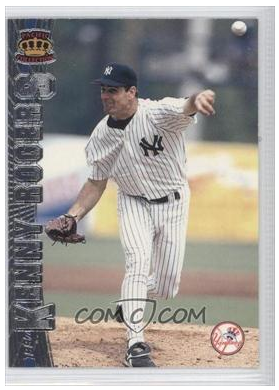
Proceed with caution: the toughest pitchers to run against
Which pitchers are the toughest to run against? Well, Kenny Rogers on the left there is certainly among them (what do you think: is that Kenny’s no-look pickoff move to 1st base; or is he staring down the runner on 3rd as he delivers the pitch?)
There are a lot of ways to look at this question. After the jump, I’ll consider a few of them.
The next set of lists all show career results since 1973 for pitchers with a minimum of 1500 IP in that period.
First, the traditional metric of lowest stolen base %. These are the pitchers who allowed less than 50% successful stolen base attempts.
| Rk | Player | IP | PO | SB | From | To | Age | BK | Tm | |||
|---|---|---|---|---|---|---|---|---|---|---|---|---|
| 1 | Kenny Rogers | 3302.2 | 41% | 79 | 3.20 | 5.36 | 63 | 1989 | 2008 | 24-43 | 23 | TEX-NYY-OAK-TOT-MIN-DET |
| 2 | Gaylord Perry | 2713.0 | 48% | 12 | 2.38 | 5.62 | 129 | 1973 | 1983 | 34-44 | 4 | CLE-TOT-TEX-SDP-ATL-SEA |
| 3 | Mark Buehrle | 2679.0 | 43% | 87 | 2.03 | 5.11 | 54 | 2000 | 2012 | 21-33 | 15 | CHW-MIA |
| 4 | Terry Mulholland | 2575.2 | 41% | 49 | 2.38 | 4.63 | 35 | 1986 | 2006 | 23-43 | 3 | SFG-PHI-NYY-CHC-TOT-ATL-CLE-MIN-ARI |
| 5 | John Candelaria | 2525.2 | 43% | 14 | 2.11 | 5.96 | 80 | 1975 | 1993 | 21-39 | 26 | PIT-TOT-CAL-NYY-LAD |
| 6 | Chris Carpenter | 2219.1 | 38% | 2 | 2.54 | 6.88 | 47 | 1997 | 2012 | 22-37 | 3 | TOR-STL |
| 7 | Kirk Rueter | 1918.0 | 34% | 30 | 2.73 | 3.84 | 34 | 1993 | 2005 | 22-34 | 0 | MON-TOT-SFG |
| 8 | Geoff Zahn | 1849.0 | 35% | 25 | 2.56 | 3.43 | 48 | 1973 | 1985 | 27-39 | 4 | LAD-TOT-CHC-MIN-CAL |
| 9 | Kirk McCaskill | 1729.0 | 47% | 21 | 3.46 | 5.22 | 66 | 1985 | 1996 | 24-35 | 9 | CAL-CHW |
| 10 | Brian Anderson | 1547.0 | 49% | 58 | 1.96 | 4.21 | 54 | 1993 | 2005 | 21-33 | 28 | CAL-CLE-ARI-TOT-KCR |
Next, allowing less than 3 stolen bases per 100 IP.
| Rk | Player | IP | PO | SB | From | To | Age | BK | Tm | |||
|---|---|---|---|---|---|---|---|---|---|---|---|---|
| 1 | Kenny Rogers | 3302.2 | 41% | 79 | 3.20 | 5.36 | 63 | 1989 | 2008 | 24-43 | 23 | TEX-NYY-OAK-TOT-MIN-DET |
| 2 | Mark Buehrle | 2679.0 | 43% | 87 | 2.03 | 5.11 | 54 | 2000 | 2012 | 21-33 | 15 | CHW-MIA |
| 3 | Terry Mulholland | 2575.2 | 41% | 49 | 2.38 | 4.63 | 35 | 1986 | 2006 | 23-43 | 3 | SFG-PHI-NYY-CHC-TOT-ATL-CLE-MIN-ARI |
| 4 | Bartolo Colon | 2393.1 | 53% | 11 | 2.91 | 6.89 | 56 | 1997 | 2012 | 24-39 | 5 | CLE-TOT-CHW-ANA-LAA-BOS-NYY-OAK |
| 5 | Chris Carpenter | 2219.1 | 38% | 2 | 2.54 | 6.88 | 47 | 1997 | 2012 | 22-37 | 3 | TOR-STL |
| 6 | Roy Oswalt | 2213.0 | 62% | 6 | 2.08 | 7.39 | 63 | 2001 | 2012 | 23-34 | 7 | HOU-TOT-PHI-TEX |
| 7 | Johan Santana | 2025.2 | 55% | 20 | 2.52 | 8.83 | 47 | 2000 | 2012 | 21-33 | 12 | MIN-NYM |
| 8 | Carlos Zambrano | 1959.0 | 51% | 16 | 4.13 | 7.52 | 53 | 2001 | 2012 | 20-31 | 5 | CHC-MIA |
| 9 | Kirk Rueter | 1918.0 | 34% | 30 | 2.73 | 3.84 | 34 | 1993 | 2005 | 22-34 | 0 | MON-TOT-SFG |
| 10 | Geoff Zahn | 1849.0 | 35% | 25 | 2.56 | 3.43 | 48 | 1973 | 1985 | 27-39 | 4 | LAD-TOT-CHC-MIN-CAL |
Next, allowing less than 2.25% of baserunners allowed to steal successfully.
| Rk | Player | IP | PO | SB | BR | From | To | Age | BK | Tm | |||
|---|---|---|---|---|---|---|---|---|---|---|---|---|---|
| 1 | Kenny Rogers | 3302.2 | 41% | 79 | 3.20 | 5.36 | 63 | 4940 | 1989 | 2008 | 24-43 | 23 | TEX-NYY-OAK-TOT-MIN-DET |
| 2 | Mark Buehrle | 2679.0 | 43% | 87 | 2.03 | 5.11 | 54 | 3591 | 2000 | 2012 | 21-33 | 15 | CHW-MIA |
| 3 | Terry Mulholland | 2575.2 | 41% | 49 | 2.38 | 4.63 | 35 | 3757 | 1986 | 2006 | 23-43 | 3 | SFG-PHI-NYY-CHC-TOT-ATL-CLE-MIN-ARI |
| 4 | Bartolo Colon | 2393.1 | 53% | 11 | 2.91 | 6.89 | 56 | 3325 | 1997 | 2012 | 24-39 | 5 | CLE-TOT-CHW-ANA-LAA-BOS-NYY-OAK |
| 5 | Chris Carpenter | 2219.1 | 38% | 2 | 2.54 | 6.88 | 47 | 3007 | 1997 | 2012 | 22-37 | 3 | TOR-STL |
| 6 | Roy Oswalt | 2213.0 | 62% | 6 | 2.08 | 7.39 | 63 | 2813 | 2001 | 2012 | 23-34 | 7 | HOU-TOT-PHI-TEX |
| 7 | Jon Garland | 2083.1 | 53% | 8 | 3.02 | 4.86 | 63 | 3017 | 2000 | 2011 | 20-31 | 1 | CHW-LAA-TOT-SDP-LAD |
| 8 | Johan Santana | 2025.2 | 55% | 20 | 2.52 | 8.83 | 47 | 2389 | 2000 | 2012 | 21-33 | 12 | MIN-NYM |
| 9 | Carlos Zambrano | 1959.0 | 51% | 16 | 4.13 | 7.52 | 53 | 2794 | 2001 | 2012 | 20-31 | 5 | CHC-MIA |
| 10 | Kirk Rueter | 1918.0 | 34% | 30 | 2.73 | 3.84 | 34 | 2798 | 1993 | 2005 | 22-34 | 0 | MON-TOT-SFG |
| 11 | Geoff Zahn | 1849.0 | 35% | 25 | 2.56 | 3.43 | 48 | 2657 | 1973 | 1985 | 27-39 | 4 | LAD-TOT-CHC-MIN-CAL |
| 12 | Vicente Padilla | 1571.1 | 61% | 6 | 3.16 | 6.42 | 51 | 2338 | 1999 | 2012 | 21-34 | 12 | ARI-TOT-PHI-TEX-LAD-BOS |
So, several of these pitchers appear multiple times on the lists. Some common factors evident for obvious reasons include handedness (mostly left-handers) and lower strikeout and walk totals (therefore, fewer deep counts and fewer pitches to steal on).
Other factors, not so easily measured, are catcher abilities and even ballpark influences (e.g. disincentives to running in a homer-friendly ballpark). To try to isolate pitcher contribution to limiting steals, let’s look at consistency of performance year in and year out. This should result in a variety of catchers represented and, in this free agent era, perhaps also a variety of different teams for many pitchers.
So, same metrics, but measuring number of seasons (min. 162 IP). First, allowing less than 50% successful steal attempts.
| Rk | Yrs | From | To | Age | ||
|---|---|---|---|---|---|---|
| 1 | Kenny Rogers | 10 | 1993 | 2008 | 28-43 | Ind. Seasons |
| 2 | Chris Carpenter | 8 | 1998 | 2011 | 23-36 | Ind. Seasons |
| 3 | Mark Buehrle | 7 | 2002 | 2011 | 23-32 | Ind. Seasons |
| 4 | Tom Glavine | 7 | 1998 | 2007 | 32-41 | Ind. Seasons |
| 5 | Mike Mussina | 7 | 1993 | 2003 | 24-34 | Ind. Seasons |
| 6 | Kirk Rueter | 6 | 1997 | 2004 | 26-33 | Ind. Seasons |
| 7 | Frank Viola | 6 | 1984 | 1991 | 24-31 | Ind. Seasons |
| 8 | Geoff Zahn | 6 | 1978 | 1984 | 32-38 | Ind. Seasons |
| 9 | Bartolo Colon | 5 | 2000 | 2005 | 27-32 | Ind. Seasons |
| 10 | Rick Langford | 5 | 1977 | 1982 | 25-30 | Ind. Seasons |
| 11 | Ron Guidry | 5 | 1977 | 1985 | 26-34 | Ind. Seasons |
| 12 | John Candelaria | 5 | 1976 | 1984 | 22-30 | Ind. Seasons |
| 13 | Gaylord Perry | 5 | 1975 | 1982 | 36-43 | Ind. Seasons |
Less than 3 stolen bases per 100 IP.
| Rk | Yrs | From | To | Age | ||
|---|---|---|---|---|---|---|
| 1 | Kenny Rogers | 12 | 1993 | 2008 | 28-43 | Ind. Seasons |
| 2 | Mark Buehrle | 11 | 2001 | 2012 | 22-33 | Ind. Seasons |
| 3 | Johan Santana | 7 | 2004 | 2010 | 25-31 | Ind. Seasons |
| 4 | Chris Carpenter | 7 | 2000 | 2011 | 25-36 | Ind. Seasons |
| 5 | Kirk Rueter | 7 | 1997 | 2004 | 26-33 | Ind. Seasons |
| 6 | Curt Schilling | 7 | 1996 | 2006 | 29-39 | Ind. Seasons |
| 7 | Terry Mulholland | 7 | 1990 | 1999 | 27-36 | Ind. Seasons |
| 8 | Roy Oswalt | 6 | 2004 | 2009 | 26-31 | Ind. Seasons |
| 9 | Bronson Arroyo | 6 | 2004 | 2010 | 27-33 | Ind. Seasons |
| 10 | Carlos Zambrano | 5 | 2003 | 2009 | 22-28 | Ind. Seasons |
| 11 | Bartolo Colon | 5 | 2000 | 2005 | 27-32 | Ind. Seasons |
| 12 | Tom Glavine | 5 | 1996 | 2007 | 30-41 | Ind. Seasons |
| 13 | Mike Mussina | 5 | 1993 | 2002 | 24-33 | Ind. Seasons |
| 14 | Frank Viola | 5 | 1984 | 1991 | 24-31 | Ind. Seasons |
Stolen bases of less than 2.25% of baserunners allowed.
| Rk | Yrs | From | To | Age | ||
|---|---|---|---|---|---|---|
| 1 | Kenny Rogers | 13 | 1993 | 2008 | 28-43 | Ind. Seasons |
| 2 | Mark Buehrle | 10 | 2002 | 2012 | 23-33 | Ind. Seasons |
| 3 | Chris Carpenter | 7 | 2000 | 2011 | 25-36 | Ind. Seasons |
| 4 | Kirk Rueter | 7 | 1997 | 2004 | 26-33 | Ind. Seasons |
| 5 | Terry Mulholland | 7 | 1990 | 1999 | 27-36 | Ind. Seasons |
| 6 | Roy Oswalt | 6 | 2004 | 2009 | 26-31 | Ind. Seasons |
| 7 | Jon Garland | 6 | 2002 | 2010 | 22-30 | Ind. Seasons |
| 8 | Bartolo Colon | 6 | 2000 | 2005 | 27-32 | Ind. Seasons |
| 9 | Tom Glavine | 6 | 1996 | 2007 | 30-41 | Ind. Seasons |
| 10 | Johan Santana | 5 | 2005 | 2010 | 26-31 | Ind. Seasons |
| 11 | Bronson Arroyo | 5 | 2004 | 2008 | 27-31 | Ind. Seasons |
| 12 | Carlos Zambrano | 5 | 2003 | 2009 | 22-28 | Ind. Seasons |
| 13 | Matt Clement | 5 | 1999 | 2005 | 24-30 | Ind. Seasons |
| 14 | Mike Hampton | 5 | 1997 | 2004 | 24-31 | Ind. Seasons |
| 15 | Curt Schilling | 5 | 1996 | 2003 | 29-36 | Ind. Seasons |
| 16 | Mike Mussina | 5 | 1993 | 2002 | 24-33 | Ind. Seasons |
So, no matter how you slice it, our man Kenny comes out on top. But, we do have some new names to go with the holdovers from the career measurements. Any surprises?
Finally, to go to the opposite end of the spectrum, I offer Mickey Lolich. Not to pick on Mickey, but he did have the misfortune of allowing 4 stolen bases in the span of a single plate appearance. Plus a balk, two walks, and a 5th stolen base in the same inning.
Here is the game, from May 18, 1969. Harmon Killebrew comes to bat with runners on the corners and ends up striking out with the bases empty. In between, the two runners on base both score, with all advances coming by way of the stolen base (the manager, by the way, was Billy Martin, one of only 10 players to be caught stealing twice in the same World Series game) .
| Inn | Score | Out | RoB | Pit(cnt) | R/O | @Bat | Batter | Pitcher | wWPA | wWE | Play Description |
|---|---|---|---|---|---|---|---|---|---|---|---|
| Bottom of the 3rd, Twins Batting, Behind 0-2, Tigers’ Mickey Lolich facing 1-2-3 | |||||||||||
| b3 | 0-2 | 0 | — | MIN | C. Tovar | M. Lolich | -4% | 64% | Single | ||
| b3 | 0-2 | 0 | 1– | MIN | R. Carew | M. Lolich | -3% | 62% | Balk; Tovar to 2B | ||
| b3 | 0-2 | 0 | -2- | MIN | R. Carew | M. Lolich | -3% | 58% | Tovar Steals 3B | ||
| b3 | 0-2 | 0 | –3 | MIN | R. Carew | M. Lolich | -5% | 53% | Walk | ||
| b3 | 0-2 | 0 | 1-3 | R | MIN | H. Killebrew | M. Lolich | -3% | 50% | Tovar Steals Hm; Carew Steals 2B | |
| b3 | 1-2 | 0 | -2- | MIN | H. Killebrew | M. Lolich | -4% | 46% | Carew Steals 3B | ||
| b3 | 1-2 | 0 | –3 | R | MIN | H. Killebrew | M. Lolich | -1% | 45% | Carew Steals Hm | |
| b3 | 2-2 | 0 | — | O | MIN | H. Killebrew | M. Lolich | 2% | 47% | Strikeout | |
| b3 | 2-2 | 1 | — | O | MIN | T. Oliva | M. Lolich | 2% | 49% | Popfly: 3B | |
| b3 | 2-2 | 2 | — | MIN | L. Cardenas | M. Lolich | -1% | 47% | Walk | ||
| b3 | 2-2 | 2 | 1– | O | MIN | G. Mitterwald | M. Lolich | 3% | 50% | Flyball: LF | |
| 2 runs, 1 hit, 0 errors, 1 LOB. Tigers 2, Twins 2. | |||||||||||
Not to worry, Tiger fans. Those were the only runs the Twins would score as Lolich won an easy one, 8-2.
Subscribe to: RSS feed

I thought I’d find Andy Pettitte on at least one of those lists, but the fact is that he has a SB% of 66% compared to an MLB avg. of 71% during the same time frame.
While he had a better “pick-off move” than Kenny Rogers, as evidenced by his 96 career pick-offs compared to Kenny’s 76, the numbers say that a great pick-off move alone doesn’t always translate to holding runners on base.
In contrast, Mike Mussina shows up on 3 of the above lists, yet he only picked off 4 runners in his entire career.
That was my first thought as well – where is Andy Pettitte? I actually thought the card was of him at first glance – lefty in a Yankee uniform and the discussion is about baserunners.
I’m thinking that Ivan Rodriguez had a little to do with the numbers Kenny Rogers put up, though Rogers did have 39 career pick offs which did not result in a caught stealing (he had 76 total pick offs). Pettitte had 40 pick offs in his career which did not result in caught stealing. I’m guessing if Pudge the Younger had been catching Pettitte that his numbers would look closer to Rogers’.
While Mussina and Pettitte played together, it looks like Mussina appears on those lists mainly because of his Baltimore years (though he did have 3 sub-50% years early in his Yankees years).
As Artie mentions, Pettitte’s career SB% against is 66%, with one season (min. 162 IP) below 50% in 1996. Pettitte was also below 50% in 2012, but in only 75.1 IP.
His SB per 100 IP is 5.8 for his career, with two seasons (2000, 2006) below 3. He allowed just 2 SB (and only 3 attempts) in 129 IP in 2010.
I’ve watched a lot of Pettite’s career. Early on, he was terrible at controlling the basepaths. His movement out of the stretch was long and easy for base runners to time.
I have a memory of an old Ricky Henderson making a young Andy Pettite look ridiculous by fighting through pickoffs to steal second and then just immediately going from second when andy went into his motion to the plate taking third STANDING no throw. I thought it was 1998, probably picking that because Henderson was back in Oakland but their April 11th 1998 meeting Henderson did not steal. I did find angels Ricky stealing against Pettite on August 21st, 1997 but not third to boot. Maybe I’m getting old…
Anyway, I think the pickoff was developed in the middle part of his career to really deal with the slowness in his delivery out of the stretch. As he got older, his stretch delivery got even longer (almost his normal delivery) because he could rely on that pickoff to keep people on first. I wonder how much of that stat though is highlighting how bad he was at preventing guys from stealing third? Maybe because he didn’t have the pickoff move when he was younger (actually well below average holding runners) combined with his difficulties stopping 2b->3b throughout his career keep him off this list. Still, I wouldn’t want to try to steal 2b off of him in 2013. He’s got to be at the top of most guys lists this coming season.
I think I found the game that may interest only me:
http://www.baseball-reference.com/boxes/NYN/NYN199907100.shtml
So Henderson steals off Pettite in the bottom of the first inning as described, but then it’s Roger Cedeno doing the 1b to 2b immediately followed by 3b trick against Pettite in the bottom of the next inning. Somewhere in my mind, Roger Cedeno turned into Ricky Henderson when he came to bat that next inning out of the 7 spot. Cedenio stole 66 bags that year to Ricky’s 37 (he was 40 years old after all) for what it’s worth. Anyway, clearly a track meet day against Pettite which was fairly common early in his career. The pickoff can also be seen in this game however in it’s earlier forms. Fooled Henderson leading off the next inning after a walk. Ricky says Ricky thinks it was a balk.
Also I wrote Ronny not Roger Cedeno thinking of another journeymen Mets player. Oh boy I am getting old.
Pettitte has an excellent pick-off move, something he no doubt uses to blunt the running game, but having a great pick-off move is only one aspect in slowing the running game. The overall motion, amount of deception, and time to the plate play big parts.
Having had the opportunity to see Mussina pitch, I would say that he could vary the amount of time he would hold and deliver a pitch as well as any pitcher I remember. Runners could not figure out when to run. With Pettitte, it’s a do-or-die approach. If runners guess right, they have a decent chance of stealing.
I guess there’s another aspect to look at here. Pettitte has thrown to Jorge Posada more than any other catcher. Posada’s CS% is just a notch under league average, so perhaps his latter years have colored our perception of him to some degree, yet even CS% is not the best way to judge a catcher’s arm. A runner, any runner, is probably going to be more comfortable attempting to steal off Posada than Ivan Rodriguez, who caught quite a few games for Kenny Rogers in Texas, and even later Detroit. So maybe a higher percentage of the top stealers will attempt to run on I-Rod, where lesser runners will hesitate, where even medium level runners will take off on Posada, helping Posada’s CS%. So perhaps all caught-stealing percentages are not created equal…maybe. Just talking off the top of my head.
Didn’t Kenny Rogers spend a lot of those seasons in question with Ivan Rodriguez as his catcher?
Not suggesting he wasn’t good at holding runners or anything, but it would kinda push those # of seasons charts in his direction. (Unfortunately b-r.com is blocked for me at work, or I’d come up with more concrete numbers here, sorry.)
Rogers and Pudge were teammates for 8 seasons, 1991-95 in Texas, and 2006-08 in Detroit. The first and last of those years were partial seasons, as Pudge had his career debut in June 1991, and was traded from Detroit in July 2008.
For the 10 seasons between those two stints as teammates, Rogers played for the Yankees, As, Mets, Rangers and Twins, so he had plenty of opportunity to work with different catchers.
Josh Tomlin doesn’t have enough innings pitched but if he did, he’d definitely be on the lists. So far, in 341.2 innings pitched, he’s allowed 5 stolen bases (in 10 attempts). Most impressive was his 2011 season in which there wasn’t a single attempt against him in 165.3 innings. And between 2010-2012 he pitched over 250 innings in a row without a successful steal.
Tomlin by the way is a righty, making his feat even more impressive.
That is impressive, Ed. Thanks.
Never mind 3 SB per 100 IP, Tomlin has less than 3 attempts per 100 IP.
I agree Doug. During the 2010-2012 period, the rest of the Indians’ staff has thrown 3987.2 innings, and allowed 517 SB attempts with 369 being successful (77%).
Tomlin:
1 attempt every 34.2 innings
1 success every 68.3 innings
Other Indians’ starters:
1 attempt every 7.7 innings
1 success every 10.8 innings
So while Bstar (#8) is correct about it being difficult to separate responsibility, in the case of Tomlin, it’s pretty clear who’s responsible.
I think it’s hard to identify what portion of controlling the running game is attributed to the pitcher and what portion is attributed to the catcher.
Kenny Rogers is a good example with Pudge catching for him. Andy Pettitte not showing up on these lists with Jorge Posada catching is another.
Also consider the case of Chris Carpenter, whose stolen base numbers look quite different with Yadier Molina catching in St. Louis as opposed to his numbers with the Blue Jays.
Carpenter in Toronto: SB% against – 74.4 / SB per 100 – 3.7
Carpenter in St Louis: SB% against – 44.1 / SB per 100 – 1.1
I can’t seem to write a post anymore without an error. Here are the correct numbers for Carpenter:
Carpenter in Toronto SB% against: 43%
Carpenter in St Louis SB% against: 31%
Certainly true, bstar.
Yet, Carpenter still was under 50% for two of his three 162 IP seasons in Toronto, when Darrin Fletcher was his catcher.
Similarly, Pettitte not showing up here, supposedly because of Jorge, may not be the whole story as Mussina had 3 of his sub-50% seasons (2001-03) with Posada and at 41%, 38% and 47%. In those same seasons with the same catcher, Pettitte was 69%, 64% and 93% (not a typo).
Just checked Rogers sub-50% seasons. He had 4 with Pudge and 6 with other catchers. In 2002, exactly one runner tried to steal on Rogers in 210 IP … and he was thrown out.
I should have checked before I posted my Pettitte note above!
Doug: Would you be able to check this out? I have read that Whitey Ford holds the seasonal record for the most IP without a SB against him. In 1961 he threw 283 such innings. Altogether he had 4 seasons of 0 SB with more than 162 IP.
Duog: Never mind, I checked it myself. Ford is in third place being bested by Hal Newhouser in 1945 and 1946 with 313 and 292 IP respectively.
Now that I have finished my breakfast I went back to BR and saw that for Newhouser’s totals in 1945 and 1946 there are quite a few PA for which data is not known. Ford’s data in 1961 is complete so I guess it can be concluded that he holds the official record.
RC:
Ford was simply the best at holding runners on first out of fear. What he might have done against Brock or Henderson is hard to say, of course, but the only AL team in his career that was consistently into stealing bases, the White Sox, were 4 out of 16 against him. In an era when baserunning was very conservative he picked off 48, and through 1964, before Ellie Howard’s arm went, allowed 19 SBs in 70 attempts a 27% success rate. Contrast Billie Pierce, also very good: between 1949 and 1961—10 pick offs, 46 SBs out of 118 attempts for a 39% rate—and Pierce didn’t have to face the team that ran all the time, his own White Sox. Berra and Howard, of course, helped out by having rifle arms—So did Sherm Lollar—but their success rate with other pitchers was far less than with Ford. Fear of him kept the runners either from going at all or from committing for that nanosecond which makes the difference between failure and success. That’s how it works, probably for the pitchers in Doug’s charts above, too.
Those 4 seasons of 0 SB against Ford are the most since 1951. No one else has more than 1.
One thing I meant to note yesterday. It’s interesting that almost all the candidates for toughest-to-run on are modern. I by modern, I’m talking most seem to have pitched in this century, the aughts.
Is this a question of access to data? My gut says with the greater appreciation of SB%, I can see more reckless running in early years, leading to higher caught rates, yet Geoff Zahn, who retired in 1985, seems to be the most ancient member of this group.
Apologies if I missed an explanation of this when I first read it.
Never mind. It was right upfront. 1973 forward!
Although that leads to the next question. Why 1973? Is it a data issue?
B-R says their event data are complete back to 1973, so I used that as my cutoff point.
Remember, these are data tracking events (stolen bases, pick-offs, baserunners) back to the pitcher on the mound at the time of the event. So, aside from complete games, it’s not something you can pick directly off a boxscore – you need the play-by-play data.
If you run the PI for the Pitching Season Finder and select Choose a Stat SB less than 50%, the results page states that “For this search only years since 1951 available”.
You know, this thread reminded me how much the baseball discussion has changed. When a guy used to get on first, the discussion used often turn to how a guy pitches out of a stretch, runner’s tendencies, pitchers pickoff moves, catcher’s watching the baserunners instead of their pitchers, etc. Probably also some mentions about the guy at the plate’s RBI total as well (as an indication of how likely that runner was to come home). Now, we talk about OBP, RISP, run probability, crazy shifts, there’s no time anymore for discussing the stretch.
I try to explain baseball to people saying it’s either excruciatingly slow or blindingly fast, mattering on how much you actually understand what you’re watching. It’s sad we’ve lost time to think about the stretch in all of these new wonderful analysis techniques.