
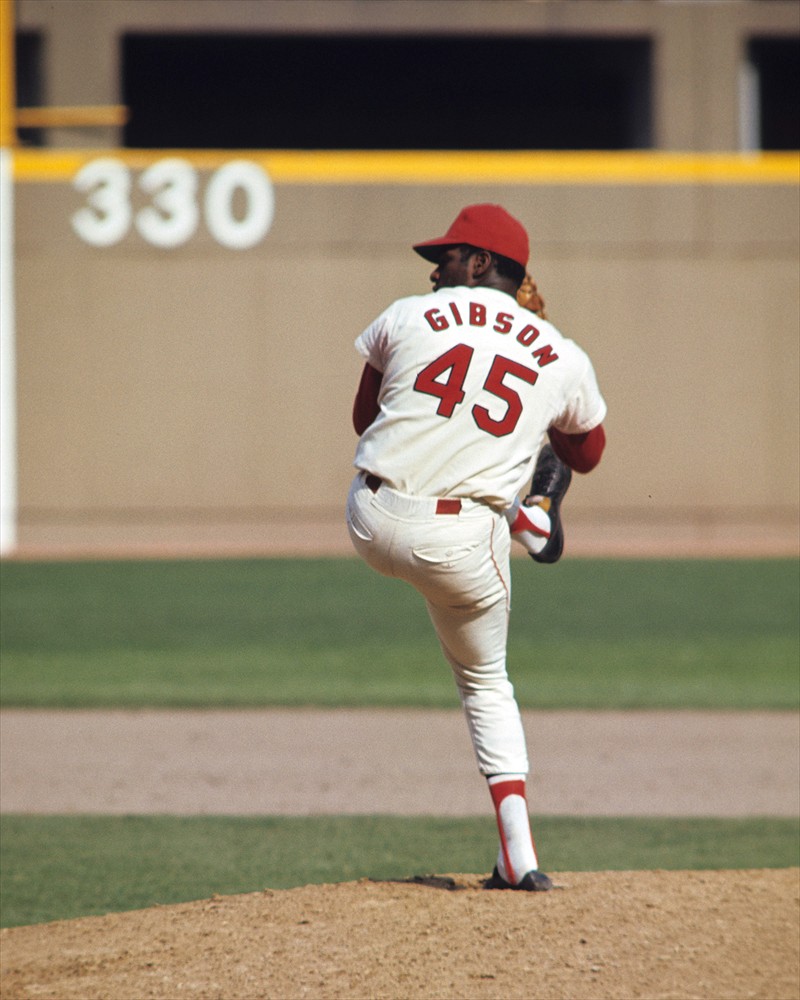
More complete games than wins?! (It’s not only possible–it used to be commonplace)
Back in the old days of baseball, pitchers complete most games that they started. In 1904, for example, 88% of games started ended up as complete games. That means that lots of pitchers registered plenty of complete game losses.
As a result, there are lost of pitchers who ended up with more career complete games than wins (thanks to all those complete games losses.)
Here are the top 20 pitchers (1900-present) with more complete games than wins, ranked my most career complete games:
| Rk | Player | CG | W | From | To | G | GS | L |
|---|---|---|---|---|---|---|---|---|
| 1 | Walter Johnson | 531 | 417 | 1907 | 1927 | 802 | 666 | 279 |
| 2 | Pete Alexander | 437 | 373 | 1911 | 1930 | 696 | 600 | 208 |
| 3 | Christy Mathewson | 434 | 373 | 1901 | 1916 | 630 | 551 | 185 |
| 4 | Eddie Plank | 410 | 326 | 1901 | 1917 | 623 | 529 | 194 |
| 5 | Warren Spahn | 382 | 363 | 1942 | 1965 | 750 | 665 | 245 |
| 6 | Ted Lyons | 356 | 260 | 1923 | 1946 | 594 | 484 | 230 |
| 7 | George Mullin | 353 | 228 | 1902 | 1915 | 487 | 428 | 196 |
| 8 | Red Ruffing | 335 | 273 | 1924 | 1947 | 624 | 538 | 225 |
| 9 | Cy Young | 331 | 225 | 1901 | 1911 | 401 | 369 | 146 |
| 10 | Burleigh Grimes | 314 | 270 | 1916 | 1934 | 616 | 497 | 212 |
| 11 | Robin Roberts | 305 | 286 | 1948 | 1966 | 676 | 609 | 245 |
| 12 | Vic Willis | 302 | 187 | 1901 | 1910 | 399 | 366 | 167 |
| 13 | Jack Powell | 294 | 167 | 1901 | 1912 | 423 | 369 | 194 |
| 14 | Eppa Rixey | 290 | 266 | 1912 | 1933 | 692 | 554 | 251 |
| 15 | Bob Feller | 279 | 266 | 1936 | 1956 | 570 | 484 | 162 |
| 16 | Wilbur Cooper | 279 | 216 | 1912 | 1926 | 517 | 406 | 178 |
| 17 | Bill Donovan | 279 | 182 | 1901 | 1918 | 351 | 314 | 129 |
| 18 | Red Faber | 273 | 254 | 1914 | 1933 | 669 | 483 | 213 |
| 19 | Mordecai Brown | 271 | 239 | 1903 | 1916 | 481 | 332 | 130 |
| 20 | Doc White | 262 | 189 | 1901 | 1913 | 427 | 363 | 156 |
As you can see, a lot of these guys are from way, way back. If we limit the list to just guys who pitched at least one season as recently as 1960, here’s the new list:
| Rk | Player | CG ▾ | W | From | To | G | GS | L |
|---|---|---|---|---|---|---|---|---|
| 1 | Warren Spahn | 382 | 363 | 1942 | 1965 | 750 | 665 | 245 |
| 2 | Robin Roberts | 305 | 286 | 1948 | 1966 | 676 | 609 | 245 |
| 3 | Bob Gibson | 255 | 251 | 1959 | 1975 | 528 | 482 | 174 |
| 4 | Juan Marichal | 244 | 243 | 1960 | 1975 | 471 | 457 | 142 |
| 5 | Ned Garver | 153 | 129 | 1948 | 1961 | 402 | 330 | 157 |
| 6 | Rick Langford | 85 | 73 | 1976 | 1986 | 260 | 196 | 106 |
| 7 | Mark Fidrych | 34 | 29 | 1976 | 1980 | 58 | 56 | 19 |
| 8 | Jay Hook | 30 | 29 | 1957 | 1964 | 160 | 112 | 62 |
| 9 | Herb Moford | 6 | 5 | 1955 | 1962 | 50 | 14 | 13 |
| 10 | Steve Barr | 4 | 3 | 1974 | 1976 | 24 | 13 | 7 |
| 11 | Gary Ryerson | 4 | 3 | 1972 | 1973 | 29 | 18 | 9 |
| 12 | Bob Meyer | 3 | 2 | 1964 | 1970 | 38 | 18 | 12 |
| 13 | Rafael Novoa | 2 | 0 | 1990 | 1993 | 22 | 9 | 4 |
| 14 | Jay Pettibone | 1 | 0 | 1983 | 1983 | 4 | 4 | 4 |
| 15 | Jack Jenkins | 1 | 0 | 1962 | 1969 | 8 | 3 | 3 |
Yeah, it doesn’t happen much anymore. The CG-loss is a pretty rare bird, certainly far rarer than the non-CG win, so guys just don’t do it much anymore.
How about these guys–those most recent pitchers to have a season with more CGs than wins:
| Rk | Player | Year | CG | W | G | GS | L |
|---|---|---|---|---|---|---|---|
| 1 | Gil Meche | 2010 | 1 | 0 | 20 | 9 | 5 |
| 2 | Jamey Wright | 2003 | 2 | 1 | 4 | 4 | 2 |
| 3 | Jason Standridge | 2003 | 1 | 0 | 8 | 7 | 5 |
| 4 | Jim Parque | 2001 | 1 | 0 | 5 | 5 | 3 |
| 5 | Rafael Novoa | 1993 | 2 | 0 | 15 | 7 | 3 |
| 6 | Bill Wegman | 1993 | 5 | 4 | 20 | 18 | 14 |
| 7 | Eric Hillman | 1993 | 3 | 2 | 27 | 22 | 9 |
| 8 | John Cummings | 1993 | 1 | 0 | 10 | 8 | 6 |
| 9 | Matt Young | 1992 | 1 | 0 | 28 | 8 | 4 |
| 10 | Rod Nichols | 1991 | 3 | 2 | 31 | 16 | 11 |
| 11 | Mike Birkbeck | 1989 | 1 | 0 | 9 | 9 | 4 |
| 12 | Mike Maddux | 1989 | 2 | 1 | 16 | 4 | 3 |
| 13 | Jack Morris | 1989 | 10 | 6 | 24 | 24 | 14 |
| 14 | Chris Bosio | 1988 | 9 | 7 | 38 | 22 | 15 |
| 15 | Mike Morgan | 1988 | 2 | 1 | 22 | 10 | 6 |
| 16 | Rod Nichols | 1988 | 3 | 1 | 11 | 10 | 7 |
| 17 | Dan Petry | 1988 | 4 | 3 | 22 | 22 | 9 |
| 18 | Walt Terrell | 1988 | 11 | 7 | 29 | 29 | 16 |
| 19 | Bobby Witt | 1988 | 13 | 8 | 22 | 22 | 10 |
| 20 | Greg Swindell | 1987 | 4 | 3 | 16 | 15 | 8 |
| 21 | Mike Moore | 1987 | 12 | 9 | 33 | 33 | 19 |
| 22 | Danny Jackson | 1987 | 11 | 9 | 36 | 34 | 18 |
| 23 | John Butcher | 1986 | 2 | 1 | 29 | 18 | 8 |
| 24 | Tom Candiotti | 1986 | 17 | 16 | 36 | 34 | 12 |
| 25 | Lee Guetterman | 1986 | 1 | 0 | 41 | 4 | 4 |
Jack Morris in 1989 is the last guy to have double-digit complete games but fewer wins.
This feat has gotten rarer and rarer, but might become a bit more common if the pitching trends of the last few years continue.
Subscribe to: RSS feed


I had no idea there were guys pitching in the 80s for whom his was true (if we exclude the single-digit-CG guys). That’s incredible. My first guess would have been that Warren Spahn was the last player to have a career like this, but then I saw the picture of Bob Gibson and thought, “Surely, he must be the most recent.” I was wrong. You learn something new every day, I guess. Especially on HHS.
Fergie Jenkins would have made the career list if he had retired after his age 37 season in 1980.
Jenkins had CG >= W in 10 of 11 seasons from 1967 to 1977, with 205 Wins and 221 CGs for that period.
Rick Langford, #6 on the post-1960 career list, compiled 21 more CGs than Wins in only a four-year period (1979-1982), with a 54-54 W-L and 75 CGs in 117 starts.
All that work took its toll. After 1982 (his age 30 season), Langford had only 23 more starts in his career, with zero CGs.
I noticed that, too. Does anyone know what happened following the 1982 season? Was there an injury, or was it just wear-and-tear? I mean, the 12.15 ERA in 7 starts is REALLY bad. How does that happen to a guy who was a pretty decent pitcher beforehand?
Also interesting is that, while he had 75 of his CG in just a four-year period, all 85 of his CG were in a six-year period (199/260 total games pitched). In the other 61 games of his career, he had none (that would be 24/196 starts). Interesting career.
I think it was overwork.
Oakland had the same 5 starters (Langford, McCatty, Keough, Norris, Kingman) 4 years running (1979-82) and they compiled CG totals of 37, 93, 59 and 38 in those years, the last 3 years under manager Billy Martin.
In 1979, they were aged 23, 24, 24, 25 and 27. Yet, all were out of the majors after the 1986 season, and two were gone after 1983.
Holy cow! I knew Martin had that reputation with pitching staffs, but knocking a bunch of 20-somethings out of the majors that quickly almost takes purpose. I mean, even Mulder/Hudson/Zito have managed longer careers than that.
I think most people trace it to 1980, Martin’s first year with the A’s. He increased the workload of all 5 starters, some of them substantially. Here are the increases from the prior year for each of them:
Langford: 218.2 IP to 290 IP
Norris: 146.1 IP to 284.1 IP
Keough: 176.2 IP to 250 IP
McCatty: 185.2 IP to 221.2 IP
Kingman: 111.2 IP to 211.1 IP
All five pitchers were fairly young at the time, between 24-28. I think this is where the notion that you should limit the total innings and the year-to-year increase for young pitchers began.
Tangent –
Can anyone make sense of Rick Langford’s bWAR progression?
1978 — 176 IP, 106 ERA+ = 2.5 WAR
1979 — 219 IP, 95 ERA+ = 4.1 WAR
1980 — 290 IP, 116 ERA+ = 2.6 WAR
1981 — 195 IP, 116 ERA+ = 0.8 WAR
1982 — 237 IP, 92 ERA+ = 1.1 WAR
How the fudge does he get 4.1 WAR for 1979, with a 95 ERA+? That’s the worst ERA+ for any pitcher with 2+ WAR that year.
And how can 1980 be worth just 2.6 WAR, with 290 IP and a solid 116 ERA+? I looked at other pitchers with similar WAR that year — Langford blows them all away in either ERA+ or IP, or both. Jack Morris got 3.0 WAR for 250 IP and a 99 ERA+.
Is the answer all in the defense? Oakland’s defense rated as awful in 1979 (-116 TZR) and spectacular in 1980 (+99, with their 3 Gold Glove-caliber OFs accounting for about 2/3 of that).
I would imagine defense was a huge part of it. a 215 run swing is pretty dern big. It does look odd, though. You’d think 290 IP alone, even at a 100 ERA+, would be worth 3-4 WAR. Maybe that’s just me, though.
For comparisons sake, fangraphs has Langford at 2.9 WAR for 1979 and 3.3 for 1980.
(I’m replying to JA @19, but I don’t have a reply button.)
He pitched about 15% of the A’s innings in ’79 and 20% in ’80. So that adds about 18 runs to replacement level over an average defense in ’79 and subtracts 20 runs in ’80. So, yeah it is mostly defense.
Reviewing Langford’s 1980 season, Martin almost duplicated Hunter’s 300/30+ season. Langford finshed with 290 innings and 28 complete game.
Langford’s 80/81 seasons under Martin can be compared to Hunter’s 75/76 seasons under Martin. Heavy workload, and both collapsed in the following seasons, ’82 and ’77. Hunter had much heavier innings in prior seasons, but I believe it was the peak workloads that no doubt damaged their arms.
Both careers were effectively over by the time they reached 30, or very shortly thereafter.
I’m pretty sure Martin ended Catfish Hunter’s career. In 1975, Hunter became the first pitcher in more than a generation to pitch over 300 innings and complete 30 games in a season. Bob Feller had been the last.
In fairness (in spreading the blame), Martin took over as Hunter’s manager midway through that season, replacing Bill Virdon, but it was Martin who rode Hunter hard down the stretch as the innings were mounting, so he deserves the majority of the blame. Looking back at Hunter’s gamelogs August forward, it’s just insane, even for the period, as the Yankees were out of the race.
When Hunter showed up in camp the following season, there were already whispers his arm was sore and there was discussions of diminished velocity. So what did Martin do? What the heck, have him go another 300 innings and 20+ complete games.
I used to think Hunter was being overused because he was the first high-priced free agent. (Yeah, I know, in his case it was set free because of a contract technicality.) The Yankees wanted every drop of his blood for the contract. Yet looking at how Martin used his pitchers in Oakland, including Langford, it’s clear it was just Martin’s style.
“Hunter became the first pitcher in more than a generation to pitch over 300 innings and complete 30 games in a season. Bob Feller had been the last.”
Mike, there were 4 other pitcher between Feller and Hunter who had 300+ IP and 30+ CG in a season:
– Robin Roberts, 1952-53 (age 25-26)
– Juan Marichal, 1968 (age 30)
– Fergie Jenkins, 1971 (age 28)
– Steve Carlton, 1972 (age 27)
After those seasons:
– After ’52, Roberts had an even bigger year in ’53, then averaged 23 wins, 28 CG, 313 IP and a 128 ERA+ for 1954-55. In all, he added 195 wins, 3366 IP and 53.0 WAR after the first 30-CG season.
– Jenkins added 169 wins, 2757 IP and 41.5 WAR afterwards.
– Carlton added 225 wins, over 3600 IP, 49.6 WAR and 3 more Cy Young Awards.
– Marichal won the 1969 ERA title at 2.10, with 27 CG and 300 IP. He only added 73 wins, 1257 IP and 15.8 WAR after the 30-CG year.
Just from 1971-75, 6 additional pitchers went over 300 IP and had at least 25 CG — Nolan Ryan, Gaylord Perry, Jim Palmer, Bert Blyleven, Luis Tiant, Mickey Lolich. They all were going strong for many years after their first 300-IP season.
I don’t really see a big difference in Hunter’s 1975 workload compared to some of his prior years. In ’75, Hunter made 24 starts on 3 days’ rest — the same as he did in ’74 and ’70, and 1 more than in ’73.
If there’s any abuse in Hunter’s workload, I’d be more inclined to see it in his 177 IP at age 20, or his average of 255 IP from 21-25.
John, thanks, you are correct. That’s a stat that I didn’t check since I had it firmly locked in my mind as correct for more than 25 years. The correct statement is that Hunter was the first American League pitcher in more than a generation (since 1946) to pitch over 300 innings and complete 30 games. That statement alone is still saying something.
Yet the convenience of the 300/30 isn’t quite the point, but more an indicator of the substantial workload Hunter was under that season and at that point in his career. He pitched a career high 328 innings in ’75, following a career high of 318 in 1974.
So this was a man who was undergoing the highest workload of his career. Today, that would be noted, and the last thing a manager would do (well there is always Dusty Baker!) would be to end that heavy workload with what Martin did in 1975. Hunter finished that year with thirteen consective complete games, capped off with the very final start of that year when he pitched an extra-inning complete game.
Arm injuries often occur when fatigue sets in; a pitcher’s mechanics are thrown off, creating greater stress on the shoulder. That’s why today, teams are concerned about pitch counts, and how a pitcher looks later in game, and later in a the season. All it takes is one pitch. So in Hunter’s case, it’s not so much the innings increase from year to year, but the cumulative impact, finished off by a stretch that he had never encountered before. (Those 13 complete games were two more than he had for the entire 1973 season.)
One other item. Hunter is the only man to accomplish 300/30 in the AL after the introduction of the DH, and he did it in a year in which he led the league in batters faced, none of which were pitchers. Langford, under Martin, came close to doing it again five years later.
I don’t believe Martin set up to ruin Hunter’s arm. Martin was old school. Yet I do think there’s a resonable chance in how he handled Hunter down the stretch in ’75 greatly shortened his career.
Interesting breakdown by decade.
CG >= W in 20 win seasons.
1950-59, 23 times, Spahn (7), Roberts (6)
1960-69, 16 times, Marichal (5), Jenkins (3), Gibson (3)
1970-79: 31 times, Jenkins (4), Palmer (4), Perry (3)
1980-89: 3 times, last by Guidry and Morris in 1983
A bit off topic but I’ve never seen this addressed. Everyone loves to mention the good ole days when starters pitched complete games – but is it possible that those pitchers were less effective late than a reliever would have been? Isn’t is possible that having starters pitch 6 innings and turning it over to the bullpen is a more effective strategy?
Chris, I don’t think there’s any question that using relievers is more effective, which is why MLB gradually shifted that way. It’s quite possible that today we see an over-adjustment, in terms of too many relievers being used, starters not used to pitching deep enough, etc., but in general I think it’s clear that the optimal usage is to have at least one reliever available.
I’ve often thought the same thing, and a snapshot look at older seasons seems to bear it out, at least going back a few decades:
2011 SP: .731 OPS
2011 RP: .696
1991 SP: .713
1991 RP: .697
1971 SP: .681
1971 RP: .683
1951 SP: .712
1951 RP: .714
So it looks like somewhere between 1971 and 1991 was when relievers started getting “better” than starters, which is probably about what conventional thinking would have given us. I’m too lazy to look at every year, but it sure seems like it would make for a nifty chart
(if there hasn’t been one already)
Of course, the way a bullpen is constructed now is completely different than in the 1950s. In the ’50s, you didn’t have a “relief ace” (certainly not more than one) whose only job it was to pitch in relief. Most relievers were failed starters or soon-to-be starters. You didn’t get into baseball with the intention that you’d be a reliever. A lot of guys now, though, know they’re going to be relievers from day 1, and that’s exactly how they end up. Plus, if a guy showed promise in the ‘pen in the 1950s, he’d become a starter. If he shows enough promise in the bullpen now, depending on what “kind” of pitcher he is, he might become a starter, or he might be so effective at relieving that his team decides to make it permanent. I’m fairly certain some of that matters when looking at stats like this.
There’s an important usage bias to keep in mind. Before the 1970s, relievers were often mop-up guys and the worst pitchers on the staff. It’s not surprising that they were hit harder than the starters. It was only in the 1970s that it became commonplace to intentionally have one or more good relievers on the team to use for just that purpose. So your numbers probably reflect more about how teams distributed talent than relievers actually just getting better on their own.
Andy, I would date the practice to the late ’50s.
It’s hard to get a clear reading on a team’s “purpose” for a given pitcher, just from the stats. So I based my search on results instead — pitchers with 40+ games in relief and an ERA+ of at least 120.
No season had more than 7 such pitchers until 1955, with 11. From 1959 onward, the number of such pitchers was always at least half the number of teams in MLB.
The number of such pitchers reached an average of 1 per team in the ’60s, hit 2 per team in the ’90s, and has approached 3 per team over the past 3 years.
Chris, I think everyone who’s given it serious thought accepts that a fresh reliever is usually more effective than the SP would be in the 8th and 9th innings.
The debate is on whether modern strategies optimize the potential gains from relief pitching.
John A.,
This is a perfect example of the official adoption of a stat (Saves) influencing strategy. “Saves” were created as a separate category in 1960, but was not official until 1969. It didn’t happen immediately, but the rule of the best reliever shifted gradually from the “fireman” role of Radatz and Hiller, to the “closer” role of Gossage and Sutter.
Of course it was Tony La Russa using Eckersley in 1987 in 9th inning only/save-only situations that encased the closer’s role in cement.
My own personal opinion is that there’s just too many relief pitchers now; an 11-man pitching staff is probably too much,and 12 guys is _definitely_ too much. With a 12-man staff, you’re starting to seriously cut into your bench. Third-string catchers are gone, platooning is harder, and you’re really hurting your bench strength, particuarly if you want to pinch-hit/ substitute defensively.
The Red Sox tried the “bullpen by commitee” concept a while ago (2002?) but got mocked pretty hard for it. I think it’ll come back in some way, by neccesity, by a team that has no real “closer” candidate.
I prepared a list that demonstrates the trend toward relief pitchers. It is by decade and shows the number of pitchers who had a season with 20 or more game appearances, all in relief. Of course a good portion of the increase after 1960 is due to expansion. I made a correction for the 2001-2010 decade only.
1901-1910…….0
1911-1920…….2
1921-1930……15
1931-1940……52
1941-1950……95
1951-1960…..192
1961-1970…..499
1971-1980…..604
1981-1990…..895
1991-2000….1486
2001-2010….2033 (1084 when corrected for a 16-team league)
Um, I’m pretty sure most pitchers complete all the games they finish.
LOL. That’s an awesome typo. Thanks.
On the other hand, you never see a Complete Game and a Game Finished in the same team’s box score.
Complete Game Losses 2000-2011:
1. Roy Halladay 15
2. Livan Hernnadez 12
T3. Jeff Weaver and Randy Johnson 9
T5. Sabathia/Vazquez/Ponson/Colon 8
There have been 169 CG Losses in the NL since the beginning of 2000, and 326 in the AL. In addition to these regular season events, there has been one CG Loss in the post-season over the 200-2011 period, and for that you have to go back to 2000 (Tim Hudson for the A’s, vs. the Yanks, ALDS 2000). Tom Glavine has not just the most recent Complete Game Loss in the World Series, he has the two most recent Complete Game Losses in the World Series (to the Blue Jays in 1992 and to the Twins in 1991)
Jack Taylor completed EVERY game he started from 1902 to 1905. He only led in CG (39) in 1904, though. He had 279 CG in 287 starts from 1989 to 1907 (97%). Even against pitchers such as McGinnity, Walsh, and Chesbro, that is very impressive.
He had 152 Wins against those 279 CG.
According to information I dug up Taylor pitched 187 consecutive CG, a record. The games from 1902 to 1905 are embedded in that streak.
Richard,
I’m kind of surprised that one those 1880′s workhorses like Radbourne or Galvin or Will White doesn’t hold this record for consecutive CG. For most of the 1880s the concept of a separate “relief pitcher” did not exist; the starting pitcher swapped positions with another position player. Substitutions were not allowed except in case of injury.
Any 19th century historians out there to elaborate on this?
Prior to 1950, the requirement to qualify for the ERA title was 10 CG. About that time they changed it to IP based on your team’s schedule.
Are you sure? In 1927 AL ERA leader Wilcy Moore had only 6 CG.
There was a post on MLB Trade Rumors recently about Yu Darvish
saying, in part, that
“Essential to [the Rangers] strategy is to ween Darvish off the high-pitch-count outings he frequently posted in Japan in favor of more efficient pitch counts.”[1]
This is clearly related to to concept of relief and complete games.
But I really don’t know what “efficient pitch counts” are. Can anyone
help with this? I mean, if a guy goes 9K/9 and 1.5K/BB over 140 pitches,
isn’t he just as efficient as a guy doing the same over 85 pitches?
Or is this just a way of saying that these days pitchers have a max throw
limit in a season? I wonder if that is borne out in the numbers?
ref
[1] http://www.mlbtraderumors.com/2012/02/west-notes-villalona-darvish-mariners.html
In your example, 140 pitches versus 85 pitches, you ask about efficiency. Unless you are implying that they pitched a different number of innings, at the same pitch-per-inning rate, obviously the 85 pitch guy is more efficient.
Efficient is absolutely the wrong word when discussing the Rangers’ plans for Darvish. Darvish has a very low BB rate for a strikeout pitcher; as far as I know he pitches very efficiently for a strikeout pitcher. I think the heart of the Rangers strategy is just that they’re not going to want Darvish to throw 130 pitches routinely, thus even if he were able to put identical numbers up in MLB as he had in Japan, he’d not be completing double-digit games per year most likely.
The only way the sentence you quoted is sensible is if ‘efficient’ is replaced with ‘lower’.
I apologize. What I wrote was a bit confusing. The point I was attempting to make was that modern idea of pitcher management is more related to pitch count than actual effectiveness. Those “old timers” often threw over 300 CGs over a 20 year career with lifetime WAR of over 75 for the top five. Doc is the active leader today with 66 CG and a WAR of 62 (over 14 seasons).
My question is, given we have gotten so much better in terms of conditioning, bio-mechanics and so forth, why is it that the pitching has become, on an individual basis, so much less effective? I guess I just don’t understand what has really changed to make Andy’s statement at #8 (relievers are more effective) the perceived wisdom.
Related, I certainly don’t get the “overwork” angle. Unless pitchers, back in the day, were supermen whose like no longer straddle the earth…
Mark — One simple thing in favor of relievers: Any pitcher is generally more effective in his first 20-30 pitches than he is thereafter. For example, starters last year allowed a .700 OPS in their first time through the lineup, but .729 the second time.
About 84% of all reliever appearances last year were 25 pitches or less, and 85% were 6 batters or less.
In the late sixties, Gibson went a year or two without even being relieved while pitching in an inning.
When I was growing up in Boys Town, Bob Gibson use to come visit us and talk with us. He’s one of my heroes, a great Nebraskan, and a great American.
Timmy:
Boys Town? So, you must know former Iowa QB Will Hollis?
Wilburn, was was before my time. I’m in my 40′s.
I recall Bob Feller citing this as his personal measure of a good pitcher: at least 100 more wins than losses, and more complete games than wins. (Maybe quoted by Bill James at some point?) Of course, Feller himself fits the bill, as does Juan Marichal: barely, by exactly one game on each parameter!
Feller and Marichal are 2 of 23 pitchers to have 100 more wins than losses.
How about this:
Most recent seasons with more CG than decisions
Player Year CG Dec Tm GS W L
Harry Ables 1909 3 2 CLE 3 1 1
George Crable 1910 1 0 BRO 1 0 0
Bill Crouch 1910 1 0 SLB 1 0 0
Ted Goulait 1912 1 0 NYG 1 0 0
Jack Rowan 1913 5 4 CIN 5 0 4
J Richardson 1915 2 1 PHA 3 0 1
H Kimberlin 1938 1 0 SLB 1 0 0
Jack Hallett 1942 2 1 PIT 3 0 1
Warren Spahn 1942 1 0 BSN 2 0 0
Spahn got his lone CG in 1942 in a forfeited game. Neither pitcher was awarded a decision.
Hallett had one of his CGs in a tie game.
I imagine the others are along similar lines.
Mark in Sydney:
There are a variety of things to look at.
1. Perhaps our notions of what constitutes a good workload isn’t quite optimal. Some old timers say pitchers don’t throw enough nowadays.
2. I’ve heard guys like Feller or W. Johnson threw as hard as anyone. I find it difficult to believe that pitchers threw harder. Perhaps the common story of the farm boy that developed hard little muscles in the earlier days of baseball before becoming professional pitchers plays a role there. All I know is that nowadays evidence tends to show that guys that throe several times a week in shorter stints instead of every few days in longer stints as a starter gain a few MPH. Maybe there were more Ryan-esque freaks in years past.
3. The game is more strikeout oriented now. Hitters take hard hacks more often and pitchers try to miss bats more often. That must play a role.
4. It seems like many of the good pitchers prior to the 50s and 60s had a bit more limited repertoires, and threw less “harmful” breaking pitches. I’ve read that some breaking pitches are great at screwing arms up.
5. Perhaps on average pitching motions have become less efficient and more destructive.
6. Height of the mound prior to 69. Easier to throw downhill.
7. But the biggest factor may be observer bias. Over time we remember the significant figures in baseball better and the more common players with shorter careers less. We can take note of any Johnny Pitcher nowadays that shows good stuff or has a powerful arm and then flamed out but most of the guys that did that years ago are long forgotten.
Of course, what I said addresses the trend toward lesser workloads and our perception that guys just aren’t as workhorsemanlike as years past. I think a combination of the above plays into the perception that guys of years past could “finish what they started.”
In terms of actual patterns in baseball, as soon I as you begin to havrcall better and better pitchers stay in the pen to come in for critical situations, you gain an advantage over your competitor. Except for binaries Hall of Famers, it is better to bring in a fresh reliever whom is not a mop up guy, not an afterthought, but perhaps a pitcher whose repertoire may or may not translate to being an effective starter, but whom in shorter stints is absolutely a plus pitcher. Once a manager or two decides that a lessee but still good pitcher whom is fresh is better for a couple innings at the end of the game rather than his very good, could sniff the Hall pitcher who has already thrown 100 120 140 pitches (as analysis bears out as true) then the manager using that strategy has the advantage over the guy who only fails to have his pitcher pitch deep into and finish games only when they get knocked around hard. And so began the progression from the pen being for mop-ups, failed starters and unproven youngsters, to there being a relief specialist, a fireman, a closer, and finally setup men and loogys. The specialization of roles. Almost certainly that specialization has gone a wee bit too far and the save stat has distorted the true role of the relief ace, thrusting him into the role of mere closer (and sometimes setup man when the incumbent closer is “good” but he setup man is better), instead of what should have occurred during the last couple decades which would’ve been the use of the fireman in shorter stints instead of having him come in to kill a rally and then stay in for a couple more innings of bases-clear relief.
I think this post is done. Sorry if it reads poorly or has weird words (autocorrect) as I typed it on me fone.
Not bad at all. One thing to add is that starters have to pace themselves, or they won’t have anything left for the later innings. This was strongly considered to be the rule in dead ball times and its influence only slowly waned. If you move a pitcher from the rotation to the bullpen you expect his fastball velocity to increase. (iirc by about 1 mph, on average.) So, for Walter Johnson, there probably was a noticeable difference between his average fastball speed and his occasional top speed. With Feller not so much, and today considerably less so.