
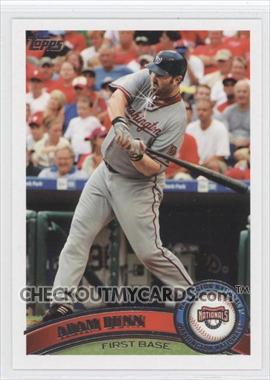
Adam Dunn and all-or-nothing hitters
Adam Dunn is enjoying a spectacular bounce-back season from his nightmarish 2011 campaign. Presently, he is on pace for 58 HR, 132 RBI, 127 BB … and 252 Ks. He is also very likely to pass the 400 HR, 1000 RBI and 2000 K career thresholds in this, his 12th major league season.
After the jump, I’ll take a look at some similar sluggers (could be hard to find), and consider the implications of an all-or-nothing approach to hitting.
So, here’s where Adam currently stands for his career. As you can see, barring injury, all of the milestones I mentioned are clearly in view for later this season. What’s more, as we’ll discover, Dunn has a chance at becoming the first player ever to reach 400 HR before reaching 1000 RBI.
| Rk | Player | PA | HR | RBI | From | To | Age | G | AB | R | H | 2B | 3B | BB | SO | Pos | Tm | ||||
|---|---|---|---|---|---|---|---|---|---|---|---|---|---|---|---|---|---|---|---|---|---|
| 5 | Adam Dunn | 6837 | 388 | 974 | 2001 | 2012 | 21-32 | 1634 | 5613 | 942 | 1363 | 292 | 10 | 1115 | 1909 | .243 | .374 | .506 | .879 | *73D9 | CIN-TOT-WSN-CHW |
Now, let’s look at other hitters to reach 400 HR and 1000 RBIs in their first twelve seasons. The fastest, season-wise, to reach these plateaus was Albert Pujols. Here are his totals after his 10th season.
| Rk | Player | PA | HR | RBI | From | To | Age | G | AB | R | H | 2B | 3B | BB | SO | Pos | Tm | ||||
|---|---|---|---|---|---|---|---|---|---|---|---|---|---|---|---|---|---|---|---|---|---|
| 1 | Albert Pujols | 6782 | 408 | 1230 | 2001 | 2010 | 21-30 | 1558 | 5733 | 1186 | 1900 | 426 | 15 | 914 | 646 | .331 | .426 | .624 | 1.050 | *37/59D64 | STL |
No other player reached these plateaus in his first eleven seasons (Ken Griffey came closest with 398 HR), so here are players to do this through 12 seasons.
| Rk | Player | PA | HR | RBI | From | To | Age | G | AB | R | H | 2B | 3B | BB | SO | Pos | Tm | ||||
|---|---|---|---|---|---|---|---|---|---|---|---|---|---|---|---|---|---|---|---|---|---|
| 1 | Alex Rodriguez | 7100 | 429 | 1226 | 1994 | 2005 | 18-29 | 1592 | 6195 | 1245 | 1901 | 338 | 25 | 730 | 1265 | .307 | .385 | .577 | .962 | *65/D | SEA-TEX-NYY |
| 2 | Mickey Mantle | 7199 | 404 | 1152 | 1951 | 1962 | 19-30 | 1675 | 5896 | 1340 | 1821 | 256 | 67 | 1251 | 1214 | .309 | .429 | .581 | 1.009 | *89/6475 | NYY |
| 3 | Ken Griffey | 7319 | 438 | 1270 | 1989 | 2000 | 19-30 | 1680 | 6352 | 1163 | 1883 | 342 | 33 | 841 | 1101 | .296 | .380 | .568 | .948 | *8/D379 | SEA-CIN |
| 4 | Willie Mays | 7337 | 406 | 1179 | 1951 | 1963 | 20-32 | 1691 | 6458 | 1258 | 2033 | 333 | 106 | 791 | 750 | .315 | .389 | .588 | .976 | *8/6 | NYG-SFG |
| 5 | Frank Robinson | 7651 | 403 | 1225 | 1956 | 1967 | 20-31 | 1786 | 6582 | 1248 | 2004 | 375 | 59 | 856 | 963 | .304 | .392 | .563 | .955 | 9738/5 | CIN-BAL |
| 6 | Eddie Mathews | 7799 | 422 | 1166 | 1952 | 1963 | 20-31 | 1792 | 6549 | 1220 | 1834 | 275 | 65 | 1155 | 1095 | .280 | .387 | .535 | .922 | *5/73 | BSN-MLN |
What’s notable about this group is that 400 HR is the tough nut to crack – most have cruised past 1000 RBI well before reaching the 400 HR plateau. So, is there anyone who has reached this dual milestone in the same season?
| Rk | Player | PA | HR | RBI | From | To | Age | G | AB | R | H | 2B | 3B | BB | SO | Pos | Tm | ||||
|---|---|---|---|---|---|---|---|---|---|---|---|---|---|---|---|---|---|---|---|---|---|
| 1 | Mark McGwire | 6314 | 457 | 1130 | 1986 | 1998 | 22-34 | 1535 | 5131 | 941 | 1353 | 219 | 5 | 1052 | 1259 | .264 | .391 | .576 | .967 | *3/D59 | OAK-TOT-STL |
That’s it. McGwire also has the distinction of getting to 400 HR in the fewest PAs.
Mark McGwire cumulative career totals through career game #1412
| G | PA | AB | R | H | 2B | 3B | HR | RBI | BB | IBB | SO | HBP | SH | SF | GDP | SB | CS | BA | OBP | SLG | OPS |
|---|---|---|---|---|---|---|---|---|---|---|---|---|---|---|---|---|---|---|---|---|---|
| 1412 | 5781 | 4728 | 835 | 1234 | 206 | 5 | 400 | 1023 | 930 | 43 | 1141 | 57 | 3 | 63 | 117 | 10 | 8 | .261 | .384 | .560 | .945 |
McGwire got to 400 HR about a full season (over 550 PA) sooner than anyone else. Harmon Killebrew is second, reaching that plateau at PA 6335.
The only other players to come close to reaching 400 HR and 1000 RBI in the same season are these guys.
| Rk | Player | PA | HR | RBI | From | To | Age | G | AB | R | H | 2B | 3B | BB | SO | Pos | Tm | ||||
|---|---|---|---|---|---|---|---|---|---|---|---|---|---|---|---|---|---|---|---|---|---|
| 1 | Harmon Killebrew | 6262 | 397 | 1008 | 1954 | 1968 | 18-32 | 1533 | 5239 | 885 | 1367 | 189 | 17 | 938 | 1154 | .261 | .374 | .531 | .905 | 357/49 | WSH-MIN |
| 2 | Dave Kingman | 6159 | 377 | 1025 | 1971 | 1984 | 22-35 | 1639 | 5524 | 765 | 1316 | 205 | 25 | 513 | 1576 | .238 | .305 | .489 | .795 | 375D9/1 | SFG-NYM-TOT-CHC-OAK |
| 3 | Willie McCovey | 6564 | 384 | 1090 | 1959 | 1972 | 21-34 | 1712 | 5536 | 933 | 1547 | 237 | 40 | 911 | 1017 | .279 | .384 | .545 | .929 | *37/9 | SFG |
| 4 | Jim Thome | 6421 | 381 | 1058 | 1991 | 2003 | 20-32 | 1536 | 5218 | 1028 | 1486 | 289 | 23 | 1108 | 1559 | .285 | .411 | .568 | .979 | *35D | CLE-PHI |
| 5 | Mike Schmidt | 6892 | 389 | 1074 | 1972 | 1983 | 22-33 | 1638 | 5663 | 1068 | 1496 | 269 | 48 | 1086 | 1427 | .264 | .384 | .535 | .918 | *5/643 | PHI |
Notice a theme? These players are all noted for making every swing with the apparent intention of trying to knock the ball out of the park. Not surprisingly, all struck out a lot. Problem, though, is nobody ever drove in a run by striking out.
These are the players with careers of 400 or more HR and RBI < 3 * HR.
| Rk | Player | SO | HR | RBI | G | PA | AB | R | H | 2B | 3B | BB | Pos | Tm | ||||
|---|---|---|---|---|---|---|---|---|---|---|---|---|---|---|---|---|---|---|
| 1 | Jim Thome | 2502 | 607 | 1687 | 2506 | 10182 | 8306 | 1573 | 2300 | 446 | 26 | 1732 | .277 | .403 | .556 | .959 | 3D5 | CLE-CHW-TOT-MIN-PHI |
| 2 | Sammy Sosa | 2306 | 609 | 1667 | 2354 | 9896 | 8813 | 1475 | 2408 | 379 | 45 | 929 | .273 | .344 | .534 | .878 | *98D/7 | TOT-CHW-CHC-BAL-TEX |
| 3 | Mike Schmidt | 1883 | 548 | 1595 | 2404 | 10062 | 8352 | 1506 | 2234 | 408 | 59 | 1507 | .267 | .380 | .527 | .908 | *53/64 | PHI |
| 4 | Dave Kingman | 1816 | 442 | 1210 | 1941 | 7429 | 6677 | 901 | 1575 | 240 | 25 | 608 | .236 | .302 | .478 | .780 | 37D59/1 | SFG-NYM-TOT-CHC-OAK |
| 5 | Ken Griffey | 1779 | 630 | 1836 | 2671 | 11304 | 9801 | 1662 | 2781 | 524 | 38 | 1312 | .284 | .370 | .538 | .907 | *89D/73 | SEA-CIN-TOT |
| 6 | Mickey Mantle | 1710 | 536 | 1509 | 2401 | 9907 | 8102 | 1676 | 2415 | 344 | 72 | 1733 | .298 | .421 | .557 | .977 | *8397/645 | NYY |
| 7 | Andruw Jones | 1709 | 426 | 1268 | 2137 | 8496 | 7454 | 1187 | 1907 | 378 | 36 | 874 | .256 | .339 | .488 | .826 | *89D/73 | ATL-LAD-TEX-CHW-NYY |
| 8 | Harmon Killebrew | 1699 | 573 | 1584 | 2435 | 9833 | 8147 | 1283 | 2086 | 290 | 24 | 1559 | .256 | .376 | .509 | .884 | 357D/49 | WSH-MIN-KCR |
| 9 | Mark McGwire | 1596 | 583 | 1414 | 1874 | 7660 | 6187 | 1167 | 1626 | 252 | 6 | 1317 | .263 | .394 | .588 | .982 | *3/D54967 | OAK-TOT-STL |
| 10 | Willie McCovey | 1550 | 521 | 1555 | 2588 | 9692 | 8197 | 1229 | 2211 | 353 | 46 | 1345 | .270 | .374 | .515 | .889 | *37/9D | SFG-SDP-TOT |
| 11 | Barry Bonds | 1539 | 762 | 1996 | 2986 | 12606 | 9847 | 2227 | 2935 | 601 | 77 | 2558 | .298 | .444 | .607 | 1.051 | *78/D9 | PIT-SFG |
| 12 | Willie Mays | 1526 | 660 | 1903 | 2992 | 12496 | 10881 | 2062 | 3283 | 523 | 140 | 1464 | .302 | .384 | .557 | .941 | *8/39675 | NYG-SFG-TOT-NYM |
| 13 | Eddie Mathews | 1487 | 512 | 1453 | 2391 | 10100 | 8537 | 1509 | 2315 | 354 | 72 | 1444 | .271 | .376 | .509 | .885 | *53/7 | BSN-MLN-ATL-TOT-DET |
Definitely lots of free swingers here. Here are some comparative stats.
| Count | RBI to HR ratio | SO per AB | SO per PA | BB per PA | |
|---|---|---|---|---|---|
| 400+ HR, RBI < 3*HR | 13 | 2.79 | 21.1% | 17.8% | 14.2% |
| 400+ HR, RBI >= 3*HR | 35 | 3.37 | 15.6% | 13.4% | 14.2% |
| Adam Dunn | 1 | 2.51 | 34.0% | 27.9% | 16.3% |
I think you’ll agree that Adam Dunn is truly in a class of his own. Dunn’s current RBI to HR ratio is lower than all other players at the time of reaching the 400/1000 plateau. Among career marks for these players, only Mark McGwire has a lower RBI to HR ratio of 2.43.
Interestingly, the 400 HR club is pretty consistent in terms of walk frequency. But, there’s a big difference in driving in runs between the higher strikeout and lower strikeout groups. Of course, this isn’t really a surprise. However, the conventional thinking in this era of ever increasing strikeout rates runs something like this:
- 1 – Lots of strikeouts are okay if the hitter hits lots of home runs
- 2 – Lots of home runs are good because home runs score lots of other runs as well
- 3 – More runs = more wins
Can’t argue with any of that, except that as point 1 becomes more pronounced, point 2 becomes less so. And, if point 2 is less pronounced, then so to is point 3. Just something to consider in evaluating today’s sluggers.
Subscribe to: RSS feed

What a legendary season he is having. Would be a real shame if he got injured. How often does a .229 hitter give us so much to talk about? How often does a .229 hitter get so much applause for having such a comeback season? How does a player bat .159 one year, and then set the all time single season strikeouts record the next year, while completely rebounding and having a season that will probably (if he keeps this pace) get him top ten in MVP voting?
It’s all absurd.
and all of this improvement, because he actually bothered to pick up a bat and hit a little bit this offseason.
what a throwback.
I can almost hear Allen Iverson’s famous rant…..”we’re talking about…..practice?!?!?”
but Dunn ain’t sitting here as no franchise player
Didn’t Dunn have an emergency appendectomy in the spring of 2011? That obviously takes a lot out of you, and pro athletes are not exactly known for giving their injuries time to heal.
I would be willing to bet that a lot of Dunn’s issues last year were due to never really getting back to his full strength.
Just for the heck of it here are the seasonal records for qualifying batters with a BA of .229 or lower.
HR…..Carlos Pena…..39
R…..Eddie Lake……96
H…..Ray Powell and Ron Santo….137
2B….AlexGonzales….37
3B….Hobe Ferriss….16
RBI….Tony Armas…..107
BB….Roy Cullenbine…137
OBP…Roy Cullenbine. .401
SLG…Carlos Pena… .537
OPS…Carlos Pena…. .893
The records for HR, R, RBI, SLG and OPS are in easy reach. BB is an outside chance. H is reachable but then his BA would rise above .229 unless his BB decrease.
Thanks for checking those out, Richard.
To fill out your list, most singles appears to be 125 by Roger Metzger.
Also, players who led the league in a “good” category when batting 0.229 or worse.
- HR: Carlos Pena 39 (2009), Dave Kingman 37 (1982)
- 3B: Rodney Scott 13 (1980)
- BB: Jim Wynn 127 (1976), Gene Tenace 110 (1974), Jack Graney 94 (1917)
- HBP: Frankie Crosetti 10 (1940), Joe Gedeon 8 (1918), Bill Hinchman 15 (1907)
- SB: George Case 28 (1946)
- SH: Bill Bradley 46 (1907), Buck Weaver 44 (1916), Otto Knabe 42 (1908), Freddie Maguire 31 (1931), Bill Hallman 29 (1901), Eddie Joost 24 (1947), Bob Meacham 23 (1985), Mark Belanger 23 (1975) 15 (1973), Ramon Santiago 18 (2003)
- SF: Alvin Davis 10 (1991), Curt Blefary 8 (1968)
And how about Roy Cullenbine in his final year, 1947. His .224 BA was by far the lowest for all qualifying batters with an OBP of more than .400.
Here’s a somewhat random question for which i’d love to hear some thoughts:
What are the origins of the term “gopher ball?” Someone asked this on one of my fant baseball websites and it got me thinking — and i’ve yet to hear a satisfying answer.
To me, one possibly obvious answer is that, after it’s hit, esp. in the old days, someone had to “go-fer” it, or go get it. But i doubt that’s it. Dictionary.com says “gopher ball” originated between 1945-55. Did we use the term “gopher” then to describe a low-level person who must perform menial fetching tasks, such as a “gopher” who must get cups of coffee for his boss? Not sure.
One person quoted wikipedia — “A gopher pitch (or gopher ball) is a pitch that leads to a home run, one that the batter will “go for” — but this doesn’t quench my personal thirst.
Neither does this one: “Gopher ball: A home run or round tripper, a combination of ‘Go four’ as in the number of bases you round on a home run.”
To me, weird baseball terms like this usually have a more unique, quirky origin with some type of story behind them. For instance, maybe in the old days of the early 20th century, there was a park where long homeruns flew, or rolled, out into a distant, unmaintained field where there were lots of gopher holes, so the team’s announcer began referring them to them as gopher balls?
What does anyone else know, or think? Or think they know?
Shping, I did a search on Google Books, and a couple of interesting findings turned up. Truly 99% of the hundreds of references were consistent with the 1945-55 date of origin. However, towards the close of my search I encountered this sentence in John B. Tunis, “The Kid from Tomkinsville” (NY: Harcourt, Brace, 1940): “The pitcher threw two wild ones, and on the next pitch Swanson hit a ‘gopher ball’ out of the park.”
There were only two other pre-War instances. The “Daily Bulletin of the Manufacturer’s Record,” vol. 95 (1929) announced: “Bids Apr. 2 for one small road scarifier with gopher ball attachment.” And an ad in “Domestic Engineering and the Journal of Mechanical Contracting” Volume 46 (1909), p. lii, proclaims in large type: “When you want the best order Gopher Ball Cocks.” (I really hope I don’t get in trouble with Andy for that.) Intriguing as these archival findings may be, I’m not sure the essential clue you’re looking for lies here.
Thanks, epluribus, for the truly intriguing and humorous info.
Definitely sounds like gopher ball had some older, totally different meaning back then as some type of device, that maybe old-time engineers would know about? Either that or:
“….Bids Apr. 2 for one small road scarifier with gopher ball attachment…”
…is some type of werid slang description for a proposed baseball trade involving Pepper Martin (“road scarifier” (?)), with Ripper Collins (“gopher ball attachment”) thrown in as part of the deal.
As for the 1909 reference you found, can’t resist saying that apparently, even back then, chicks must have dug the gopher ball.
More on “gopher ball” origins: Wow, i’m really excited because i think i might have figured this out!
Following the clues from epluribus (see above), which included this line from a 1929 engineering document:
“…one small road scarifier with gopher ball attachment.”
and some research i just did, it sounds like a “scarifier” in engineering terms is a piece of construction equipment/machine used to break up asphalt, concrete, etc, as seen here: http://www.volvoce.com/dealers/en-au/genserv/products/motorgraders/attachments/Pages/midmountscarifier.aspx
And this leads me to believe that, just maybe, “gopher ball” in engineering terms, used to refer to the giant, swinging balls-on-a-chain that construction crews use to demolish old buildings. The idea would be that these giant balls, of course, punch giant “gopher holes” in the buildings or pavement that they’re swung against. (Is there anyone out there with construction knowledge who can confirm or deny this?)
Now — here’s the exciting part! — picture an extremely hard hit baseball that smashes off the fence, scoreboard, or other structure so hard, that it smashes or dents it, or even punches a hole in it! Could this be the origin of the term “gopher ball” in baseball?!?
I realize this might be a big assumption, and it all really depends on confirming the definition of “gopher ball” in construction terminology, but i don’t mind saying again, i’m pretty excited about this possibility!
Imagine this play-by-play, circa 1930:
“…Foxx swings and crushes a deep fly ball to leftfield…he really nailed this one… it’s going, going… and holy smokes! it just smashed through the scoreboard like a… like a gopher ball! Holy smokes, what a shot!…”
Am i crazy, or does this seem plausible?
Doug — great card/picture selection for Dunn, by the way. Gotta love the magical glinting/shining of his necklace as he smites the baseball!
I vaguely remember reading a study some sabermatrician did four or five or six years ago with Adam Dunn. He pitted nine Dunns against nine modern Hall of Famers who, I think (I could be wrong about several of these particulars; too many brain cells have taken it on the lam since then), had 3,000 hits with the fewest number of home runs. So guys like Molitor, Boggs, Gwynn, Carew, Yount, etc. And he ran 1,000 game simulations (or 10,000 or 100,000 – I don’t know what’s likely in these scenarios) and the nine Dunns beat the non-slugging Hall of Fame lineup overall.
Of course this was only an offensive simulation. Just picturing one of the Dunns playing shortstop and kicking even routine grounders to Cleveland (unless of course they were playing in Cleveland, in which case he’d have kicked them to Detroit or Cincinnati) underlined the absurdity of the whole thing. I mean, it’s nice to demonstrate the importance of homers and walks and the relative harmlessness of strikeouts, but sometimes these studies get pretty abstract. A lot of baseball is catching and throwing the ball as well as hitting it. You can’t have nine DHs. Somebody’s got to play in the field.
And that’s the thing about Dunn. He’s a likeable enough player, but he’s almost become a cartoon he’s so one-dimensional, similar to Luzinski and Thome when they were with the Sox. I imagine Larry Bird would have loved toward the very end of his career to have simply shot three pointers and not have had to bother playing defense and rebounding and running the floor. I go back and forth on the DH but, really, if you put the Dunns and Ortizes in the lineup for their batting prowess, you should have to pay at least some price due to their defensive deficiencies.
Throw in a couple or three base stealers like a Tim Raines and a Juan Pierre to that “small ball” team and I bet you get a different result completely. In fact, I’ve spent a good chunk of the day wondering what sort of small ball team would consistently beat a team of HR and K wizards.
You’re no doubt right, Jim, but I think even Carew and Molly and Yount will steal enough bases to beat the nine Dunns handily.
Plus if Dunn’s catching, Boggs with his .415 OBP and propensity to walk will be around to third so fast it’ll be dizzying
Plus too, I don’t remember the exact parameters for lineup inclusion, but if you now had to add Rickey Henderson to the team (though his 297 homers might just place him beyond qualification) you’d have your elite basestealer anyway.
And Brock, of course.
tag:
Hi. nsb here.
Don’t fall into the trap: game simulations aren’t games. Nine Adam Dunns on the field or at the plate would be total disaster. The map is not the territory. Statisticians from the invention of the abacus onward have picked and chosen what figures to use, what ratios of importance to consider, and so on, to get the results they want or think are the most likely or desirable, or simply to support a point of argument.
nsb (this time I think I got it right):
I was in no danger of falling into the trap. I found the whole thing absurd, as I noted. It’s just as you say, if you cherry pick the stats you want, you can prove just about anything. And of course millions upon millions of Monte Carlo simulations “proved” that investing in subprime mortgages via mortgage-backed securities and their more synthetic variants was safe, and we all know how that turned out.
I’d love to see a play-by-play of one of those simulated games of an entire team of Adam Dunns. It’d be like that scene from “Being John Malkovich” where John Malkovich goes inside his own head.
That would be waaaay cool, but my suspicions and fears are that it would wind up being something far more prosaic and banal.
I.e.:
Dunn 1 strikes out
Dunn 2 strikes out
Dunn 3 walks
Dunn 4 strikes out
Until long about the fifth inning after, say, Dunn 6 strikes out and Dunn 7 walks and Dunn 8 walks and Dunn 9 strikes out, Dunn 1 comes up again and bombs a three-run homer. I think the play-by-play could end up being so mind-numbing you’d give a standing O to Dunn 5 for grounding out to second.
Yeah the batting play by play could get old fast but defensively it would be interesting. For example, when Dunn 6 goes deep into the hole at short and throws out, say, Austin Jackson at first.
Seriously though, I’d be quite interested in seeing some good simulations along these lines, especially a small ball team with fast and aggressive base runners versus a home run derby type of lineup, or any other type of lineup for that matter. Certainly this topic must have been beaten to death by Bill James and others? But I’d like to see some good sims on the topic.
So does anybody know what happened to him last year? Such a consistent hitter over the rest of his career, and then a season where he slugged .277 slipped in.
What’s the opposite of steroids?
Alcohol?
It’s consumption is known to lower testosterone levels.
Uhh, oh. Surprised I’m not growing breasts.
Well, he had fairly major surgery and then tried to rush back before he was ready. That’s never a recipe for success. I think that could explain a good deal of the problem, with a feedback loop from the physical ailments leading to psychological “pressing” and whatnot in the first year of a big contract to just mess him up all around until he was able to recover fully over the summer, relax, and get back his swing.
Or he just could have been dating Paris Hilton.
That should have been “over the winter” obviously.
I believe the 1909 reference is to a toilet flushing mechanism. But, no idea why that might be called “gopher”.
The 1940 reference seems like a gopher ball is a mistake pitch that just begs to be hit. Or perhaps only if the hitter connects with such a pitch. Either way, the “go for it” contraction seems plausible.
Yeah, you’re right, it looks like “gopher ball” might also refer to a toilet or water-leveling mechanism, or something manufactured by the Gopher Company, so i’m not quite as excited as i was in #9 above, but who knows?
Maybe the Gopher Co. donated $1 for every homerun a team hit, and that’s how it got started?
I’ll try to stop any more wild speculating for now, but thanks for indulging me in the meantime guys.
Actually, the Gopher Ball Cock was the product of The Union Brass and Metal Mfg. Co, St. Paul, Minn. The fact that the company’s ad specifies “bottom supply; raised seats,” confirms that you are on the right track (I thought these details indelicate to provide in my initial posting, ditto the excited boast of “Two Thumb Screws!”). Gopher seems to have been a Union Brass product line.
The fact that the term appears without any gloss in a kids’ book of 1940 indicates that this was a well known term by the 1930s. Lefty Gomez claimed to have coined the term (“my go-fer ball”) when interviewed by sportwriters in 1930, when he was a rookie. Since sportwriters in 1930 were probably unaware of what a great after dinner speaker Gomez would turn out to be, I doubt they spread the word – especially since there’s nothing funny about it unless there’s some cleverness about the animal pun, and the cleverness is easier to picture if “go-fer” is a pun on gopher, rather than the other way round.
My money – all 100 drachmas – is on your earlier speculation: gopher mounds in unkempt ball fields, probably fallow farm fields where overgrown weeds made balls hard to find among the critter holes beyond the outfield. The author of the 1940 novel was in his 50s when he wrote that book for kids, and his lexicon was probably conservative and meant to be transparent to a wide young audience (although he had been a sportswriter for the NY Evening Post – thank you, Wikipedia – so Gomez would have been in his ear).
Dickson’s Baseball Dictionary is not sure of the origin of “gopher ball”. There are several references going back to at least 1930 that mention coaches telling the batters to “go fer” 2 or 3 or more bases on a well hit ball. There is some speculation that the term goes way back to the very early days when there were no outfield fences and the outfielders would have to go for balls hit over their heads.
Interesting. Never really thought about it. Considering gopher ball means HR, which is an extreme flyball, and the opposite of a ground-dwelling creature. So, yeah, I could see it evolving from make the outfielders “go for” it. Or, perhaps, the coach saying, hit the ball to where only the gophers will find it.
A perfect 4-4 today from Dunn.
I mean, 3 k’s and a bb in 4 PA’s.
grantland.com’s weekly power rankings mention dunn and the possibility of the three true outcome triple crown
http://www.grantland.com/story/_/id/8065816/sweeping-away-nats-keeps-yankees-top-rest-league-plays-catch-up
(fingers crossed for decent formatting)
PLAYER YEAR HOME RUNS WALKS STRIKEOUTS
Murphy, Dale, Braves 1985 37 90 141
Schmidt, Mike, Phillies 1983 40 128 148
Wilson, Hack, Cubs 1930 56 105 84
Mantle, Mickey, Yankees 1958 42 129 123
Ruth, Babe, Yankees 1928 54 137 88
Ruth, Babe, Yankees 1927 60 137 89
Ruth, Babe, Yankees 1924 46 142 81
Ruth, Babe, Yankees 1923 41 170 94
(per ELIAS)
We all knew those 8 players per my post #37, “Thursday Early games/Late Wednesday notes” on 6-15-12
I should say those 8 events.