Lightning in a bottle – baseball’s one-year wonders
In 2011, Blue Jays’ starter Ricky Romero had a breakout season with 6.2 WAR and an All-Star selection, but this year … not so much. Perhaps, another in baseball’s rich history of players who suddenly shine brightly on the biggest stage, then just as quickly fade away, never again to approach that brief flirtation with stardom?
You’ve probably heard that sentiment expressed in various ways and, perhaps, without thinking a great deal about it, presumed there was some measure of truth to it. Well, I’m here to tell you – it ain’t necessarily so. In fact, the true one-year wonder may indeed be about as likely as catching lightning in a bottle.
After the jump, I’ll look more closely at the one-year wonder phenomenon (or non-phenomenon). If you’re like me, I suspect you may be surprised.
Cutting to the chase, here are the one-year wonder hitters.
| Player | Year | WAR | Age | Tm | G | PA | AB | R | H | 2B | 3B | HR | RBI | BB | SO | SB | CS | Pos | |||||
|---|---|---|---|---|---|---|---|---|---|---|---|---|---|---|---|---|---|---|---|---|---|---|---|
| Jacoby Ellsbury | 2011 | 8.0 | 146 | 27 | BOS | 158 | 732 | 660 | 119 | 212 | 46 | 5 | 32 | 105 | 52 | 98 | 39 | 15 | .321 | .376 | .552 | .928 | *8/D |
| Franklin Gutierrez | 2009 | 6.2 | 105 | 26 | SEA | 153 | 629 | 565 | 85 | 160 | 24 | 1 | 18 | 70 | 46 | 122 | 16 | 5 | .283 | .339 | .425 | .764 | *8 |
| Rich Aurilia | 2001 | 6.5 | 146 | 29 | SFG | 156 | 689 | 636 | 114 | 206 | 37 | 5 | 37 | 97 | 47 | 83 | 1 | 3 | .324 | .369 | .572 | .941 | *6 |
| Rick Wilkins | 1993 | 6.5 | 151 | 26 | CHC | 136 | 500 | 446 | 78 | 135 | 23 | 1 | 30 | 73 | 50 | 99 | 2 | 1 | .303 | .376 | .561 | .937 | *2 |
| Billy Grabarkewitz | 1970 | 6.2 | 134 | 24 | LAD | 156 | 640 | 529 | 92 | 153 | 20 | 8 | 17 | 84 | 95 | 149 | 19 | 9 | .289 | .399 | .454 | .852 | *564 |
| Aurelio Rodriguez | 1970 | 6.2 | 102 | 22 | TOT | 159 | 663 | 610 | 70 | 152 | 33 | 7 | 19 | 83 | 40 | 87 | 15 | 6 | .249 | .302 | .420 | .721 | *5/6 |
| Zoilo Versalles | 1965 | 7.1 | 115 | 25 | MIN | 160 | 728 | 666 | 126 | 182 | 45 | 12 | 19 | 77 | 41 | 122 | 27 | 5 | .273 | .319 | .462 | .781 | *6 |
| Bob Cerv | 1958 | 6.1 | 159 | 32 | KCA | 141 | 571 | 515 | 93 | 157 | 20 | 7 | 38 | 104 | 50 | 82 | 3 | 3 | .305 | .371 | .592 | .963 | *7 |
| Eddie Lake | 1945 | 6.3 | 137 | 29 | BOS | 133 | 586 | 473 | 81 | 132 | 27 | 1 | 11 | 51 | 106 | 37 | 9 | 7 | .279 | .412 | .410 | .822 | *6/4 |
Certainly, the names of Versalles and Grabarkewitz on the list have become somewhat synonymous with this topic. Versalles famously parlayed this campaign into an MVP season for the AL champs. Also, I’d be willing to bet the first name on the list won’t be staying there for long. But, that’s all the names there are, back to 1901.
Surely, there must be more than these, you say. Well, here are my criteria – these are the only players since 1901 with careers of 5 or more seasons with exactly one 6+ WAR season and no other 3+ WAR seasons. I chose those definitions since, in most seasons, players will need a least 6 WAR (or more) to make the WAR top 10 for MLB. Similarly, seasons of less than 3 WAR are usually just noise in terms of identifying a season’s top performers, and seldom will attract more than passing attention. Obviously, those criteria can be debated, but I don’t believe they’re terribly unreasonable.
For the pitchers, using the same criteria.
| Player | Year | WAR | Age | Tm | G | GS | CG | SHO | GF | W | L | SV | IP | BB | SO | |||||||
|---|---|---|---|---|---|---|---|---|---|---|---|---|---|---|---|---|---|---|---|---|---|---|
| Joe Mays | 2001 | 6.3 | 1.151 | 4.74 | 2.47 | 1.92 | 25 | MIN | 34 | 34 | 4 | 2 | 0 | 17 | 13 | .567 | 0 | 233.2 | 64 | 123 | 3.16 | 143 |
| Justin Thompson | 1997 | 7.4 | 1.137 | 6.09 | 2.66 | 2.29 | 24 | DET | 32 | 32 | 4 | 0 | 0 | 15 | 11 | .577 | 0 | 223.1 | 66 | 151 | 3.02 | 152 |
| Kevin Tapani | 1991 | 6.6 | 1.086 | 4.98 | 1.48 | 3.38 | 27 | MIN | 34 | 34 | 4 | 1 | 0 | 16 | 9 | .640 | 0 | 244.0 | 40 | 135 | 2.99 | 143 |
| Mark Eichhorn | 1986 | 7.1 | 0.955 | 9.52 | 2.58 | 3.69 | 25 | TOR | 69 | 0 | 0 | 0 | 38 | 14 | 6 | .700 | 10 | 157.0 | 45 | 166 | 1.72 | 246 |
| Mark Fidrych | 1976 | 9.3 | 1.079 | 3.49 | 1.91 | 1.83 | 21 | DET | 31 | 29 | 24 | 4 | 2 | 19 | 9 | .679 | 0 | 250.1 | 53 | 97 | 2.34 | 159 |
| Wayne Twitchell | 1973 | 6.4 | 1.213 | 6.81 | 3.99 | 1.71 | 25 | PHI | 34 | 28 | 10 | 5 | 0 | 13 | 9 | .591 | 0 | 223.1 | 99 | 169 | 2.50 | 152 |
| Jim Merritt | 1967 | 6.2 | 0.993 | 6.36 | 1.19 | 5.37 | 23 | MIN | 37 | 28 | 11 | 4 | 4 | 13 | 7 | .650 | 0 | 227.2 | 30 | 161 | 2.53 | 138 |
| Hank Aguirre | 1962 | 7.2 | 1.051 | 6.50 | 2.71 | 2.40 | 31 | DET | 42 | 22 | 11 | 2 | 13 | 16 | 8 | .667 | 3 | 216.0 | 65 | 156 | 2.21 | 185 |
| Bobby Shantz | 1952 | 8.7 | 1.048 | 4.89 | 2.03 | 2.41 | 26 | PHA | 33 | 33 | 27 | 5 | 0 | 24 | 7 | .774 | 0 | 279.2 | 63 | 152 | 2.48 | 159 |
| Ken Heintzelman | 1949 | 6.0 | 1.328 | 2.34 | 3.35 | 0.70 | 33 | PHI | 33 | 32 | 15 | 5 | 0 | 17 | 10 | .630 | 0 | 250.0 | 93 | 65 | 3.02 | 130 |
| Cy Blanton | 1935 | 7.0 | 1.081 | 5.02 | 1.95 | 2.58 | 26 | PIT | 35 | 30 | 23 | 4 | 3 | 18 | 13 | .581 | 1 | 254.1 | 55 | 142 | 2.58 | 159 |
| Jim Shaw | 1919 | 6.1 | 1.223 | 3.76 | 2.96 | 1.27 | 25 | WSH | 45 | 37 | 23 | 3 | 6 | 17 | 17 | .500 | 5 | 306.2 | 101 | 128 | 2.73 | 117 |
| Lefty Tyler | 1918 | 6.5 | 1.058 | 3.41 | 2.24 | 1.52 | 28 | CHC | 33 | 30 | 22 | 6 | 3 | 19 | 8 | .704 | 1 | 269.1 | 67 | 102 | 2.00 | 138 |
| Ed Karger | 1907 | 6.5 | 1.025 | 3.93 | 1.86 | 2.11 | 24 | STL | 39 | 32 | 29 | 6 | 5 | 15 | 19 | .441 | 1 | 314.0 | 65 | 137 | 2.04 | 123 |
Rather more seasons across a broader range of years. But, still, not a huge number of players. As with the hitters, one MVP season here (Shantz). Also, one WS champion (Tapani). Note that Romero is not on the list as he does not yet have 5 years in the majors.
One interesting sidenote is Jim Merritt, the only liveball era pitcher on this list who garnered no award votes or All-Star recognition for his 6 WAR season. Ironically, Merritt’s 1970 All-Star season when he went 20-12 and finished 4th in the Cy Young (and even got some MVP votes) is, at 1.6 WAR, in the top 10 for lowest WAR in any liveball 20 win season.
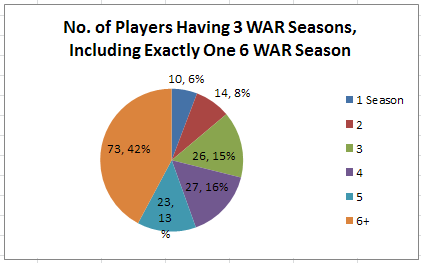
My take from this is simply that cream rises to the top. Thus, a player who is good enough to compile a 6 WAR season is also, in most instances, good enough to also compile at least one other 3 WAR season. This can be seen in the charts below. First, for the hitters.
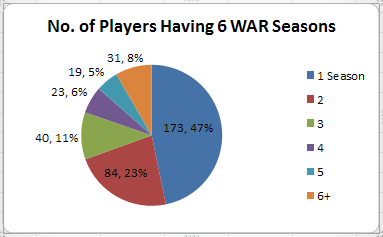
The chart on the left shows the number of players achieving a 6 WAR season. Of those who do, almost half (47%) achieve only one such season. The right chart is a breakdown of those players with one 6 WAR season, showing how many 3 WAR seasons were compiled. This chart shows that having a 6 WAR season as the only 3 WAR season in a career is the least likely result – only 6% of these players did that, or only about 3% of all players with a 6 WAR season. Far more common is for that one 6 WAR season to be among several 3 WAR seasons. In fact, over 85% of players with exactly one 6 WAR season have at least two other 3 WAR seasons, and over 70% have at least three other 3 WAR seasons.
Now, the same measures for the pitchers.
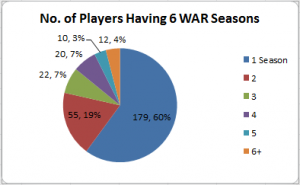
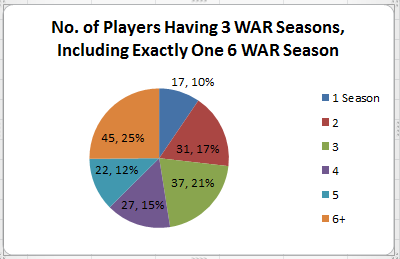
Pretty much the same story as with hitters. Achieving a single 6 WAR season accounts for 60% of all players with 6 WAR seasons. But, for that 60%, having the 6 WAR season be the only 3 WAR season is the least likely scenario, accounting for about 10% of players with one 6 WAR season, or about 6% of all players with 6 WAR seasons.
So, remember, only cream rises to the top. A “fluke” 6 WAR season is a very, very unusual occurrence.
Subscribe to: RSS feed


How many of those pitchers were relievers? Seems likely they didn’t pan out as starters but could have had long careers as relievers. Mark Eichhorn I’ve never heard referred to as a one-year wonder before, found that kind of insulting to him. They don’t let relievers throw 150 innings anymore. His WAR per inning rate probably didn’t change much throughout his career.
Good point about relievers generally not being WAR compilers, unless they compile huge innings (as Eichhorn did in ’86).
Among others who were both starters and relievers in their careers:
- Twitchell, one good season (’76) as reliever, but otherwise consistently mediocre in both roles
- Aguirre, 5 seasons as starter, only the one here a good one. Much better as reliever (career 117 ERA+)
- Shantz, 7 seasons as starter or swingman, only one other (’57) a good one. Consistently good as reliever at end of career.
Everyone else was a starter or swingman for all or nearly all of their careers.
Yeah Eichorn is the odd fit as he has a 2.5 WAR, a 2.6 WAR, and a 2.9 WAR season.
I really don’t think Bobby Shantz should be classified as a one-year wonder. He never again reached the heights of his 1952 season but he did pitch for another 12 years with moderate success. In 9 of those years his ERA+ was greater than 100 including his highs of 214, 153 and 148. He was a big contributor to the Yankees pennant in 1957 when he led the league in ERA and posted an 11-5 W-L record. And then there were his 4 gold glove awards.
I agree it does seem strange to talk about a guy like Shantz in these terms. Yet, in a way, his is exactly the profile I was searching for. Decent role player for basically all of his career, save one season when he ‘s the best pitcher in the league. There just aren’t many careers like that. Most players who have a season close to the best in the league also have other very good seasons, not just solid role players.
Yes, Shantz did have those good ERA years, but in limited innings. And those GGs are fine, but pitcher’s fielding is definitely in the nice-to-have category, not a principal requirement.
Can we add batting WAR and pitching WAR together (I know we can’t add oWAR and dWAR together in the new version of WAR)? If we can do that then Bobby Shantz falls off of the list as he has a 0.5 batting WAR and a 2.9 pitching WAR in 1957 (his 1951 season would also jump to 3.0 with 2.3 pitching and 0.7 batting) . Not that I think about it, where is the defensive contribution of the pitcher counted, in pitching or batting WAR? I’m guessing the batter value, since that is where the dWAR is.
I know he doesn’t quite reach your 6.0 standard, but Al Cowens’s 1977 season sticks out like a sore thumb in his career. WAR 5.0 (no other seasons above 2.6). OPS+ 137, no other seasons above 114. WAA 3.0, no other seasons above 1.0 and most of them are negative. When you look at his counting stats on his page on baseballreference.com, pretty much every category it looks like the profile of another player was stuck in there at age 25.
OK, time to check out Norm Cash’s 1961 season and see why he doesn’t qualify
Pitcher Gene Bearden also missed the 6 WAR cut-off but his 20-7 year in 1948 combined with his league leading 2.43 ERA (ERA+ = 168) led the Indians to a pennant. He played 5 more years with a record of 25-31 and an ERA+ of 90.
Missed one. Actually, his teammate from the Miracle Braves (Lefty Tyler, who is on your list, but not for 1914) got me to thinking about him. Bill James, the ace of the 1914 Miracle Braves. He had a 7.7 WAR in 1914 and surrounded that with nothing more than 0.3 in his other 3 seasons. I see why you missed him, he didn’t meet your seasons played criteria, but he is the ultimate in one hit wonders or lightning in the bottle guys.
Sounds very much like Mark Fidrych. James had 30 CGs and 332 IP in that miracle Braves season, but only 208 IP the rest of his career. Fidrych had just 162 IP in four seasons following his 24 CG, 250 IP rookie season.
I wonder if Fidrych were a pitcher these days, his team would do the same to him as the Nationals will do with Stratsburg.
Nats are a potential WS team this year, so I think that the two situations are somewhat different.
True but his HAAR (Historical Abstracts Above Replacements) led the league for 25 years
Some close calls were:
Chris Hoiles with top WAR seasons of 6.5, 3.1, 3.1, 2.6
Terry Turner 9.2 (aided by the best ever single season defensive WAR of 5.4 according to rWAR), 4.1, 3.0, 3.0
Dick Ellsworth 9.9, 3.4, 1.9
Mark Prior 7.2, 3.4, 2.9 (exactly 5 year career)
Dontrelle Willis 7.0, 3.8, 3.7, 1.1
Bronson Arroyo 6.5, 3.1, 2.4
Ryan Dempster 6.7, 3.9, 3.2
For this subject, I always think of one name – Joe Charboneau, AL ROY from the 1980 Indians.
He doesn’t fit any of your criteria as he only lasted 3 seasons and never even had a 3 WAR season (mostly because of his Left Field/DH positioning). But I remember him as lightening in a bottle.
Or the Royals version of same, Bob Hamelin, who you could have written almost the exact same sentences about.
Absolutely, Tmckelv.
What’s curious though (at least to me) is that 10 years before Joe, the Indians had another rookie left-fielder nobody remembers whose rookie season and career look startlingly like Charbonneau’s. Take a look at Roy Foster and see if you don’t agree.
Although he was just before my time, I always knew of Roy Foster because he came in 2nd in the 1970 AL ROY race to my favorite player, Thurman Munson.
Roy had a really good year in 1970. He had a great case for that award (because of his 23 HR and 50+ point lead in SLG) until the WAR stat came about as Munson dominated in that regard (5.3 to Foster’s 0.9).
Versalles was a defensive whiz, which contributed to the hype.
Yes he led the league in oWar, as well.
And clearly it was a ‘good’ season with the stick – but a lot of that black ink came from being the leadoff hitter on BY FAR the best offense in the league. Versalles easily led the league in Plate Appearances.
Minnesota scored 4.78 runs per game.
Detroit was #2 at 4.20
Huge.
But his OPS+ was only 115.
That was good for 20th among qualifying hitters.
Yes I am cherry picking.
________________________
Roberto Hernandez had 5.9 WAR and 148 OPS+ in 2007. His next best is 2.5 and 105 in 2010. I already posted a comment on July 14 that he had a seasonal high which exceeded his lifetime WAR (4.4).
Just to avoid confusion, it might be helpful to say Roberto Hernandez nee Fausto Carmona.
Doug this is fantastic research, thank you.
The more we use WAR as a comparative statistic the more I become wary of it, particularly the ‘full’ WAR stat, with dWAR fed into it.
Jacoby Ellsbury?
His 2009 season was worth 2.5 wins above a AAAA scrub?
And his 2008 season was worth more?
I’m more of an intuitive sabermetrician than a literal one, and that just doesn’t seem right.
Voomo, I agree that the dWAR component is extremely dicey, to the point of being nebulous. I wish I knew more about how the figure is reached. Range factors, ballpark adjusted factors, this factor, that factor. Do teams of statisticians actually watch every play of every game and make statistical analyses on every defensive play? And if so, what are the parameters, or is there some subjectivity involved?
Aurilia was the 2 hitter on that Giants team.
The 3 hitter hit 73 homeruns.
For his career, Aurilia did this with men on base:
.286 .341 .433 .774
In 2001:
.331 .369 .609 .978
And with just a runner on first:
.414 .454 .829 1.283 (119 PA)
How about Eddie Lake? 6.3 WAR in 1945 (when many major league caliber players were more focused on war than WAR), but never more than 2.2 WAR in any other year in his 11-season career. Total career WAR: 9.7. Also, Bob Cerv, 6.1 WAR in 1958, and never more than 1.9 in any other season in his 12-season career.
Among all non-pitchers since 1901 with a season of 6 or more WAR, only Grabarkewitz (career WAR 5.2) ended his career with a lower career WAR thn Lake, though Cerv was close (career WAR 10.2). Other retired guys with a 6+ WAR season and career WAR under 15: Zoilo (10.4 career WAR), Aurelio ((11.7) and Wilkins (13.1), all from your list, plus Cerv. Also, perhaps surprisingly, Cecil Fielder (14.7 career WAR) and less surprisingly, Morgan Ensberg (12.8 WAR). Fielder and Ensberg each had a 3+ WAR season to go with their 6+ WAR season, so they weren’t true one-year wonders for your list, but their high overall value was certainly short-lived.
Thanks for pointing out Lake and Cerv. They should be on the list. I will update.
This is great. So many great stories in this post.
I was considering doing something like this for BTB, but more along the lines of finding peak-season WAR minus second-highest-season WAR.
My understanding of what constitutes a one-year wonder differs somewhat from Doug’s. One reason you never heard from them again after their break-out year was that they so completely lost their magic that they left baseball. This is typically a rookie phenom that was on the roster LESS than 5 years, not more. So maybe a survey of the rookie blazers that soon bombed out would result in more than 7 position players since 1901? More likely to explain the perception that this is not so rare? As others have stated, it is almost considered an insult to call some of the listed players a one-year wonder, considering the complete body of their work. To me, a true one-year wonder had one super nova year, then faded away quickly, not lingering on for several years of play at least decent enough to keep them on a major league roster.
If you were to make a survey of the rookie flame-outs, I have a feeling you may uncover several who left baseball involuntarily because of war, death, incarceration, etc. There would be several cases of “what if . . . ?” to ponder about when a truly talented player could have done so much more if not cut down in their prime. I’ll leave the research to you stat-heads, if any of you are game.
Right, Ken. We are considering a bit different phenomena. I was interested in guys whose established level of play over a number of seasons differed vastly from their highest level of play.
Your thought is more along the Joe Charbonneau type of player. Which is fine – just different than what I was looking for.
I also had thought of the term differently, Ken, and more along your lines. For me, though, the term is dismissive – it would never apply to a pitcher like Fidrych, but might fit Bo Belinsky, even though he was really more of a one-month wonder: it was his first month.
Not that there’s any problem with Doug approaching it as he did. But the 6.0 WAR threshold does rule out the rookie sensations whose flashy first year was a partial one, and whose sophomore slumps never came to an end.
Another really interesting post, Doug. But I’m going to nitpick on a point, which I think has broader implications: your characterization of Jim Merritt’s record and the tension between advanced and primitive stats.
You summed up Merritt in 1970 by suggesting that it wasn’t much of a year for him because he had a low WAR, implying that CYA and MVP award voters who gave him a nod had not misguidedly focused on W-L. The reason his WAR is low seems to be primarily because his 4.08 ERA was mediocre. But what award voters were looking at could have been more than W-L, and they might have been perfectly aware of his ERA. (We certainly understood the importance of ERA in 1970.) If you explore Merritt’s record, you’ll find that his ERA was really disastrous in his losses, but quite excellent in his wins – of which there were many. His ERA breaks down as follows:
In 20 wins (ave. 8.1 IP): 2.49
In 3 NDs: 4.65
In 12 losses (ave. 4.2 IP): 10.24
(Two of Merritt’s short stints seem to have been related to an injury towards the end of the season that knocked him out of several starts, perhaps the arm injury that led to his 1-11 record in ’71.)
Merritt had only three cheap wins (more than three runs allowed) and only one tough loss (fewer than four runs allowed). No ND was a blowout (only 5 runs among the three).
Basically, Merritt generally delivered excellent complete or near-complete games to earn his 20 wins, which was a great contribution to a pennant winning team. What makes his record look so bad was proliferation of disaster starts – 6, 7, 8 runs, multiple times.
I’d argue that a guy whose good and bad days are honestly reflected by a 20-12 W-L record has had a great year, regardless of how high his ERA swelled on the bad days. This a case where a much maligned counting stat – completely ignored in WAR calculations – gives a clearer picture of the quality of the pitcher’s contribution than the generally more telling average stat.
Now I certainly don’t want to advocate that we regard W-L as more significant than ERA (and risk being exiled from HHS!), but I do want to argue that games are played one by one and real game-winning value is accrued in quanta that advanced stats may not reflect where primitive stats may. Sometimes the real value of a player’s contributions may be misrepresented by averages, and better reflected by voters who have been following the narrative of the season.
No slight to Merritt intended, epm. I was actually impressed that all the seasons on the list starting with Blanton’s had received an All-Star selection or an Awards vote. All except Merritt’s season. It just struck me as ironic that the one season in Merritt’s career when he was an A-S and got some awards vote was, by WAR, so underwhelming. That he got no love from the voters in ’67 is not too surprising with 20 game-winner and former CYA selection Dean Chance as his teammate.
As to pitching better when you win than when you lose, that of course is a pretty consistent trait for just about every pitcher
. That he did more of the former than the latter is to his credit. But, had he been less bad than the horror he was in his losses, his team might have managed to win one or two of those. I’m inclined to think that the voters overlooked his ERA (as you are doing, but WAR doesn’t) because of the 20 wins.
Just on a whim, I checked Rick Helling’s 20 win season (1998) where he had a 4.41 ERA in a higher offensive context
In 20 wins (average 7 innings pitched) ERA 2.71
In 6 no decisions (average 5 IP) ERA 8.01
In 7 loses (average (average 6.1 IP) ERA 7.48
I guess that tell us that Helling had a lot of offensive support to bail him out of a loss 6 times when he gave up an average of 4.5 runs in 5 innings, at least.
By my calculations in Merritt’s 15 combined non-win games ERA would be just over 9, in Helling’s 13 his was about a run & a quarter lower.
epm: One way to use advanced stats to measure what you are seeking to measure, and to adjust for the possible weakness in WAR you have identified, is to look at Win Probability Added (WPA). Instead of awarding one Win, one Loss, or one No Decision for every start, WPA awards some percentage of a win or a loss for each start depending on the extent to which a pitcher increased or decreased his team’s chances of winning that particular start. It’s not a perfect stat (no stat is perfect), but it tries to get at what you are observing about Jim Merritt’s 1970 season, but in a subtler way than does Win-Loss record.
So what does WPA tell us about the merit of Merritt’s 1970? Something in between his Wins total and his WAR. Jim was fourth in Wins in the NL in 1970. On the other hand, he was 30th in WAR in 1970 among NL starting pitchers. If we look at WPA, Merritt was 13th in the NL among starting pitchers in 1970. That may actually be a better measure in this case of his value than his Wins, WAR or ERA. He had 19 “Quality Starts” in 1970, which was tied for 15th in the NL, compared to 26 Quality Starts for his teammate Gary Nolan, who tied for the league lead in QS with Tom Seaver and Gaylord Perry. A category in which Merritt was near the top of the league in 1970 was run support from his own team, where b-ref shows him tied for sixth among NL starters. Compare that to Gary Nolan, who, though pitching for the same team as Merritt, got only enough run support to be tied for 30th in the league in that category. It seems to me the few Cy Young voters in ’70 who chose Merritt as the second or third best pitcher in the league gave too much credit to Merritt’s Wins total, but on the other hand WAR does probably underestimate his value that season.
Note, by the way, that 1970 was the first time Cy Young voters cast ballots for second and third place. Before ’70, voters had simply voted for the one guy they thought was the best pitcher in the league and the guy with most votes won. If that method had remained in place one more year, we wouldn’t even be discussing Cy Young votes for Merritt.
Great stuff, birtelcom. Thanks.
WPA is an interesting stat, birtelcom, and I appreciate it single game contexts. Because I understand its goals but not its mechanisms, I’m wary of using it in season contexts, but your use of it here shows that it can contribute to close analysis. I won’t be able to debate you on those grounds in this response. Next life.
I’m not sure why run support is particularly relevant when we already know how many “cheap wins” Merritt had (defining that as W’s with 4+ runs allowed). Merritt’s W’s were rarely *the product of* good run support, and that seems to me what the issue is.
Since you raise Nolan as a comparison, I ran some numbers on both (by the way, back in the day I liked Nolan lots more than Merritt, so this isn’t fan bias). Here are their basic numbers:
Merritt 20-10 / 4.08 / WAR 1.6 [WPA 1.6]
Nolan 18-7 / 3.27 / WAR 4.3 [WPA 2.9]
Nolan looks better on every count but W’s, and hugely better on WAR (and WPA). Here are their records on wins alone (I have to correct my earlier numbers on Merritt: I ran my calculations again – meaning I used a fresh post-it – and found I’d transposed a number that hurt Merritt’s win-ERA):
Merritt (20 wins) 8.1 IP / 2.14 ERA (2.19 RA)/ 5.06 run support
Nolan (18 wins) 7.2 IP / 2.18 ERA (2.58 RA)/ 4.60 run support
Merritt has 3 “cheap wins,” Nolan has 4.
Now Nolan offers a lot more in the no-decision department: he had 12 such starts and a 3.54 ERA, whereas Merritt only had 3. (The Reds were 8-4 in Nolan’s NDs and 2-1 in Merritt’s.) So Nolan wound up eating up a few more total innings. And of course Nolan had not only fewer losses, but few disaster starts (his loss ERA was 6.61; Merritt’s correct figure is 9.80). A lot of Merritt’s apparently strong run support comes from the Big Red Machine getting in a slugfest in which Merritt got slugged – and quite a few of the Reds’ slugs came after Merritt had already hit the showers, so they really are a statistical irrelevance.
In terms of bullpen-resting work, Merritt was 11-1 in complete games, Nolan was 3-1.
I’m not sure the picture really should show Nolan as far superior, or even superior at all, in terms of his contribution to team W-L. Homogenized, Nolan is clearly the superior; merely Pasteurized, I think the cream on top is roughly equivalent.
All this is by way of saying that I have no problem with WAR for what it does – assess player performance over a season and career – but that when the question is player value there may be more to consider, because value is contributed in specific contexts. While W-L (and RBI and R) can be misunderstood in isolation, that type of stat is still telling a significant story related to player value, and at award time, that may be as important to an informed voted as sustained level of performance.
Great post, Doug! (And I’m not just saying that in loving memory of Mark Fidrych and Aurelio Rodriguez.)
Like Richard, I was surprised that Gene Bearden didn’t make the list. According to Bill Veeck (yes, I’m reading “Veeck as in Wreck” again), Bearden’s downfall was initiated by Casey Stengel, who had managed him in the PCL the 2 years before Bearden’s breakthrough ’48 season. Casey took over the Yankees in ’49, and told his guys to lay off Bearden’s knuckler until they had 2 strikes, because it usually broke out of the strike zone. Word got around the league, goes the story, and pretty soon Bearden was just another fella.
One little problem with this tale: The Yankees beat the tar out of Bearden in 1948, his big year, to the tune of 0-2 with a 9.49 ERA and 2.43 WHIP and 10 walks in 12.1 IP over 2 starts and 3 relief outings. They were the only team he didn’t beat at least twice that year, and the only one against whom his ERA was over 3. They whupped him about the same in ’49.
Maybe Casey was already feeding the Yankees advance scouting reports in ’48, but as far as I know he wasn’t affiliated with them at the time.
Casey was not affiliated with the Yankees at the time but he was on good terms with Yankee GM George Weiss who had been trying to convince Yankee owners for a couple of years to hire Stengel. After Larry MacPhail quit as owner Weiss convinced Topping and Webb to hire Stengel.
John, now that I know that you are Tigers fan, I’m curious to know what are the Tigers fans’ perception of two of the most beloved players in Mexico’s baseball history: Aurelio Rodriguez and Aurelio Lopez.
Lopez has one of my all-time favorite nicknames – Senor Smoke
I used to emulate the original A-Rod during wiffle ball games growing up. you catch a grounder at 3rd and wait until the last possible second and whip the ball side-arm as hard as you can to 1st. I think that caused me to blow out my elbow.
Aurelio Rodriguez was an absolute joy to watch play 3rd base. Talk about a cannon. Guy had one of the best arms I’ve ever seen. He was the best defensive 3rd baseman I’ve seen, outside of Brooks Robinson, although I admit that were/are other very good ones I saw rarely or not at all.
Luis — Both were very popular with Tigers fans.
Aurelio Rodriguez came to us in the big trade in which we dumped the troubled Denny McLain, who had worn out his welcome; in the same deal, we picked up Eddie Brinkman (giving us a slick-fielding, if light-hitting, left side), and Joe Coleman, who averaged 21 wins over the next 3 years and tossed a shutout in the ’72 ALCS when our backs were to the wall. So there was a positive aura around Rodriguez from the start, and while we would have cheered him even harder if he could hit his weight, we appreciated his glove work and were happy when Brooksie finally stepped aside and Aurelio claimed the Gold Glove.
Señor Smoke kept the ’79 Tigers over .500 in a year when John Hiller got old and the rest of the bullpen was uniformly awful:
http://www.baseball-reference.com/teams/DET/1979.shtml
He was an afterthought at first, used to mop up in lost causes, but when all else had failed we turned to him and he racked up 21 saves in our last 92 games. Then in ’84, he was the complement to Guillermo Hernandez, as they combined for a whopping 278 innings, all in relief. Lopez went 10-1 that year, plus 2 wins in the postseason (no runs in 6 IP), and his 48 relief wins from 1979-84 were 2nd in all of MLB. We loved him!
Tmckelc, Jim B., John, Muchas gracias.
As you must know, both Aurelios suffered untimely deaths, Lopez in a car accident, in the state of San Luis Potosi while serving as Mayor of his home town. Here in Mexico he was known as “El buitre” (the voultrum). Rodriguez was killed in Detroit before an Old Timers Tigers reunion. His tomb is located in the Los Mochis stadium (Winter League).
Luis, thanks for sharing that about Lopez & Rodriguez. I only knew a little; I didn’t even know that Lopez had been mayor or was named to the Mexican League HOF.
A lot of people, even Tigers fans, might be surprised to know that the 2nd-best relief WAR in Tigers history (after Hiller ’73) was *not* the MVP/CYA Guillermo Hernandez in ’84, but Aurelio Lopez in ’79, with 5.2 WAR. That mark has been topped just 4 times since then, last by Eichhorn in ’86.
Que en paz descanse, mis estimados amigos.
Doug, good stuff but some of the numbers don’t add up. Shouldn’t the total in each right hand chart equal the one 6+ WAR season of the left hand chart minus the number of seasons in the table above. The hitters add up to too few, the pitchers too many.
The numbers in the chart include players who did not (or do not yet) have 5 year careers. That’s why there are 9 hitters on the list, but the “1 season” pie slice in the right-hand chart is 10, and 14 pitchers on the list and a pie slice of 17.
The totals for all slices in the right hand pie equal the total for the “1 season” slice in the left-hand pie.
Fidrych’s WAR in 1976 would have been even higher if he had started his first game before mid-May, and I don’t think there’s any question that he would have had continued success for years if he hadn’t hurt his arm. Clearly, guys who sustain a serious injury, which is most likely to happen to pitchers, need to be separated from guys who do not, when labeling them as “one year wonders”, no?
To be sure, Jim, there are many reasons for a player’s performance to decline. Perhaps my term is too loaded, and people see it as a label and, especially, as a pejorative. What I was really searching for were players whose play rose far above their norm (hence, a 5-year career requirement) for one glorious season – that’s all. I expected there would be more of them than what I found.
For the other interpretation of one-year wonder, I prefer the term “flash in the pan”. I may follow-up with a piece on those guys.