All it took was a bit of photo editing to make his message correct.
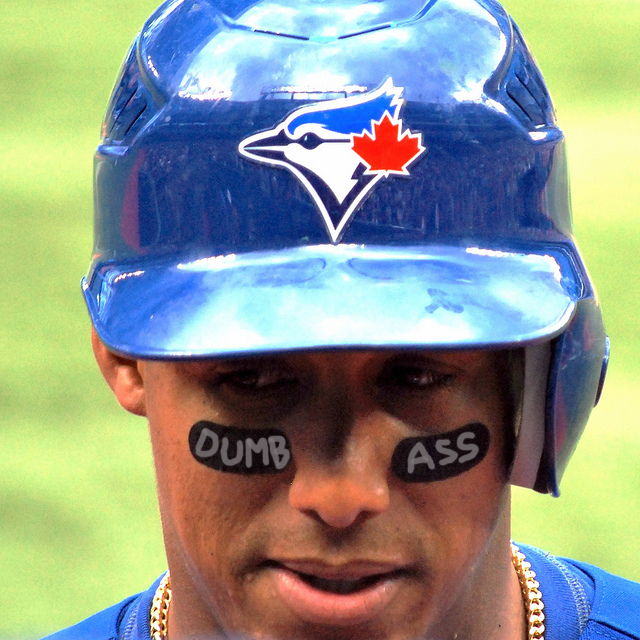

All it took was a bit of photo editing to make his message correct.
Last night, Derek Jeter tied Willie Mays for 11th on the all-time hit list:
1.	Pete Rose           4256
2.	Ty Cobb+            4189
3.	Hank Aaron          3771
4.	Stan Musial         3630
5.	Tris Speaker        3514
6.	Cap Anson           3435
7.	Honus Wagner        3420
8.	Carl Yastrzemski    3419
9.	Paul Molitor 	    3319
10.	Eddie Collins       3315
11.	Derek  Jeter 	    3283
 	Willie  Mays        3283
How high might Jeter finish on the all-time list? Continue reading
Taken from the Baseball-Reference.com bullpen, here are a few interesting things that happened in MLB on September 13, 1983.
Makes sense, right? Quisenberry was one of the preeminent closers of the 1980s. On this date in 1983, he saved his 39th save of the season. Thirty ninth! That was all it took for the all-time record!
Now here’s the interesting part. Guess where a 39-save season would rank now. The answer is that it would tie for138th-most in MLB history.
Yes, folks, the way closers are used has changed a lot.
Since that 1983 performance, the only player to top 100 stolen bases in a season was Vince Coleman, and in the last 20 full seasons the highest total is 78, by Jose Reyes in 2007.
One can’t help but wonder when we’ll next see a 100-SB performance in the majors. (Raise your hand if you just thought of Billy Hamilton.) Will we ever again see a guy have 3 such years in a row? I find it hard to believe but I’ll never say never. The game has shifted a lot since the early 1980s, but nothing says it can’t shift back.
Fitzgerald is one of 4 Mets to accomplish the feat:
| Player | Date | Tm | Opp | Rslt | PA | AB | R | H | 2B | 3B | HR | RBI | BB | SO | WPA |
|---|---|---|---|---|---|---|---|---|---|---|---|---|---|---|---|
| Mike Jacobs | 2005-08-21 | NYM | WSN | L 4-7 | 1 | 1 | 1 | 1 | 0 | 0 | 1 | 3 | 0 | 0 | 0.062 |
| Kazuo Matsui | 2004-04-06 | NYM | ATL | W 7-2 | 5 | 3 | 1 | 3 | 2 | 0 | 1 | 3 | 2 | 0 | 0.268 |
| Mike Fitzgerald | 1983-09-13 | NYM | PHI | W 5-1 | 4 | 4 | 1 | 1 | 0 | 0 | 1 | 2 | 0 | 1 | 0.106 |
| Benny Ayala | 1974-08-27 | NYM | HOU | W 4-2 | 4 | 3 | 2 | 1 | 0 | 0 | 1 | 1 | 1 | 1 | 0.093 |
It’s interesting that all 4 of these guys spent very little time with the Mets (Matsui had the most with 3 seasons) and all of them were considered significant disappointments.
We have added 5 new writers! Please join me in welcoming them to the team.
Ashley (Twitter: @wcoastfangirl)
Stacey Gotsulias (Twitter: @StaceyGotsulias)
Dalton Mack (Twitter:@dmack1291)
Dan McCloskey (Twitter: @_LeftField)
Bryan O’Connor (Twitter: @replevel)
You can read all about these fine folks on our About page.

Photo credit: US PRESSWIRE
The New York Yankees close out the American League entries in our Mount Rushmore series, and this one is a doozy. Continue reading

Vance Worley / USPRESSWIRE
Vance Worley had a wonderful start to his major-league career with the Phillies.
Through his Age 23 season (2011) he pitched 144.2 innings with 8.1 K/9, a 1.203 WHIP, and a 135 ERA+.
Here are some similar players. These guys all threw between 100 and 190 innings through their Age 23 season and had an ERA+ between 125 and 145: Continue reading
UPDATE: We have found 5 new writers, to be announced shortly.
High High Stats is looking to add some new writers. I have a few people in mind, but haven’t approached anybody yet, so if you’re interested, please drop me an email.

Here are some of the details:
We’ve got quite a nice community here, and I am looking to continue to build it. I have an eventual goal of taking this thing to a larger stage, so hop on board if you’d like to be part of it!
On this date in 1975, according to the Baseball-Reference.com Bullpen entry for today:
On the final pitch of his Hall of Fame career, Cardinals great Bob Gibson gives up a grand slam to Pete LaCock. It will be LaCock’s only bases-loaded homer of his career.
I have heard this fact many times–it’s a sad thing.
But a fellow on Twitter named Al Yellon (@bleedcubbieblue) pointed out to me that this “fact” is not a “fact” at all.
Take a look at the box score for the game.
In the 7th inning of the game, here’s how it went:
Bob Gibson replaces Larry Lintz (PR) pitching and batting 9th
Fly ball
Walk
Single
Walk
Ground out
Wild pitch
Intentional walk
Home run (by Pete LaCock)
Ground out
(end of inning)
Mike Wallace replaced Bob Gibson to start the top of the 8th.
So, the grand slam clearly did not come on the last pitch of Gibson’s career, since he recorded a ground out following the home run.
What gives? Why does this story about Gibson persist when it is so obviously false?
If you blog about politics, or administer a website about politics, let me know. I am working with a fantastic new group that is running a fantasy competition (like fantasy baseball) all about politics, and they are looking to pay people to refer new users. Email me andy@ (this blog address) or just post a comment below and I’lll email you.

Albert Pujols / USPRESSWIRE
Today in 2010, Albert Pujols hit career homer run #400. He was the 3rd youngest player to reach that plateau, behind just Alex Rodriguez and Ken Griffey Jr.
At the time, Pujols seemed unstoppable. Over the first 10 full years of his career (2001-2010) he averaged 40.8 HR and 123.0 RBI per season. Thanks to injuries and a slip in his performance, though, he hasn’t been quite the same guy since.
That day 2 years ago was the 1,523rd game of Pujols’ career. Through that game he had 400 HR in 6636 plate appearances, or 1 HR every 16.6 PAs.
Since then, through yesterday, Pujols has played in 303 games. He’s hit 73 HR in 1323 plate appearances, or 1 HR every 18.1 PAs.
That may not seem like a huge difference, but let’s imagine that Pujols ends up with 12,000 career plate appearances, around 15th all-time. At his earlier HR rate of 1 per 16.6, that would mean 722 career homers. At his more recent rate of 1 per 18.1, it would mean 662 career homers. The first number is just ahead of Ruth, while the second number is just ahead of Mays.
I’m just sayin’.