Happy Opening Day 2013! (part 2)
8 Replies

In a closely contested election that sparked much sharp discussion — even lapping over into a whole separate thread — Larry Walker ultimately prevailed (in his 11th appearance on a COG ballot). Larry becomes the 13th player inducted into the Circle of Greats. The voting also concluded in startling fashion as last-hour voting pushed two holdovers and one newcomer off future ballots by the slimmest possible margin. More on the former Montreal Expo Walker, and the voting, apres le saut Continue reading
Virgil Trucks, who won 177 games from 1941-58, mainly for Detroit, died last Saturday at the age of 95. (Click for obituaries from the Detroit Free Press, Washington Post, New York Times; read his SABR Bio.)
Trucks might be known best for a trio of quirky feats:
“Game Score” is a Bill James invention that assigns a formula-based number to every start by a starting pitcher, based on his innings pitched, runs and hits and walks allowed, and strikeouts racked up, during that particular game. For more detail on the Game Score formula you can check here: Game Score – Wikipedia .
The idea behind Game Score is to have a single number that summarizes the level of “dominance” a starter achieved during his appearance. A Game Score of 100 might be achieved with, say, a complete-game one-hitter with two walks and 17 Ks. In contrast, a zero Game Score might be a one-inning start giving up nine runs on seven hits and three walks with no Ks. After the jump, the highest Opening Day Game Scores achieved for each franchise since 1916. Continue reading
In an announcement on fangraphs.com, it’s been revealed that they and Baseball-Reference.com have unified the replacement level used for WAR calculations, meaning that bWAR and fWAR will now be the same.
I just chatted with our old friend @Neil_Paine about this and got some info:
In response to a question I was asked on Twitter, I figured out the age at death for all of MLB’s Hall of Famers. Click through for the info.
This post is for voting and discussion in the thirteenth round of balloting for the Circle of Greats. This round adds those players born in 1957 (and a couple of special guests). Rules and lists are after the jump. Continue reading
Wade Boggs chickened out before every game, but not COG voters, who boldly voted Boggs into the Circle of Greats by a wide majority. Boggs becomes the twelfth COG inductee. More on Wade and the voting after the jump. Continue reading
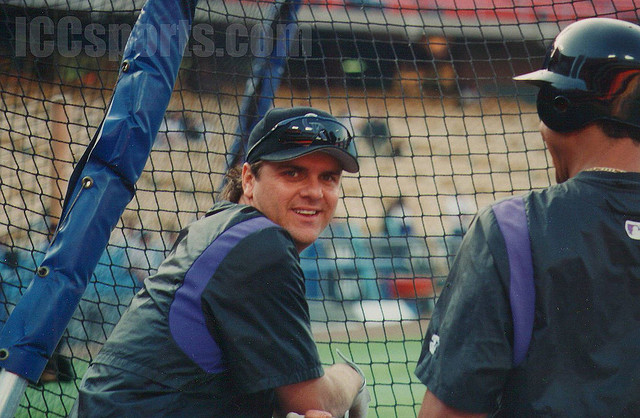
Larry Walker, courtesy of iccsports on Flickr.
This post was inspired by a comment by a HHS reader a few weeks back. Artie Z, talking about Larry Walker, said:
Walker wasn’t just posting a .300/.370/.500 line in Coors – it was a .381/.462/.710 line in Coors. That’s a higher batting average than Cobb and a higher slugging percentage than Ruth. I think the numbers are so disorienting that it makes people think that Rbat isn’t doing its job, but then when you (1) look at how Rbat adjusts other Coors hitters and (2) look at how much better Walker was than those other hitters (other than Helton) it makes a little more sense.
Now, when Rally’s WAR (which was the basis for Baseball-Reference’s WAR) originally was published, I was a bit surprised by Walker’s ranking. I knew he was great, but I think I just did what everybody else did and dismissed him as a legitimate Hall of Fame candidate based on his home park.
The more I’ve looked into his case, the more I realized he’s a Hall of Famer—and not just by a little bit. We now have the ability to adjust offensive numbers based on thier context (era, park, etc.). Even after adjusting Walker’s numbers, he’s Hall-worthy. Actually, if we didn’t adjust his numbers, he’d basically be Stan Musial. People are dismissing his numbers as being more like Dale Murphy. The truth, of course, lies somewhere in between.