1974 Topps #130 Reggie Jackson
Well, we’re back into the truly classical era now, moving to a franchise that was founded in 1901. For our purposes, this poll includes the Philadelphia, Kansas City, and Oakland A’s.

1974 Topps #130 Reggie Jackson
Well, we’re back into the truly classical era now, moving to a franchise that was founded in 1901. For our purposes, this poll includes the Philadelphia, Kansas City, and Oakland A’s.
With the First-Year Player Draft going on as we speak in baseball, I read an interesting tweet from Jay Jaffe a little while ago. Jay tweeted:
last time Astros had 1st pick, they passed on Derek Jeter, took Phil Nevin. Scout/HOF P Hal Newhouser quit in disgust nyti.ms/Ks4x9M.
— Jay Jaffe (@jay_jaffe) June 4, 2012
It got me interested, and it turns out Jeter fell to the Yankees with the sixth pick in 1992. The Astros deserve some slack. The teams that drafted second through fifth picked far worse than they did.
Here’s a treat for you. Following is a graph of Tony Gwynn‘s rolling batting average throughout his career for each 162-game period. The first data point is at his 162nd-career game and gives his batting average for his first 162 games.
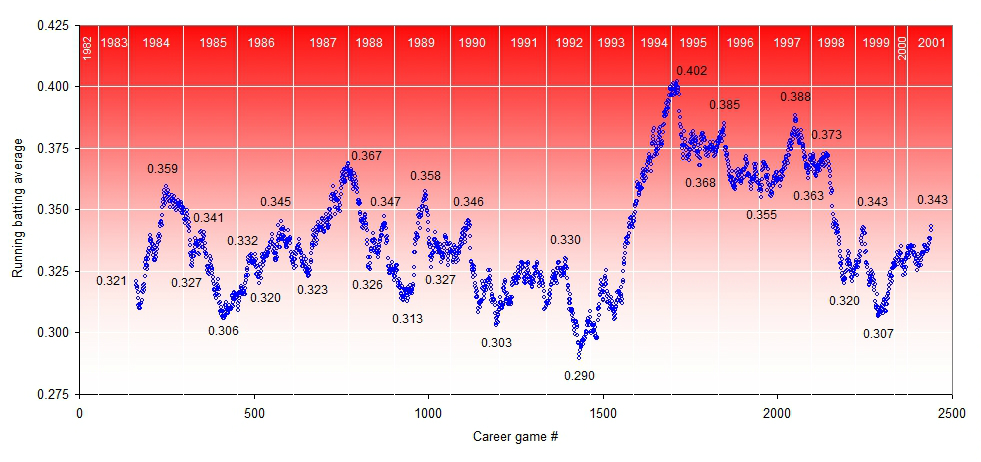
Click on the image for a slightly larger version.
I’ve labeled many of the high and low points. Right away, you’ll notice that Gwynn hit .402 over a 162-game period ending in 1995. From July 27th 1993 through May 13, 1995, Gwynn appeared in 162 games, and had 704 plate appearances. He had 624 at-bats with 251 hits (.402 BA), as well as 15 HR, 100 RBI, 121 runs scored, a .457 OBP and a .563 SLG.
Other notes about the fabulous Mr. Gwynn:
Yankees 5, @Tigers 1: Derek Jeter hit the game’s first pitch over the wall in right, Phil Hughes tossed a 4-hitter for the first 9-inning CG of his career, and Justin Verlander lost a 3rd straight start for the first time since 2008.
A few notes on Saturday’s games.
Orioles 2, @Rays 1: For the first time since last Saturday, the O’s managed to ferry a lead to their lights-out bullpen. Pedro Strop frayed some nerves after inheriting 2 men on with 1 out in the 8th, moving them up with a wild pitch and loading the bases with a walk. But Ben Zobrist hit the first pitch for a GIDP, and Jim Johnson pitched a perfect 9th to snap Balto’s 6-game slide and notch his MLB-high 17th save.
HHS reader Paul E recently identified that Adam Dunn is on pace to obliterate the record for the highest season total of strikeouts and walks, believed to be Mark McGwire‘s 317 (162 BB, 155 SO) in 1998, one of only a handful of seasons above 300. Dunn, though, is currently on pace for 133 BB and 260 SO, perilously close to the 400 mark.
Strikeouts and walks are two of the TTOs (three true outcomes – HRs are the third), so named because a batter’s PA does NOT result in a batted ball being put into play (at least not so that the defense can do anything about it). McGwire’s total in 1998 for all of the TTOs was 387, a mark that Dunn, barring injury, is certainly likely to challenge, if not surpass.
But, what about the opposite end of the spectrum – which hitters have accumulated the lowest TTO totals? I’ll take a look after the jump.
Some quick math, 1962-present
Mets: 26 complete-game 1-hitters
All other teams: 467 complete-game 1-hitters
Mets: 8,020 total games
All other teams: 201,898
So all other teams have produced 467 1-hitters in 201,898 games, or a rate of 0.23% of the time.
The Mets have produced 26 1-hitters in 8,020 games, or a rate of 0.32% of the time.
It may not sound like a lot, but it means that the Mets should have had 18 or 19 1-hitters in their existence instead of the 26 they’ve actually had. What does this tell us? What we already knew–they had been overdue for a no-hitter.
A variously detailed look at a selection of non-no-hitters….
@White Sox 7, Mariners 4: You win this kind of game when you’re on a streak. Jake Peavy cruised into the 7th with a 4-0 lead (1 hit, 2 walks), but it slipped away over the next 2 innings, mainly on big hits by Kyle Seager (who’s hitting lefties as well as righties). Chi fans needn’t have fretted: M’s CF Michael Saunders (who made a great catch in the 7th to start a DP) took an embarrassing facial to start the 8th, and Chicago scored 3 unearned runs after 2 were out.
I had to separate this from the “…by decade” post, due to data limitations. Here are all individual shutout streaks of 3 or more since 1918. Streaks spanning years are included.
By request of HHS reader Brett, here are the longest individual shutout streaks since 1918, broken down by decade. Note that streaks spanning two seasons are included, except those that spanned two decades (because I don’t want to spend my morning editing tables). See separate post for composite list of all shutout streaks of 3 or more since 1918.