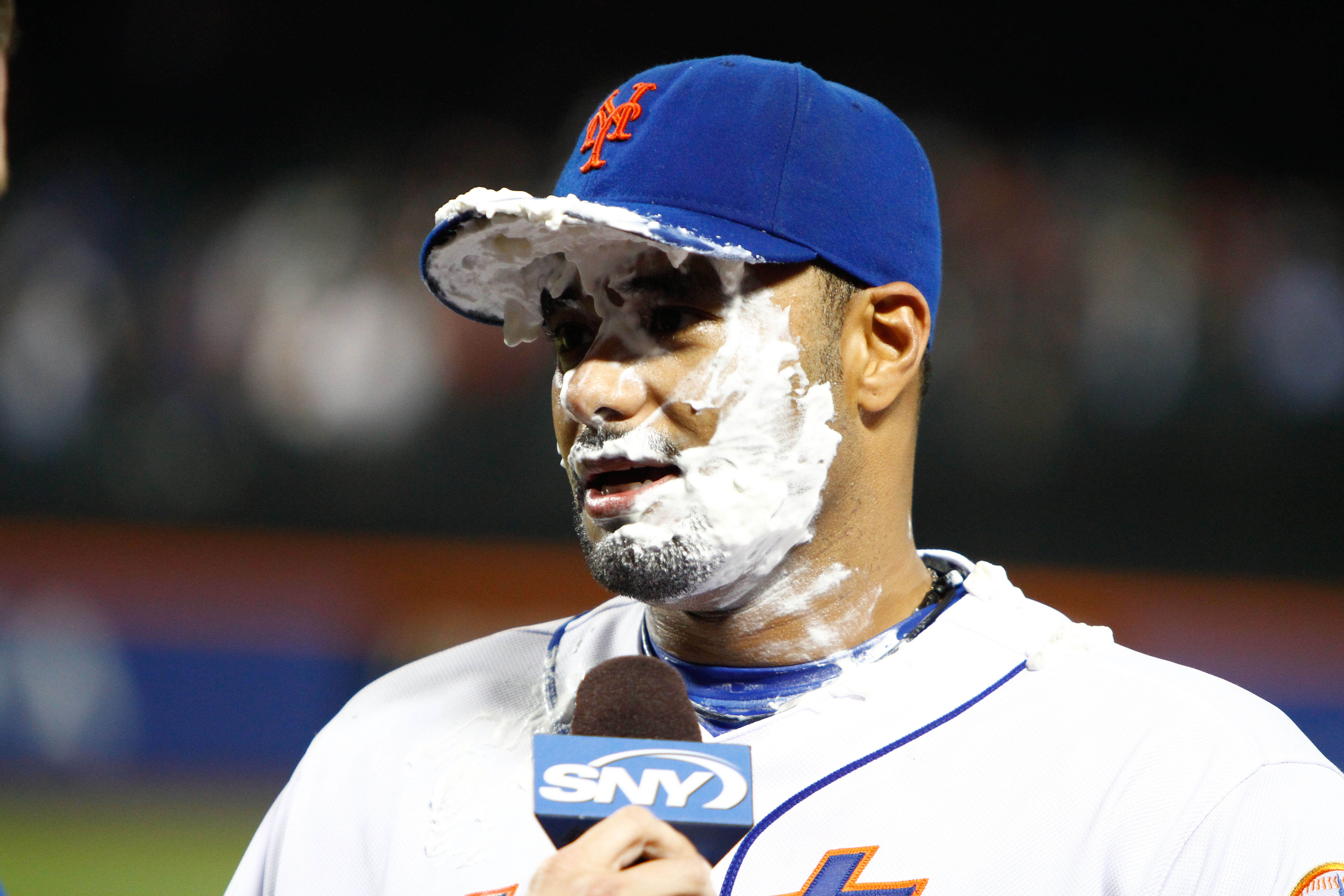
Johan Santana frothing at the mouth in excitement after his no-hitter / USPRESSWIRE
Here are 10 facts about The Mets and Johan Santana following his no-hitter for the Mets. Continue reading

Johan Santana frothing at the mouth in excitement after his no-hitter / USPRESSWIRE
Here are 10 facts about The Mets and Johan Santana following his no-hitter for the Mets. Continue reading
Only 3 games were played Thursday. Let’s see how much can be squeezed out of those box scores.
Tigers 7, @Red Sox 3: Miggy stole, Prince tripled, Delmon homered, Pods hit one over the CF, and the Tigers won a game — what the Sam Hill is goin’ on here?
More K-rate madness: Max Scherzer leads MLB with 11.7 SO/9, and his gross K rate of 29% of all batters faced ranks 3rd among qualifiers (behind Gio & Strassy). Yet he has allowed 10.7 H/9 and a .296 batting average. That combination is completely unprecedented:
Writing about the traditional Triple Crown of baseball — one hitter leading his league in batting average, homers and runs batted in in the same season — may seem like a corny throwback to some readers on this site, as many of you have long since learned to replace batting average and RBI with more nuanced statistics for evaluating player performance. But nostalgia and tradition have their own attractions, and perhaps once we become sufficiently comfortable with the fact that batting and RBI are simply eccentric old stats that are more trivia than important measures of talent, we can also relax and have a little harmless fun with them.
In that spirit, I propose to revive the old Triple Crown, which seems to have become well nigh un-achievable in its traditional, league-leadership form, by moving it to the division-leadership context, where a Triple Crown remains very difficult to pull off in contemporary baseball but is at least possible. It seems to me acceptable to treat the six divisions as the equivalent of the old pre-1969 leagues in this respect. After all, the divisions have served much the same purpose since 1969 as the leagues did from 1901 through 1968. The six divisions are the current settings for the race to first place over the long regular season, just as the leagues were before 1969. If a player can lead his division over a full season in BA, HRs and RBI, I would argue his achievement is reasonably comparable to the league-wide Triple Crown of pre-division days. Details, including the historical division Triple Crown winners, after the jump. Continue reading
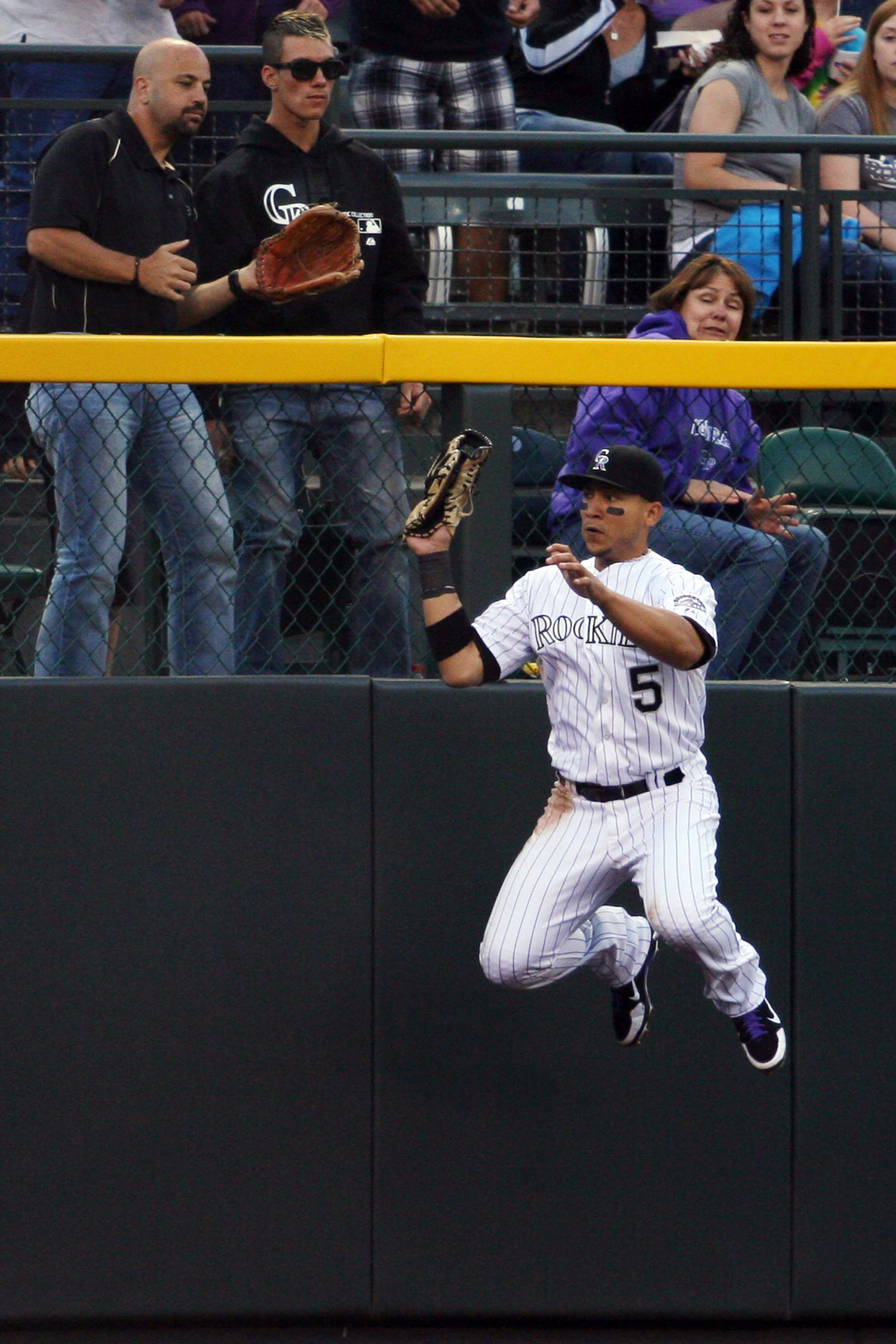
Here’s a great photo of Carlos Gonzalez catching a fly ball yesterday.
Photo credit: Chris Humphreys-US PRESSWIRE
Yesterday’s radio interview is now available online here. Right now it’s playing in the main media player on that page (5/31 show). At some point it will get archived further down that page as the Week 4 show.
My appearance starts around the 39-minute mark.
I love the 1989 film Major League. I’ve seen it maybe 20 times since childhood to the point that watching it is now more or less an annual ritual. There’s no suspense for me at this point, I’ll admit, as I could probably transcribe much of the script from memory. I know well the story of how a ragtag Cleveland Indian team is culled from the Mexican League, correctional system, and beyond to deliberately lose to spur relocation and how the players begin to win after learning of the ruse. It’s Hollywood contrivance to a large degree, though I also assume there’s some truth in it.
I interviewed Joe Posnanski in 2010, and one thing he told me (that I left out of the interview I published) is that some of the hardships for the club in question, such as a dilapidated team plane, drew from the 1977 Indians. I also assume there’s enough decent players outside of the majors right now to stock a team. This post offers a 25-man roster of such players, life imitating Major League, we could call it.
 Ted Kluszewski was among the most feared NL hitters of the early and mid 1950s. In his best 4-year run from 1953 to 1956, he compiled 148 OPS+ while batting .315 with 171 HR and 464 RBI, ranking, respectively, 4th, 3rd, 1st and 2nd in the NL for those categories.
Interestingly, though, Ted is a member of two quite different groups of hitters. After the jump, you’ll see what I mean.
Congratulations to JoshG and John Autin! JoshG identified that Ted Kluszewski is one of just 8 hitters since 1946 with a season of 30 or more HR and fewer strikeouts than HR (Kluszewski had 4 such seasons; only DiMaggio had more, with 6, including 5 in a row in 1937-41). John Autin got the second part of the quiz, identifying that Kluszewski also (probably surprisingly) is one of just 12 hitters since 1946 with a season (min. 502 PA) of 10 or fewer HR and also 25 or fewer of both strikeouts and walks. Kluszewski had such a season in 1949. Glenn Beckert and Don Mueller lead the way, each with 3 such seasons.
I will be appearing on ESPN Radio 1510 AM in Kansas City tonight to discuss the results of our Royals Mount Rushmore poll. The folks from the Kansas City Baseball Vault have invited me on as a guest and I expect to be heard around 7:30 ET / 6:30 CT.
You can listen live at 1510.com or, if it’s already aired, check out the show archive at the link above.
I just did a manual workup of all 3-homer games since 1992, split out by team’s home stadium. Note that this doesn’t take into account stadium changes–for example the numbers for Washington include all 3-HR games by Expos or Nats hit at home, and all 3-HR games by visitors at the Expos’ or Nats’ home stadium.
Team   H    V   Total
CHC    9    8   17
COL    8    9   17
TEX    9    7   16
CIN    9    6   15
BOS    6    5   11
TOR    6    5   11
MIL    7    3   10
PHI    2    8   10
CLE    5    3    8
ARI    4    3    7
BAL    3    3    6
DET    3    3    6
KCR    0    6    6
NYY    5    1    6
WSN    2    4    6
ATL    1    4    5
CHW    1    4    5
HOU    2    3    5
LAD    3    2    5
SEA    2    3    5
STL    3    2    5
OAK    3    1    4
SDP    1    3    4
LAA    2    2    4
PIT    1    2    3
SFG    1    2    3
TBR    2    1    3
FLA    1    1    2
MIN    0    2    2
NYM    0    0    0
So these are 3-HR games by home-team players, and by visiting players, and the total.
Check out the disparities for the Brewers, who have hit a lot more at home than their visitors have, and the Phillies, who have yielded a lot more at home than they’ve hit.