Monday Night Baseball (roundup)

The anticipated duel between multiple Cy Young Award winners went off the rails early, as Tim Lincecum yielded 4 runs on 4 hits and a walk before getting the second out. He settled down, but finished by allowing 5 runs in 6 IP, the third straight time this year that he’s allowed 5+ runs (and fourth straight dating to 2011). He has not otherwise been touched for 5+ runs more than two straight starts at any point in his career.

  • Does anyone answer the Opening Day bell better than Roy Halladay? Since 2007, his record in his first three starts is 15-1 with a 1.97 ERA and 0.96 WHIP.
  • Continue reading

The illustrated all-time team

High Heat Stats contributor Graham Womack has published a wonderful piece on his blog, Baseball Past and Present, called the All-Time Dream Project. He logged more than 600 votes to come up with the top players at each position, and got an excellent team of writers to write something on each of the winners.

What’s that? You want more? Well he also commissioned artwork from Sarah Wiener for each of the winners, and you can even pick up a set of the trading cards.

Check out this wonderful post at the link above.

Monday morning action & random stuff

In the annual Patriots Day game in Fenway, Daniel Bard issued 7 walks (a new game high for this year) in 6.2 innings. His last two walks, to Carlos Peña and Evan Longoria, pushed in the game’s only run.

  • Boston’s last 1-0 home loss was to the Yankees in July 2008, when Joba Chamberlain outdueled Josh Beckett for 7 innings.
  • Their last 1-0 home loss on Patriots Day was in 2000.
  • James Shields got the first out in the 9th, but walked a batter and was lifted. The last CG shutout by a visitor in Fenway was a 2009 3-hitter by Roy Halladay.
  • The game ended with Cody Ross looking at 3 strikes from Fernando Rodney with the tying and winning runs on base. It was the second time in the game that Ross took 3 strikes.
  • Rodney finally allowed a baserunner — an intentional walk to David Ortiz, who had 2 HRs in 11 prior meetings with Rodney.
  • The Rays are 3-0 on Patriots Day in Fenway.
  • I love the fact that Joe Maddon has Peña batting #2 in the order. You can have all the Darwin Barneys and Elvis Andruses with their “bat control” and their .320 OBPs; give me a #2 hitter who makes the pitcher sweat.

Continue reading

Derek Jeter has been raking since passing 3,000 hits

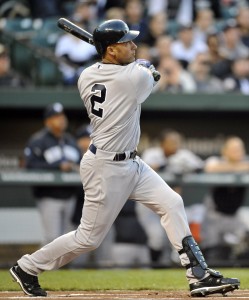
Derek Jeter / PRESSWIRE

Since Derek Jeter reached 3,000 career hits on July 9th, 2011, he has played in 73 games. His numbers over those games are:

334 PAs, 43 RBI, 47 R, 5 HR, .331/.383/.450

Very impressive, especially considering how poorly he hit in 2011 before reaching 3,000 hits (66 games, 312 PAs, 22 RBI, 40 R, 2 HR, .257/.321/.329).

I thought I’d compare Jeter’s post-3000 performance with other recent players to surpass that same total, to see if they, too, hit well when the individual pressure was off.

Craig Biggio played in only 69 more career games after reaching 3,000 hits in 2007. Over those 69 games, his line was a dreadful 249 PAs, 23 RBI, 23 R, 5 HR, .253/.260/.362.

Rafael Palmeiro played in only 22 more career games after reaching 3,000 hits in 2005. Over those 22 games, his line was a fairly horrid 90 PAs, 9 RBI, 7 R, 3 HR, .241/.322/.380.

Rickey Henderson reached 3,000 hits on the final day of the 2001 season, coming on October 7th after the season had been delayed due to the events of 9/11/2001. He played 102 more games in his career, with a line of 306 plate appearances, 21 RBI, 47 R, 7 HR, .219/.356/.339. Rickey could take a walk right up until the end, but that’s about all he could manage.

Cal Ripken reached 3,000 early in the 2000 season and played in 201 additional career games. Over those games he had 811 PAs, 118 RBI, 79 R, 27 HR, .246/.289/.396 (not incredibly bad.)  To compare to Jeter, if we look at just the 85 games right after he reached 3000 hits, Ripken’s line was 337 PAs, 54 RBI, 38 R, 13 HR, .242/.291/.419. Good, but especially coming in a higher offensive environment than Jeter’s playing in right now, not nearly as good.

Wade Boggs appeared in just 10 more games after reaching 3,000 in August of 1999. Over those 10 games, he did quite well, with 33 PAs, 3 RBI, 2 R, 0 HR, .345/.394/.448. Those numbers are comparable to Jeter’s, but over many fewer plate appearances.

Tony Gwynn played in 156 more games after reaching 3,000 hits. Check out this line: 443 PAs, 63 RBI, 51 R, 7 HR, .337/.377/.476. Not too shabby.

Jeter seems intent on playing at least a couple more seasons. If he can stay reasonably healthy and play reasonably well, he has a shot at becoming just the 6th player to reach 3,500 career hits.

Run, Don’t Walk – First Base Ahead

Following up on the Imperfect Trifecta post, thought I’d give Rollins and Pierre a break and let some others share the limelight. The guy on the left was one of our faves back at the B-R Blog, a player with some quite unusual statistical characteristics, although not ones customarily associated with winning.

WARNING: This post is definitely written tongue in cheek. My apologies, in advance, if you are offended by the tone – not my intention, just having a bit of fun.

This post is about players who simply abhor walking. At any cost (and it’s often substantial). Instead, these purists insist on getting on base (or trying, at least) the difficult way, with their bats and their legs. Alas, it is an awfully hard chore for many of them.

Continue reading

4/15/1947, or “Why are they all wearing #42?”

Of all the words of baseball history I’ve come across, I think the most beautiful are these attributed to then-NL President Ford Frick, responding to rumors of a boycott against Jackie Robinson:

I do not care if half the league strikes. Those who do it will encounter quick retribution. All will be suspended and I don’t care if it wrecks the National League for five years. This is the United States of America and one citizen has as much right to play as another.

The National League will go down the line with Robinson whatever the consequences. You will find if you go through with your intention that you have been guilty of complete madness.

Continue reading

Baseball’s 20 Year Reunions

Many of us have probably been to our 20 year (or more) high school reunion. There are some people you may have stayed in touch with all those years, others may have crossed your path just a few times, but for many of your classmates it could be the first time you’ve met since high school.

It can be like that in baseball too. Except, there aren’t nearly as many on-field reunions because most players don’t stay in the game for 20 years. Even when they do, their playing time at either or both ends of their careers can make reunions with other specific players pretty unlikely. And, of course, there’s always the difficulty of being in different leagues. But, it does happen sometimes. After the break, you can take a look at pairs of players who have appeared together in games separated by 20 or more seasons. Which players do you think have had the most “reunions”?

Continue reading