Over the Hill At 20? Jason Heyward and Claudell Washington

In his age 20 season, 2010, Jason Heyward produced 5.2 Wins Above Replacement, according to baseball-reference’s formula (5.1 using the fangraphs formula).  That’s All-Star level production for a player of any age, and extremely high production for a twenty-year-old. More on high-WAR 20-year-olds, and their future, after the jump. Continue reading

Stat Challenge #2 (for real this time!)

OK, I have posted another stat challenge, and you can join it right here. As Insert Name Here suggested I have opened it to the public so we may get some competition from folks who don’t read the blog. It is free to enter.

Speaking of the blog, we had some downtime this morning for reasons still unknown, but I am suspicious of the live chat plugin since I just installed that yesterday. I have disabled that live chat for now while we investigate. (You can still post comments on the chat thread.)

I have also entered a $1 challenge that has 1000 entrants and a lot of cash prizes. I didn’t create this league. If you feel like it, you can enter that one here.

As a reminder, if you don’t have a FanDuel account, please use this link to sign up as High Heat Stats gets a referral bonus.


The Last Hurrah: Late Career Revivals

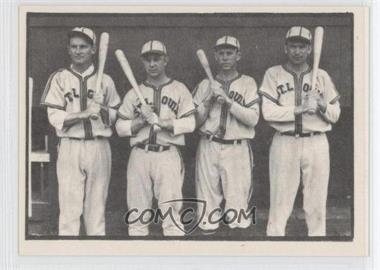
Richard Chester had a recent guest post concerning George McQuinn, 1st baseman in the 30s and 40s, mostly for the Browns and Yankees. That’s George on the left, with Chet Laabs, Harlond Clift and Wally Judnich, all regulars for the 1940-42 Browns. Looking at McQuinn’s career, specifically his standout 1947 season at age 38 with the World Series champion Yankees, reminded me of something Bill James wrote about in his Abstracts back in the 80s. James called it the “Last Hurrah” phenomenon when aging players, having started their inevitable decline phase, suddenly have a bounce-back year reminiscent of their younger days.

Continue reading

Was Brad Ausmus a good catcher?

Just looking at Brad Ausmus’ apparent effect on pitchers.

Roy Oswalt in his career: 3.21 ERA, .687 OPS
Roy Oswalt with Ausmus catching: 3.04 ERA, .685 OPS

Shane Reynolds in his career: 4.09 ERA, .742 OPS
Shane Reynolds with Ausmus cstching: 4.16 ERA, .728 OPS

Mike Hampton in his career: 4.06 ERA, .741 OPS
Mike Hampton with Ausmus catching: 3.36 ERA, .709 OPS

Jeff Weaver in his career: 4.71 ERA, .780 OPS
Jeff Weaver with Ausmus catching: 4.86 ERA, .783 OPS

I picked a few pitchers who threw a lot of their career innings to Ausmus. There doesn’t seem to be much of a trend. Obviously these data should be taken very lightly, as they don’t correct for context and the career numbers cover a lot of territory (for example Mike Hampton was a very different guy during the years he teamed with Ausmus).

If you look at specific teams and years, teams have vastly better numbers with Ausmus as the receiver than with other catchers, but this is because other catchers usually caught the 5th starter.

Anyway, I’m curious how a study like this would play out if done fully and correctly, and how much of a difference in ERA or OPS against would be significant.

Stat Challenge #2

Thanks to those of you who participated in our first stat challenge. The results are here, with insertnamehere edging me out to win the league.

Our next challenge is for games on Sunday and you have until about 1pm then to enter. It’s free. To enter click here. If you need to create a FanDuel account, please use that same link as High Heat Stats gets a bonus when you do.

Coming soon, we’ll be providing a prize for these Stat Challenges, so get your practice in now.