Baseball stats for beginners: the importance of home/road splits

What do you think of these two players:

Player A: 9014 plate appearances, 414 doubles, 416 homers, 1604 RBI, .320 BA, .920 OPS

Player B: 9102 plate appearances, 332 doubles, 348 homers, 1298 RBI, .277 BA, .789 OPS

Look at that difference in OPS–huge, right? Player A drove in a lot more runs with a much higher batting average.

Among players with 9300 to 9700 career plate appearances, the player with the closest OPS to Player A is Al Simmons. The player with the closest OPS to Player B is Ted Simmons. That’s a pretty good representation of those numbers–Player A is a Hall of Famer while Player B is merely “really good”.

So who are these two players really? Continue reading

The Complete List of Normalized Strikeouts (min. 1000 IP)

On Thursday I posted the leaders for normalized strikeouts along with their adjusted career strikeouts. At the time I wanted to make the  entire list available to everyone, but due to technical issues, this was not possible. Today it is.

Thanks to a new plug-in added by Andy the entire list of pitchers is now available, sortable and searchable on this page.

You can also find it listed under “Stats” in the bar on top of the page.

Living in the Postseason – Pitchers with the Highest Percentage of Career IP Coming in the Postseason

The 2011 postseason was quite a ride for Rays pitcher Matt Moore. Not only did Moore pitch 7 dominant innings in game 1 of the ALDS vs. Texas, his 3 relief innings in game 4 gave him 10 postseason IP, more than he had thrown in his regular season career. Moore is the extreme, but there are plenty of active players who have pitched a significant part of their careers in the postseason.  This is particularly true for young pitchers of the Texas Rangers. Here are the pitchers who have the highest percentage of their career innings (regular + postseason) coming in the postseason. All stats were derived from information in the Lahaman Database. Continue reading

The Hall of Fame case for Paul Konerko

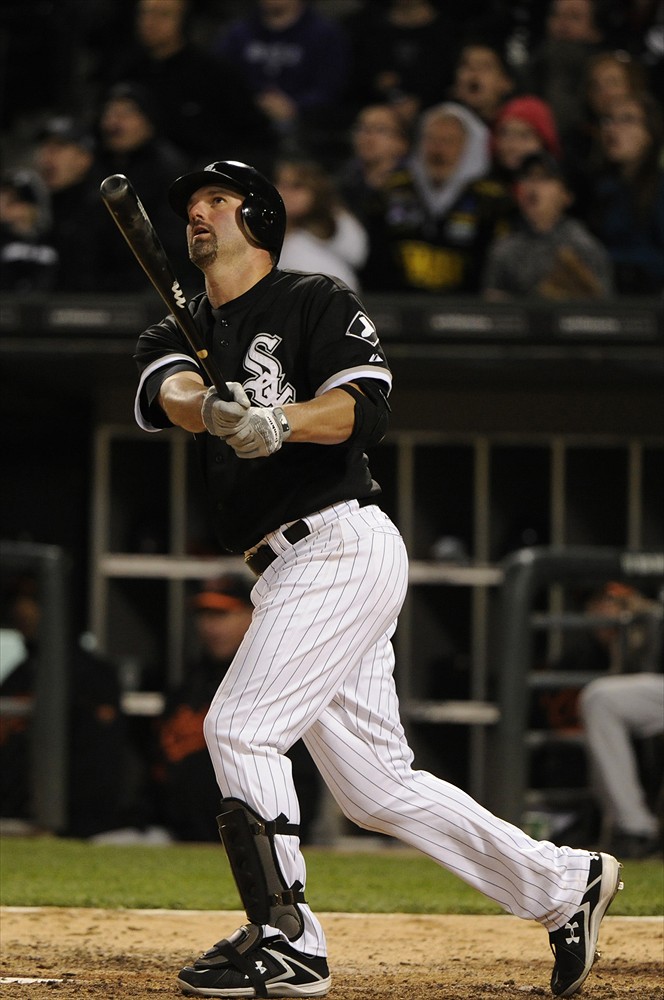
Paul Konerko homering / Icon SMI

Paul Konerko was a first-round draft pick by the Dodgers in 1994. Coming into the league with high expectations, he bounced around early, first getting traded to the Reds and later to the White Sox. He was a good player for Chicago from 1999 to 2002, playing second fiddle (and sometimes even third or fourth fiddle) to Frank Thomas, Magglio Ordonez, and even Carlos Lee.

Then, in 2003, as Konerko was in what should have been his prime Age 27 season, he posted a stinker instead. He had a .234 batting average, 83 OPS+, and lead MLB with 28 GiDPs.

Many people wrote him off at that point, figuring he’d never recover enough to become a star. And yet–that’s exactly what he’s done. Quietly, he’s posted some fantastic seasons lately and may have crept into consideration for the Hall of Fame. Continue reading

Batters control strikeouts more than pitchers

In 2011, there were 185,245 plate appearances and 34,488 strikeouts, meaning that 18.6% of PAs resulted in strikeouts. This number is obviously the same whether you look at it from the batters’ standpoint or the pitchers’–both groups averaged the same 18.6% strikeout rate.

Among batters, though, we know there is a large variation in strikeouts. Among those who qualified for the batting title, Drew Stubbs (205) and Mark Reynolds (196) led the way while Juan Pierre (41) and Jose Reyes (41) had the fewest. That range of a factor of 5 is larger than that of pitchers. Among starters who qualified for the ERA title, Justin Verlander (250) and Clayton Kershaw (248) had the most while Brad Penny (74) and Josh Tomlin (89) brought up the rear. (Penny and Tomlin also pitched many fewer innings, and their K/9 rates were even closer to the leaders’.)

Click through for a histogram of the 2011 season broken down.

Continue reading

Crowning New Strikeout Kings – Fully Normalized Strikeout Leaders

Cy Seymour was arguably one of the best pitchers turned hitters that baseball has seen, yet he remains almost forgotten. Before he was a centerfielder, the 1905 NL batting champ started his career as pitcher in 1896. Seymour pitched 3 full seasons and had the league leading strikeout rate in all three. Even though Seymour’s career strikeout rate does not look impressive, when strikeouts are normalized, his rate is the best baseball has ever seen (1871-2011 min. 1000 IP). (For a biography and analysis of Seymour’s career, see this wonderful piece by Bill Kirwin.)

Andy’s recent posts on normalizing strikeouts piqued my interest and I thought that it might be interesting to normalize the strikeouts for every pitcher in major league history. This was done by using the Lahman Database and applying the following method:

  • For each league in each season I calculated the league rate of SO/IP.
  • Each player in that league was assigned an expected number of strikeouts based on his IP  that season.
  • Each player’s season-by-season expected strikeouts were added up for his career and compared it to his actual career totals.

Using this method provides us with the following leaders in ratio of SO:Expected SO (min. 1000 IP)  since 1871. Continue reading