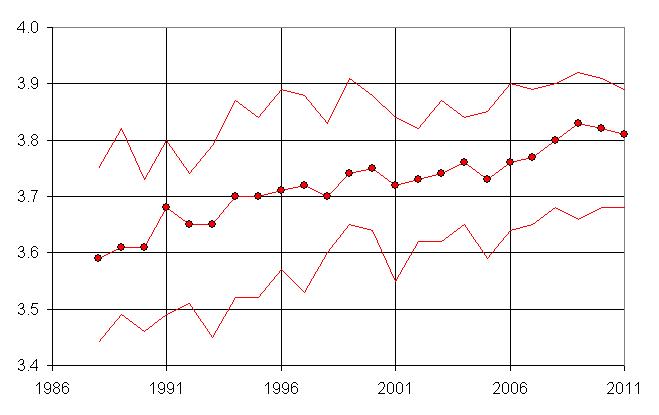
Here’s a plot showing the average pitches per plate appearance across all of MLB going back to 1988:
Click through for discussion.
Continue reading
Here’s a plot showing the average pitches per plate appearance across all of MLB going back to 1988:
Click through for discussion.
Continue reading
The Great Wall of China is one of the most highly visited tourist attraction in Beijing, China. It’s the symbol of China, because anytime you see the image of the Great Wall, then you definitely realize that image has something to do with China.
The Great Wall is recently added to the one out of the twenty one finalists operating for that New Seven Wonders of the World to get determined in July 2007. I firmly believe that the Fantastic Wall of China would make it to this checklist, as this monument is deemed to become one of the most appealing sights all over the world because of its architectural and historical significance.
Enlisted in the World Heritage site by UNESCO in 1987, the Great Wall winds up and down stretching across hills, lowlands, deserts and plateaus extending from the eastern border of China to its western border; having a history of about 2500 years ago to the time of the Warring Period, the Great Wall has served China a great goal regarding defense in the ancient time and it is really now one of Chinas most booming tourist destinations.
The historical past of the Great Wall of China displays how history, culture, defense and political administration are intertwined to finally bring out a site which now serves for entertainment and leisure purposes.
Since the Great Wall stretches across various provinces, the identical goes for the very best time to visit website; the scenery from across the wall in various seasons is different and allows you to determine the amazing and huge landscape of China. In spring time, all the plants and trees are lush green with gorgeous displays of the wall looking fresh in bright green colors. Spring time is constantly the best time for you to visit the Great Wall because the wall isn’t constantly crowded with travelers.
In summer and autumn, the flowers and plants are more blooming than other intervals of the year and a view from over tends to make the wall look like an extended silver necklace. This time is always the best time for you to climb the Great Wall.
Fall is also a terrific time to pay a visit to the Wall since the peaks and hilltops are displayed in colors making an incredible and excellent view.
Winter which can be generally the most effective time to view the entire length of the wall turns the landmark to snowy frosted scenery. Most tourists usually do not wish to go to at this time simply because of the bitter winter cold.
To travel and see the stunning landscapes on the Great Wall of China, you have to climb it from the most accessible section. One of the most common sections of the Great Wall for visitors are at the Simatai sections, Badaling sections and the Mutianyu section. These sections have all played their roles during the construction and destruction of the Great Wall of China during the revolution.
The Simatai section, northeast of Beijing is the quiet section of the wall which is still preserved the way in which it was since hundreds of years ago; this is the reason why it is good to take a long quiet stroll on this area.
The Badaling section of the Great Wall was the very first section to be opened to travelers and locals; this is why a lot of vacationers come to this component of the wall.
The Mutianyu section will be the furthest section of the Fantastic Wall; this region is the greatest area of the Great Wall that is still getting preserved and has a reduced number of visitors due to the distance.
Several travelers from around the world are eager to go to and climb the Great Wall of China. For foreign visitors interested in this travel project, it’s ideal to seek out the solutions of the trustworthy tour operator in China to help you make the arrangements. You can find a broad number of package tours designed to fit your Great Wall of China Tour and making it a memorable one.
As a followup to this post, I thought I’d run a few tables of leaders at stranding inherited runners in recent years and all-time.
Andy’s and John’s posts from earlier today made me curious about the career stats of pitchers who debuted with a shutout. Since 1919, 44 pitchers have thrown a shutout in their pitching debut (1 was a five inning game another a seven inning game, the rest were 9 innings). 1/4 of those pitchers never won 5 games in the majors, including 4 who never won another game. Here are the career stats for the 44:
What two-tiered achievement is shared by Mike Norris and Dave (Boo) Ferriss, and no other MLB pitcher?
(The mystery has been solved — congratulations to regular contributor Richard Chester. Click through for the answer.)
At Andy’s suggestion (see comment #17 here), I did a quick-and-dirty study of late-career walk rates for players who finished with around 3,000 hits.
The hypothesis to be tested is that players approaching both 3,000 hits and the end of their career tend to walk less often than they did before.
Included in the study were 30 players who wound up with 2,800 to 3,200 hits. I excluded those whose careers ended before “3,000 hits” became an iconic target (i.e., Sam Crawford and Willie Keeler).
I calculated their walk rates (BB per 700 PAs) for 4 periods:
Any period with less than 200 PAs is presented as “n/a” in the table. (Apologies for the table formatting, which I can’t seem to control.)
Walk Rates for Players Who Finished with 2,800 – 3,200 Hits
|
Hits |
BB per 700 PAs |
Player | |||
|
Career |
Last |
Last |
Last |
||
|
3184 |
64 |
36 |
40 |
35 |
Cal Ripken |
|
3154 |
69 |
51 |
41 |
45 |
George Brett |
|
3152 |
70 |
103 |
n/a |
n/a |
Paul Waner |
|
3142 |
54 |
62 |
59 |
60 |
Robin Yount |
|
3141 |
54 |
48 |
53 |
n/a |
Tony Gwynn |
|
3110 |
70 |
60 |
69 |
n/a |
Dave Winfield |
|
3088 |
63 |
61 |
57 |
53 |
Derek Jeter |
|
3060 |
69 |
39 |
38 |
29 |
Craig Biggio |
|
3055 |
115 |
118 |
112 |
n/a |
Rickey Henderson |
|
3053 |
66 |
79 |
81 |
86 |
Rod Carew |
|
3023 |
49 |
38 |
37 |
37 |
Lou Brock |
|
3020 |
77 |
86 |
84 |
71 |
Rafael Palmeiro |
|
3010 |
94 |
75 |
72 |
80 |
Wade Boggs |
|
3007 |
78 |
66 |
67 |
72 |
Al Kaline |
|
3000 |
42 |
46 |
40 |
49 |
Roberto Clemente |
|
2987 |
48 |
56 |
46 |
53 |
Sam Rice |
|
2943 |
83 |
108 |
123 |
n/a |
Frank Robinson |
|
2935 |
139 |
175 |
178 |
194 |
Barry Bonds |
|
2930 |
77 |
80 |
81 |
n/a |
Rogers Hornsby |
|
2927 |
45 |
37 |
38 |
n/a |
Al Simmons |
|
2884 |
46 |
42 |
38 |
46 |
Zack Wheat |
|
2880 |
49 |
63 |
68 |
n/a |
Frankie Frisch |
|
2876 |
106 |
90 |
n/a |
n/a |
Mel Ott |
|
2873 |
135 |
146 |
154 |
n/a |
Babe Ruth |
|
2866 |
66 |
76 |
74 |
n/a |
Harold Baines |
|
2848 |
51 |
48 |
30 |
n/a |
Brooks Robinson |
|
2844 |
35 |
31 |
33 |
n/a |
Ivan Rodriguez |
|
2841 |
61 |
51 |
53 |
n/a |
Omar Vizquel |
|
2839 |
76 |
117 |
121 |
n/a |
Charlie Gehringer |
|
2812 |
37 |
35 |
34 |
34 |
George Sisler |
Over all, I do not see a consistent pattern that would confirm the hypothesis. But the following players did have a marked decline in walk rate in their later years:
Compared to the 3 preceding years, Cal Ripken‘s walk rate fell by 54% in 1999, the year when he would have reached 3,000 hits if not for a couple of DL stints. (He got hit #2,991 in game #149, but played no more that year.) Ripken averaged 57 BB/700 PAs for the preceding 3 years, but that rate fell to 26 in 1999 (13 walks in 354 PAs). If he was pressing, though, it sure didn’t affect his hitting — his .340 BA, .584 SLG and .952 OPS were all career highs, and his SO rate was a couple of % points below his career rate.
Ripken got hit #3,000 in the 10th game of 2000. In the previous 9 games, he drew a normal 4 walks in 39 PAs.
George Brett‘s walk rate fell 46% from the prior 3-year average in 1992, the year in which he reached 3,000 hits on Sept. 30 with a 4-hit game. Brett averaged 71 BB/700 for the prior 3 years, but just 38 that year. And his BB rate was even lower in the run-up to that game — 7 walks in 229 PAs from August 1 to Sept. 30, and none at all in the 20 games immediately before the big one.
After a sterling ’92 capped by a go-ahead hit in WS game 7, Dave Winfield began 1993 needing 134 hits for 3,000, having averaged 72 BB/700 PAs for the previous 3 years. That rate fell to 53 in 1993, but coincided with a general decline in performance. There was no particular variance in his walk rate in the 20 to 50 games leading up to hit #3,000.
Craig Biggio began 2007 needing 70 hits for 3,000, having averaged just 42 BB/700 PAs for the prior 3 years (already well below his previous career average of 71). In 2007, his final year, Biggio’s walk rate dropped further, to 29 BB/700 PA. In the 30 games culminating in hit #3,000 (and a baserunning boo-boo), Biggio was hacking to the tune of 3 walks and 26 Ks in 118 PAs.
Well, I was going to write up a few more, but I ran out of time….

Here are players who posted a very strong 1st or 2nd season (specifically they had to be among the 172 guys since 1901 to qualify for the batting title with an OPS+ of at least 125 in either year) but finished with a career OPS+ no higher than 110: Continue reading
Former major-leaguer Danny Clyburn, who sadly died yesterday, hit only 4 major-league homers, but he hit them off some really good pitchers:
| 1998 HRs | Date | @Bat | Pitcher | Score | Inn | Out | Pit(cnt) | RBI | WPA | Play Description | ||
|---|---|---|---|---|---|---|---|---|---|---|---|---|
| 1 | 1998-09-25 | BAL | @ | BOS | Tim Wakefield | behind 0-4 | t 4 | 2 | 5,(1-2) | 1 | 0.055 | Home Run (Line Drive to Deep LF Line) |
| 1999 HRs | Date | @Bat | Pitcher | Score | Inn | Out | Pit(cnt) | RBI | WPA | Play Description | ||
| 2 | 1999-04-11 | TBD | BOS | Derek Lowe | tied 4-4 | b 8 | 2 | 3,(1-1) | 1 | 0.298 | Home Run (Fly Ball) | |
| 3 | 1999-04-17 | TBD | @ | BOS | Mark Portugal | behind 0-4 | t 4 | 1 | 1,(0-0) | 1 | 0.059 | Home Run (Line Drive) |
| 4 | 1999-05-08 | TBD | @ | CLE | Mark Langston | ahead 5-2 | t 5 | 0 | 2,(1-0) | 1 | 0.063 | Home Run (Fly Ball) |
Three of his four homers came against the Red Sox, and all 4 pitchers were good.
Our recent discussion about Lou Brock a couple of questions about comparisons with Craig Biggio, who himself will be eligible for the Hall of Fame for the first time coming up soon. In short, there really is no comparison.
At first glance, Brock and Biggio have a number of similarities:
After that high-level view, though, Biggio really separates himself from Brock (and most other players) when you dig into the details. Continue reading