Jacques arrêté les Rouges

Arrêté is French for stop, and that’s what Jake Arrieta did to the Reds on Thursday, holding Cincinnati hitless as the Cubs pounded their opponent by a 16-0 count. It’s the first no-hitter of the new season, the second of Arietta’s career, and his second in eleven regular season starts. The win pushes Arrieta’s record to a perfect 4-0 in four starts this season, with a microscopic 0.87 ERA.

More on Arrieta’s gem after the break.

Continue reading

Early-Season Oddities in 2016

For the April 20-26 issue of USA Today Sports Weekly, Andy analyzed league-wide stats after each team’s first 10 games of the 2016 season. He explains what has made this year unique and how playing style continues to evolve.

Here is the link to the column. High Heat Stats is contributing to the magazine every week this season, so stay tuned for future links or consider picking up a print copy.


The weird and the wonderful: a quick early season review

Two weeks into the new season and the clubs with the longest current winning streaks are the Braves and Twins. Which is interesting because both those clubs lost their first 9 games, only the second time since 1913 that two teams have stumbled so badly out of the gate.

More quirky tidbits from the young season are after the jump.

Continue reading

The distribution of all home run hitters in MLB history

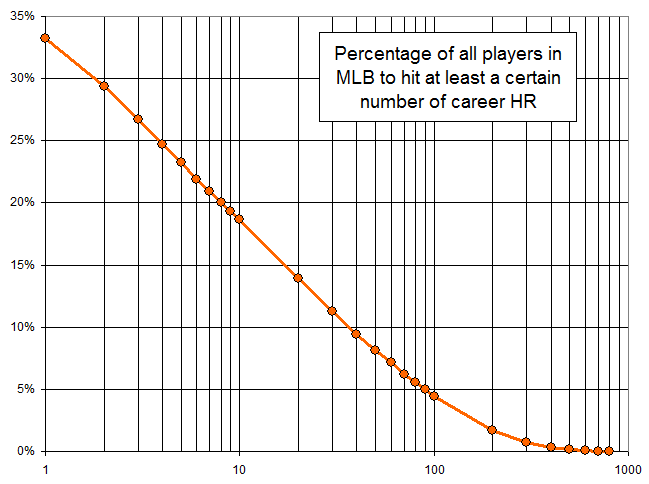
Here’s a relatively simple plot showing the percentage of all 18,690 MLB players in history to hit “X” home runs. In other words, about 33% of all players hit at least 1 homer, about 29% hit at least 2 homers, etc. Some other key numbers: 19% hit at least 10, 4.4% hit at least 100, and 0.16% have hit at least 500.
thismanyHR

It’s unsurprising that the curve is linear for the middle section–with around 3,000 players to hit 10+ homers, we see a smooth and expected distribution with so many data points. I assume the lower end of the curve at 1 and 2 homers falls off because there is an unusually high number of players to hit very few homers. This includes lots of pitchers and other players who had only a cup of coffee and managed only a dinger or two. The high end of the curve fails to fall off linearly I assume because players who hit a fair number of homers tend to be the ones who are selected to stick around in MLB and therefore hit even more. The hitting of homers isn’t simply a random event distributed over the entire population–certain players are selected to remain in MLB, and the longer a guy sticks around, the more likely it is that he hits homers at an above-average pace.

Run, Don’t Walk

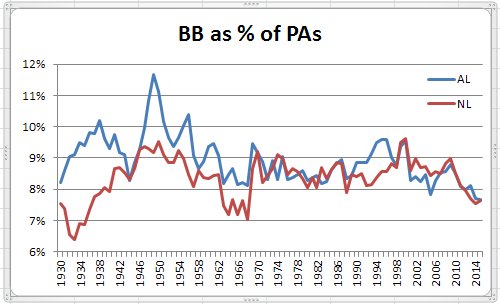
MLB walk rates are at historic lows, another artifact of a declining run scoring environment. Rates below 8% of PAs have been recorded in both leagues for the past two seasons, levels not seen since the 1960s in the NL, and not seen previously in the AL in the live ball era.

BB per PA 1930-2015

More after the jump.

Continue reading

Jays-Rays: “slip sliding away” or “breaking up (a double play) is hard to do”

The new “Chase Utley” slide rule was applied in Tuesday’s Jays-Rays game, and raised some immediate controversy, not least because the offending slide was among the most gentlemanly you’re likely to see in an attempt to break up a double play.

After the jump, it’s your turn to weigh in on the new rule.

Continue reading

WAR and WAR/162 rankings over 2013-2015

I just ran some numbers to see what they show. I took the 191 players to play at least 324 games (2 seasons’ worth) over the last 3 years and ranked them by their WAR total (ugh, Skip Schumaker!). Then I calculated their WAR per 162 games played. Finally, I sorted the results by ranking difference between their raw WAR total and WAR/162 value. Players at the top of this list jumped up the most places–so mainly these are guys who didn’t quite play 3 full seasons but posted high WAR totals. Players at the bottom of this list fell the most places, and they are mainly guys who played a lot and accumulated decent-but-not-great WAR totals that suffered when normalized to games played.

The full table is after the jump. Continue reading