This is part of a series of posts. Please read our methodology here)
Charlie Hayes played 1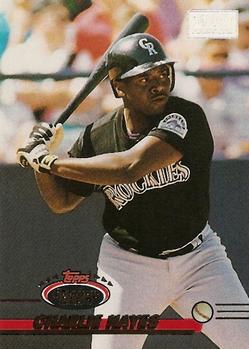 4 years in the majors and was liked enough to do two tours of duty with 3 different franchises–the Giants (1988-89 & 1998-99), the Phillies (1989-1991 & 1995) and the Yankees (1992 & 1996-97). By virtue of playing an important position, third base, and being a consistently above-average defender, he turned out a career WAR of 10.5 despite being a below-average hitter for a corner infielder.
Hayes posted by far his best offensive season when he joined the Rockies in their inaugural season of 1993. And this season wasn’t just a “Coors effect”–his 118 OPS+ was 4th in the NL among 3Bs, just behind Gary Sheffield (120) and Dave Hollins (119), who all trailed leader Matt Williams (137) by a good chunk.
In 1993 Hayes had career bests in all of his slash-line categories, posting .305/.355/.522 vs career numbers of .262/.316/.398. He posted career highs in just about every offensive statistic, including hits, HR, 2B, SB, RBI, and R.
All this translated to +12 WAR batting runs that season. In his 13 other seasons, he totaled -92 batting runs, with every season being negative save a +3 in 1998.
Like many players on this countdown, Hayes is probably remembered as a better offensive player than he actually was, thanks to substantial value in his defense and his deserved longevity in the majors.



 Yordano Ventura’s season was interrupted by a midsummer demotion to the minor leagues. He rediscovered success upon returning to the rotation, thanks to a lowered arm slot and

 York’s Matt Harvey, Barry Zito (San Francisco Giants, 2012) was the most recent Scott Boras client to serve as starting pitcher for a World Series opener. Prior to him, it was Anthony Reyes of the 2006 St. Louis Cardinals.
 Escobar has been an aggressive hitter throughout 2015, but he is taking that to an extreme this October. In 20 percent of his postseason plate appearances, the shortstop has put the first pitch in play.