Continuing my post on exceptional pitching seasons, Part 2 looks at most exceptional pitcher seasons for rate statistics. More after the jump.
As I did for Part 1, for this post I’ve made use of the Lahman database, compiled annually by Sean Lahman. This database has basic statistical information for all major leagues for every season since 1871. The methodology I’ve employed for this analysis is to identify the best and second best seasons for every pitcher for a variety of statistical categories. The pitchers with the largest difference between those two seasons are identified as having the most exceptional seasons for a category, the descriptor “exceptional” denoting the largest difference or greatest exception from all other seasons.
Rate statistics are, by nature, very context sensitive. Two pitchers may have identical ERAs but, if one pitched 20 innings and the other pitched 200, that ERA tells you much, much more about the second pitcher than the first. To avoid distortions for seasons with limited playing time, I will be comparing only “qualified” seasons when identifying exceptional seasons for rate statistics. For this purpose, I will be classifying each pitcher season into one of three categories with a minimum qualifying IP for each category. Clear as mud? Hopefully, this table will help.
| Season Classification | Starts as a % of Games Pitched | Minimum Qualifying IP |
| Starter | 60% or more | 100 |
| Reliever | less than 20% | 30 |
| Swingman | >= 20% and < 60% | 75 |
So, every pitcher season will fall into one of the three categories based on a pitcher’s games started, and will be deemed a qualifying season (or not) depending on whether the pitcher’s innings pitched reached the minimum specified for that category.
I have employed lower IP thresholds for qualifying seasons than traditionally used, mainly in consideration of pitchers of the last 30 years or so, who tend to have lighter workloads than their brethren in earlier years. For example, using the official 162 IP threshold for a qualifying season for a starter, there were 83 starting pitchers with qualified seasons in 1975, for an average of 3.5 per team, compared to 52 such pitchers in 2025, for an average of only 1.7 per team. But, using 100 IP as a qualifying threshold finds 105 such pitchers in 1975 (4.4 per team) and 139 in 2025 (4.6 per team), so the lower threshold brings those two eras into much closer alignment. My rationale for wanting to bring eras into alignment for starting pitching is simply that, throughout the modern era, the job of starting a large majority of a team’s games has generally been borne by a similar number of pitchers, almost never less than four, and seldom more than six or seven.
While the number of pitchers making most of a team’s starts hasn’t changed greatly over time, how much of the game that is pitched by those primary starting pitchers has changed dramatically. Thus, relievers are far more prominent in the game today than at any prior time. Accordingly, most of the pitching seasons classified as reliever seasons are from the recent past, with the vast majority from the past 50 years or so. Setting a low qualifying threshold for relief pitcher seasons was done in consideration of the high degree of specialization in the game today, where pitching just one inning has become a typical relief outing. Thus 30 IP is roughly equivalent to one relief outing per week which, admittedly, is not a lot. Bullpens, though, are now as large as, if not larger than, entire pitching staffs in bygone days, and with the revolving door that is the bullpen gate, with young pitchers going up and down between the majors and minors in dizzying profusion, there are just a whole lot of relievers being used to cover a finite number of innings. The end result tends to be a few relievers getting most of the “high leverage” innings, and many different relievers covering the rest of the work. Whether rightly or wrongly, I’ve chosen to cast a wider net than just the bullpen workhorses, so as to also recognize those other relievers, some of whom even make careers of being “low leverage” relievers.
The exceptional season results are illustrated in a chart like the one below, showing the most exceptional seasons of the modern era for starting pitchers for the Strikeouts per 9 Innings Pitched metric.
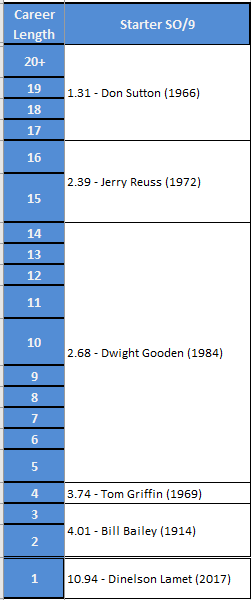
The first column shows career length measured in seasons, and the second is the most exceptional season for Strikeouts per 9 IP among players with that career length. In Part 1, Career Length denoted the actual number of seasons in each pitcher’s career. Here, since we are considering only qualified seasons for rate statistics, Career Length will denote the number of qualified seasons for each pitcher for that role. Thus, for the above example, Career Length denotes the number of seasons for each pitcher which met the qualifying criteria for starting pitchers, as shown above in Table 1. Thus, among players with careers including 20 or more qualified seasons as a starting pitcher, Don Sutton has the largest difference in Strikeouts per 9 IP (1.31) compared to his next highest season result. Where table rows have been grouped, the top row in the group identifies the player’s career length, and the bottom row identifies the range of career lengths for which his exceptional season applies. Thus, Dwight Gooden‘s career included 14 qualified seasons as a starting pitcher, but his exceptional season in 1984 shows the largest difference (2.68) over his second highest result among all pitchers with careers including 5 or more qualified seasons as a starting pitcher. So as not to be left out, players with the best total in a career including just one qualified season are shown in the bottom row.
The exceptional season results will be presented separately for each of the three pitching season classifications. I’ve tried to find something interesting to say about all of the players identified in these tables, and have done so for most of them. As you’ll see, the same players and seasons will show up for multiple metrics, but I’ve only done a blurb once for each player. In the player comments, when I use the term “official qualified”, I am referring to MLB’s official qualifying criteria. Where “qualified” is not preceded by “official”, I am referring to qualified seasons as I have defined them for this post. So, let’s begin with the exceptional seasons for starting pitchers.
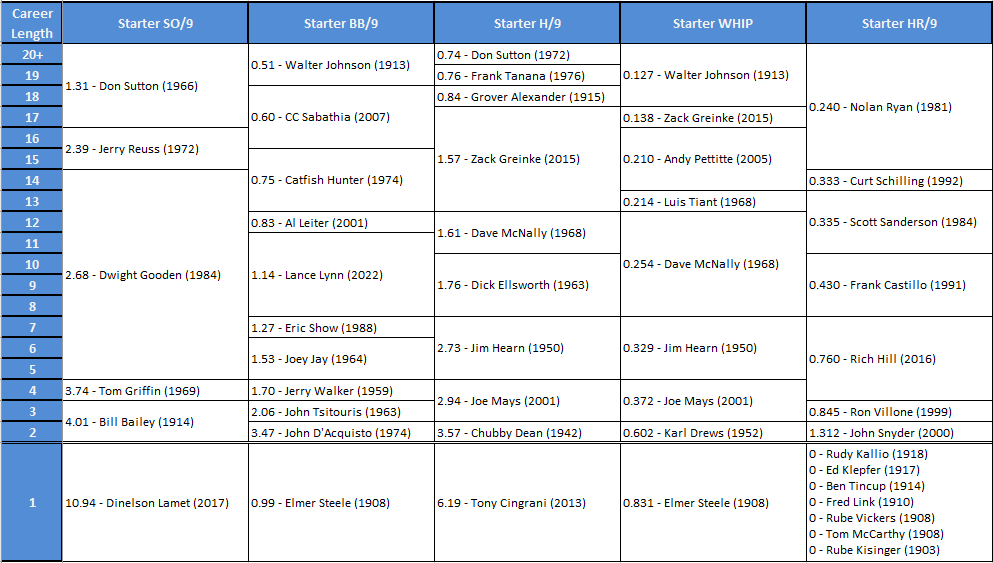
Strikeouts per 9 Innings Pitched
- Don Sutton‘s exceptional season was his rookie campaign in 1966, with his 8.3 SO/9 more than a full strikeout better than his second best season two years later. Sutton ranked 3rd in SO/9 that season, while his 4.02 SO/BB ratio (also a career best) was 5th best in the league.
- Jerry Reuss makes the list for his 1972 season with 8.2 SO/9, more than two strikeouts better than his second best season that would not come until eleven years later. Despite the extra whiffs, the 23 year-old Reuss struggled to keep runs off the board, posting an 81 ERA+ that was actually slightly better than the season before. But, better fortune lay ahead for Reuss, with his career best 5.4 WAR season to come three years later.
- Dwight Gooden‘s spectacular 1984 rookie season shows up here with Gooden leading the majors in SO, SO/9, FIP, WHIP and H/9. Gooden’s 11.4 SO/9 that season established a new record for starting pitchers in official qualified seasons, eclipsing Sam McDowell‘s 10.7 in 1965. Gooden’s mark still ranks second among rookie pitchers in official qualified seasons, trailing only Kerry Wood‘s 12.6 SO/9 in 1998.
- Like Gooden, Tom Griffin‘s career best SO/9 was a majors-leading result posted in his rookie season. It was also Griffin’s best year for WAR, SO, ERA and H/9 in an official qualified season. Griffin struggled with his control throughout his career, only twice posting BB/9 under 4 and never under 3.5; he is one of 27 modern era pitchers with H/9 under 9 and BB/9 over 4.5 in a 1000+ IP career.
- Bill Bailey makes the list for his 9.2 SO/9 in 1914 for the Federal League’s Baltimore Terrapins. Dave Davenport led the FL that year with 5.9 SO/9, a figure Bailey would have beaten handily had he qualified officially; even Bailey’s actual 131 strikeouts averaged over 154 IP (the modern day qualifying rule) yields 7.7 SO/9. Bailey’s 546⅓ IP before his age 23 season ranks 5th in Browns/Orioles franchise history; he has both the lowest ERA and lowest ERA+ of anyone in the top 12 (in IP) on that list.
- Dinelson Lamet‘s lone qualified season as a starter came as a Padre rookie in 2017. His best season was his officially qualified 2020 campaign with 2.3 WAR (more than his career total) and top 5 league rankings in ERA, SO, SO/9, H/9 and WHIP. Lamet pitched his first games in relief the next season, a transition that never really worked for him; for his career, Lamet posted a 4.13 ERA with 3.7 BB/9 as a starter, but 6.85 ERA with 6.3 BB/9 in relief.
Walks per 9 Innings Pitched
- Walter Johnson makes the list for his 1913 season, leading the majors in WAR, Wins, W-L%, ERA, CG, SHO, IP, SO, ERA+ WHIP, H/9, SO/9 and SO/BB. But, for BB/9, he had to content himself with an AL best 1.0 (it was actually 0.99). Johnson’s 15.2 WAR is the most in the modern era, just ahead of his own 14.3 WAR the season before. Johnson posted eight seasons with double-digit WAR; nobody else has more than three.
- CC Sabathia posted his career best 1.4 BB/9 in his CYA season in 2007. It is one of 18 modern era seasons with 6 WAR, SO/9 over 7.5 and BB/9 under 1.5, all of them since 1995.
- Catfish Hunter posted 1.3 BB/9 in his 1974 CYA season for the world champion A’s. It was Hunter’s fourth of five straight 20 win seasons, a run during which he completed over half of his starts. Hunter’s 1975 season is the last of the modern era with 300+ IP and over 75% of starts completed.
- Al Leiter makes the list for his 2001 season with the defending NL champions Mets. Leiter’s 28 WAR as a Met is a franchise record for pitchers 30 or older.
- Lance Lynn recorded his career best BB/9 for the White Sox in 2022. The year before, he became the third expansion era Sox pitcher to post a 5 WAR season aged 34 or older. (Quiz: 1. Which of those pitchers posted two such consecutive seasons?) (Jim Kaat, 1974-75)
- Eric Show makes the list for his 1988 season in which he also posted career bests in Wins, SO and WHIP. Show’s 100 wins for the Padres is a franchise record.
- Joey Jay makes the list for his 1964 season with the Reds. Jay’s 42 wins over his first 75 games as a Red is an expansion era franchise high, and his 30 games for the Braves before his 20th birthday are a modern era franchise high. Jay did not record a loss in those 30 games, the most games by any modern era pitcher with zero losses before turning 20. (Quiz: 2. Which two pitchers share the expansion era record for most games without a loss before their 20th birthdays?) 25 games, Jim Bethke (1965), Elvis Luciano (2019)
- Jerry Walker, another 1950s bonus baby like Jay, posted his best BB/9 at age 20 in 1959. That season was also Walker’s best in WAR, Wins, ERA, CG, SHO, WHIP, FIP, H/9 and SO/BB, earning him his only All-Star selection. Walker remains the youngest pitcher to start an All-Star game.
- John Tsitorious makes the list for his 1963 season with the Reds that was also his best year for WAR, Wins, ERA, CG, SHO, IP, ERA+, FIP, WHIP, H/9 and SO/BB. Tsitorious shut out the Cardinals in consecutive starts that season. (Quiz: 3. Which live ball era pitcher posted a season with shutouts in three straight starts against the Redbirds?) Bob Friend (1956)
- John D’Acquisto recorded his career best BB/9 with a mark of 5.2 for the 1974 Giants. His second best result as a starter was 8.7 two years later. D’Acquisto is the only expansion era pitcher with BB/9 over 6 and SO/9 under 7 in a 500+ IP career.
- Elmer Steele makes the list for his 1908 rookie season with the Red Sox. Steele’s 0.831 WHIP that year is the best by a modern era rookie in a 100+ IP season with 60% of games started.
Hits per 9 Innings Pitched
- Frank Tanana makes the list for his 1976 season with the Angels that was also his best year for Wins, ERA, CG, IP and WHIP. The next season Tanana and Nolan Ryan both topped 7 WAR for the Angels, one of 13 expansion era teams with two such pitchers.
- Grover Alexander‘s 6.1 H/9 led both leagues for the 1915 NL champion Phillies. Alexander also led both leagues with his 36 wins, 1.22 ERA and 241 strikeouts, as he posted the first of three consecutive triple crown seasons and four overall, both marks modern era highs. (Quiz: 4. Which triple crown winner was benched in that season’s World Series?) (Rube Waddell, 1905)
- Zack Greinke‘s 2015 season was his best year for H/9, ERA, ERA+ and WHIP. Greinke, Randy Johnson, Pedro Martinez and Roy Halladay have all posted 8 WAR seasons in both leagues. (Quiz: 5. Which pre-expansion pitcher posted 8 WAR seasons in both leagues?) (Joe McGinnity)
- Dave McNally posted his best H/9 season in 1968, together with career bests in ERA, ERA+, FIP, WHIP, BB/9 and SO/BB. McNally’s 25.3 WAR for the Orioles is a franchise record for left-handers.
- Dick Ellsworth makes the list for his 1963 season with career bests in WAR, Wins, ERA, CG, SHO, IP, SO, ERA+, FIP, WHIP and H/9. Ellsworth’s season is one of only three 10 WAR campaigns by modern era Cub pitchers.
- Jim Hearn‘s best H/9 came in 1950, when his career took a sudden turn for the better after a mid-season trade to the Giants. Hearn recorded a majors-leading 5 shutouts that season despite pitching only 134 innings. Those five shutouts are also the most by any pitcher over their first 20 games as a Giant (Hearn needed only 16 games), while Hearn’s 3.2 WAR per 100 IP was the best by a Giant starter in a 100+ IP season since Christy Mathewson‘s 3.5 mark in 1909.
- Joe Mays makes the list for his 2001 season, with career bests in almost every category. Mays’s 143 ERA+ that season is the lowest league-leading mark by a live ball era Senators/Twins pitcher. (Quiz: 6. Which two HoF pitchers previously enjoyed that distinction?) Walter Johnson (1924), Stan Coveleski (1925), both with 149 ERA+
- Chubby Dean (no relation to Dizzy and Daffy) recorded his career best H/9 with the 1942 Indians. Dean has the distinction of recording the only modern era season with 40+ games, both as a pitcher and as a pinch-hitter.
- Tony Cingrani posted 6.2 H/9 for the Reds in 2013, despite allowing 1.2 HR/9. (Quiz: 7. Which pre-expansion team was the first to have two starting pitchers record H/9 of 7 or less and HR/9 of 1 or more in official qualified seasons?) 1960 Dodgers (Stan Williams, Sandy Koufax)
Walks plus Hits per Inning Pitched
- Andy Pettitte posted his career best WHIP for the 2005 NL champion Astros. Pettitte is one of 22 modern era pitchers with 100 more wins than losses. Pettitte and Clayton Kershaw share the live ball era record of 18 consecutive seasons with starts in 60% of games and a .500 or better W-L%. (Quiz: 8. Which modern era pitcher recorded the only longer streak of such seasons?) (Grover Alexander, 1911-29, all above .500)
- Luis Tiant posted a career best 0.871 WHIP in 1968, together with league-leading marks in WAR, SHO, ERA, ERA+, FIP and H/9. Tiant’s 1966 season for the Indians is the only expansion era campaign with 5+ shutouts and 5+ saves.
- Karl Drews makes the list for his 1952 career best season. Drews posted 4.7 WAR that year, the only positive WAR total of his eight year career. Drews was one of three Phillie pitchers to top 3.5 WAR that season, matching the modern era franchise record that had stood since 1901 and was finally broken in 2025.
Home Runs per 9 Innings Pitched
- Nolan Ryan makes the list for his 1981 season, allowing just two home runs in 149 IP. Ryan posted six seasons leading his league in both walks and strikeouts, including two seasons with 200 or more of each. (Quiz: 9. Which other pitcher posted a season with 200 or more walks and strikeouts?) (Bob Feller, 1938)
- Curt Schilling posted his career best HR/9 in his 1992 season for the Phillies, together with majors-leading marks in WHIP and H/9. Schilling won 50 or more games with a winning record for three franchises. (Quiz: 10. Which modern era pitcher won 75 or more games with a winning record for three or more franchises?) (Tommy John: with Yankees 91-60; Dodgers 87-42; and White Sox 82-80)
- Scott Sanderson makes the list for his 1984 season with the Cubs, allowing only 5 home runs in 140⅔ IP. That result is rather anomalous for Sanderson, as he allowed 20+ HR in 8 of 13 seasons from 1982 to 1994, the sixth highest total during that period. Sanderson posted a career best 17 wins for the 1990 A’s but amassed only 0.3 WAR, one of seven live ball era pitchers on pennant-winning teams with a 15+ win, 200+ IP season of 0.5 WAR or less.
- Frank Castillo‘s best HR/9 season was as a rookie with the 1991 Cubs. His 0.4 HR/9 is second lowest in the expansion era among Cub starting pitchers in 100+ IP rookie seasons.
- Rich Hill shows up for his 2016 season split between the A’s and Dodgers, allowing a pair of homers with each team in 110⅓ total IP. Hill’s 9 wins and 2.9 WAR for the A’s that season rank 1st and 2nd, respectively, in franchise history in seasons of 15 or fewer games. (Quiz: 11. Which pitcher recorded the most wins over his first 15 games with the A’s?) (Jim Nash, 11 wins in 1966)
- Ron Villone posted a career best 0.5 HR/9 in 1999, his first season as a starting pitcher. Villone’s 6.3 BB/9 over his first four seasons is the highest rate by a modern era pitcher in 150+ IP pitching exclusively in relief.
- John Snyder posted a career best 0.6 HR/9 in his final season in 2000. Snyder’s 7 wins in 1998 are the most by a White Sox rookie in a season of 15 or fewer games. But, his 5.93 ERA and 1.7 HR/9 are both worst by a Sox starting pitcher in 200+ IP over the first two seasons of a career.
- A goodly number of dead ball era pitchers did not allow a home run in a lone qualified season as a starting pitcher, with Rube Vickers standing out by pitching over 300 innings in that season. But, I talked about Vickers in Part 1, so instead will say a word or two here about Fred Link, the only modern era starting pitcher to allow no home runs over 100+ IP in the only season of his career. Link’s one season, for the 1910 Cleveland Naps, included a bit role in a “passing of the torch” game on June 4th, with 22 year-old Walter Johnson, in his breakout season, beating 43 year-old Cy Young pitching for the Naps (Link relieved Young to finish the game). Link shares with HoFer Waite Hoyt the distinction of being the only pitchers to win the first two CG of their careers in extra innings. In the second of those games, Link held the Browns to one run on three hits over 11 IP. Link then shut out St. Louis on four hits on June 28th. Those two outings impressed his opponent enough for the normally tight-fisted Browns to purchase Link from Cleveland in August. Link played just three games for St. Louis before finishing his professional career with three seasons in Indianapolis (the last playing for the Hoosiers, champions of the Federal League in its inaugural 1913 season; the new circuit would declare itself a major league the following season).
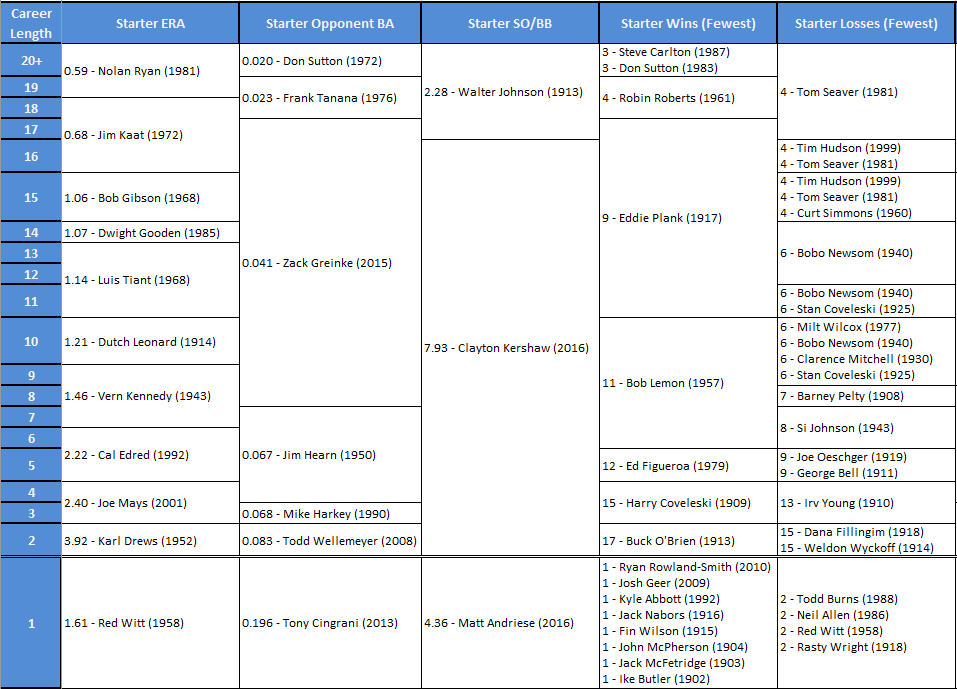
Earned Run Average
- Jim Kaat‘s career best ERA as a starter came in 1972, allowing just 26 earned runs over 15 starts and 113⅓ IP. His 157 ERA+ that season was also a career best. Kaat’s 25 year career gives him an impressive “career span” of 69 seasons. I define a player’s career span as the shortest period encompassing the entire careers of all of the player’s teammates and opponents. In Kaat’s case, that period is the 69 seasons from 1939 to 2007, as Kaat pitched against both Ted Williams (debuted in 1939) and Julio Franco (retired in 2007).
- Bob Gibson‘s famous 1.12 ERA in 1968 is reflected here. I said a fair bit about Gibson in Part 1, so I’ll just remark here that, since that season, no pitcher has come within 0.4 runs of that mark in a 162+ IP season, and only three have come within a half run. Going backwards prior to the expansion era, Gibson’s mark still stands as the best ERA in 154+ IP seasons all the way back to 1915.
- Dutch Leonard recorded the lowest ERA of the modern era in a 154+ IP season, with his 0.96 mark in 1914. His 279 ERA+ stood as the best in such seasons until eclipsed by the 291 ERA+ by Pedro Martinez in 2000. Leonard’s 13.4 WAR and 2.87 WAR per 100 IP over his first two seasons remain Red Sox franchise records for starting pitchers with 200+ IP for those two seasons.
- Vern Kennedy makes the list for his 1943 season with the Indians. Kennedy’s 2.45 ERA that year was less than half of the 5.11 ERA he compiled in more than 1300 IP over the seven prior seasons since his second best 3.91 ERA as a White Sox rookie in 1935. Kennedy’s 1.591 WHIP is the highest by any modern era pitcher in a 2000+ IP career.
- Cal Eldred‘s 1.79 ERA in his 1992 rookie season is reflected here. That mark ranks second in the expansion era for starting pitchers in 100+ IP rookie seasons. The Brewers increased Eldred’s workload to a league-leading 258 IP the next season, but his ERA more than doubled to 4.01. That would turn out to be Eldred’s second best ERA in a 100+ IP season, as he never regained his rookie form, as a starting pitcher. Eldred moved to the bullpen late in his career and enjoyed a modicum of success in that role; his 123 ERA+ ranks second among modern era Cardinal relievers aged 35 or older in 150+ IP over the last three seasons of a career.
- Red Witt‘s 1.61 ERA in his 1958 rookie season is the lowest by a modern era pitcher in a lone 100+ IP season as a starting pitcher. Witt’s 4 WAR and 3 WAA that season are both franchise highs by Pirate pitchers in a modern era seasons of 20 or fewer games. It was all downhill for Witt after that season, posting a 6.29 ERA and -2.4 WAR over his final four seasons.
Opponents’ Batting Average
- Mike Harkey‘s 1990 rookie season is reflected here, holding hitters to a .234 BA over 27 starts and 173⅔ IP. Harkey was injured most of the next two seasons. When again healthy in 1993, his ERA shot up to 5.26, two full runs higher than his rookie mark, and didn’t improve after that, as Harkey closed his career with a 5.51 ERA over his final three seasons. Harkey’s 4.6 WAR in 1990 ranks second among expansion era Cub pitchers in official qualified rookie seasons? (Quiz: 12. Which Cub rookie tops that list?) (Burt Hooton, 5.0 WAR in 1972)
- Todd Wellemeyer makes the list for his career best season in 2008, compiling 2.4 WAR and holding batters to a .245 BA over 32 starts and 191⅔ IP. That would be Wellemeyer’s only official qualified season, as he tumbled to -2.5 WAR and a 5.82 ERA over his final two seasons.
Strikeout to Walk Ratio
- Clayton Kershaw‘s incomparable 2016 season blows away all competition in SO/BB ratio. His 15.64 SO/BB exceeds the second best result by 4.01, or 34.5%, among modern era starting pitchers in 100+ IP seasons. Among such seasons, Kershaw’s 0.725 WHIP ranks as the lowest result, while his 0.7 BB/9 places his season among only ten with that result below 0.75.
- Matt Andriese‘s 4.36 SO/BB in 2016 is the best by a modern era pitcher in a lone 100+ IP season as a starting pitcher. Andriese continued as a starter the next season, before moving to the bullpen for the remainder of his career. Andriese is one of five Rays pitchers with 250+ IP, including 25 or more starts and relief appearances, over the first three seasons of their careers. (Quiz: 13. Which one of those pitchers is still active?) (Ryan Yarbrough)
Wins (Fewest)
We looked at most exceptional seasons for most wins in Part 1, so this time, we’ll look at exceptionally bad seasons for Wins.
- Steve Carlton makes the list for his 6-14 season in 1987, three wins less than he compiled in his 9-14 season the year before. Carlton’s .302 W-L% and -2.2 WAR over his final four seasons are both worst among Hall of Fame starting pitchers. Carlton started and won 2 games in the 1983 NLCS, and he started and lost 2 games in the 1981 NLDS. (Quiz: 14. Which other pitcher recorded the same results in two best-of-five post-season series?) (Jaret Wright, 1997 ALDS & 2004 NLDS)
- Robin Roberts‘ 1-10 season in 1961 is reflected here. Roberts recovered from that debacle to compile 13.5 WAR over his next four seasons, the first of ten expansion era pitchers to top 2.5 WAR each season aged 35-38. Roberts recorded six consecutive 300+ IP seasons (1950-55) with 20+ wins, the most such seasons (consecutive or not) by a live ball era pitcher.
- Eddie Plank‘s final season for the 1917 Browns is reflected here. Plank’s six seasons (1902-07) with 15+ HBP is the modern era record, recently tied by Charlie Morton. (Quiz: 15. Which live ball era pitcher recorded the highest ratio of HBP to BF in a season with 500+ BF?) Hunter Greene (2024), HBP of 3.1% of BF
- Bob Lemon makes the list for his 6-11 season in 1957, his final 100+ IP campaign. Lemon’s 10 shutouts in 1948 tied the AL live ball era record, set by teammate Bob Feller two seasons earlier. (Quiz: 16. Who holds that record today?) (Dean Chance, 1964)
- Ed Figueroa recorded four straight 2+ WAR seasons (1975-78) with 16 or more wins before his 4-6 season reflected here. Figueroa’s 7 post-season starts are the most by a Yankee pitcher without recording a win. (Quiz: 17. Which Yankee pitcher holds the pre-expansion franchise record for post-season starts without a win? ) (Art Ditmar, no wins in 2 post-season starts)
- Harry Coveleski makes the list for his 6-10 season with the 1909 Phillies. Coveleski’s career took off with a move to the junior circuit in 1914, recording three consecutive 20 win seasons for the Tigers, each with ERA under 2.50. Coveleski’s 81 career wins are the fewest among 96 modern era pitchers with three or more 20 win seasons.
- Buck O’Brien followed a 20 win season in 1912 with the 3-11 season reflected here. O’Brien allowed 5 runs in the first inning of game 6 of the 1912 World Series (the one with the tied game), then the shortest start in Fall Classic history. The next day, teammate Smoky Joe Wood joined O’Brien in the record book, surrendering 6 runs in his one inning of work. Wood was back on the mound for the sudden death game the following day, pitching three innings of relief and getting his second L turned into a second W when the Red Sox rallied to walk off the Giants in extras.
- Lots of pitchers recorded a single victory in a lone 100+ IP season as a starting pitcher. I’ll say a few words about Ike Butler, the one pitcher in that group who played just one major league season. Butler played that one season for the 1902 Orioles who were merely mediocre (37-45) through the end of July, but atrociously bad (13-43) in August and September. Thus, it was Butler’s misfortune to join the team that August, making 14 starts and completing 12 to finish with a 1-10 record (one of his complete games was a tie). In September, the Orioles invaded Philadelphia for back-to-back double-headers, looking to play spoiler against the league-leading Athletics. Butler got the ball for the first game of the series and was staked to an early 4-0 lead, but the A’s got to him in the middle frames to give Rube Waddell his 20th win. The next day, manager Wilbert Robinson sent Butler to the mound again, and his fatigued rookie delivered a second CG in as many days, but came out on the wrong end of a 4-3 score (not a huge surprise given the circumstance, but Butler’s 10 walks in that game are the most in a CG pitched on zero days rest). After running his record to 0-8, the overmatched Butler (he allowed 4+ runs in every appearance, except for a four out relief stint) finally notched his only win against Washington. Butler finished his professional career with eight minor league seasons, mostly in the Pacific Northwest. (Quiz: 18. Which expansion era pitcher matched Butler’s feat of losing the first 7 complete games of his career? ) (Jeff Weaver, 2000-01)
Losses (Fewest)
- Tom Seaver tops this list for his 14-2 season in 1981 in which he posted a career best 6.5 H/9, but also career worst results in BB/9, SO/9 and SO/BB. This was the last of Seaver’s 15 consecutive .500 or better official qualified seasons to start his career, still the longest such streak of the modern era.
- Tim Hudson‘s 1999 debut season is highlighted here, with an 11-2 record, a career best 8.7 SO/9 but also a career worst 4.1 BB/9. Hudson is one of nine modern era pitchers to record 25+ pWAR in both the AL and NL. (Quiz: 19. Which of those pitchers compiled less career pWAR than Hudson’s 56.5 total?) (Dutch Leonard, 1933-53, 51.7 pWAR)
- Curt Simmons makes the list for his 1960 season, with a 7-4 record for the Cardinals after being released early that season by Phillies. That would be Simmons’ first of six straight 150+ IP seasons for St. Louis, as he became one of four modern era pitchers aged 30 or older to average 1.5+ WAR per 100 IP over 1000+ IP for the Cardinals.
- Bobo Newsom‘s 1940 season for the AL champion Tigers is highlighted here, with a 21-5 record and career bests in Wins, W-L%, ERA+ and H/9. Newsom, Lefty Grove and Kevin Brown are the only live ball era pitchers to record two 7 WAR seasons, aged 31-32.
- Stan Coveleski posted a 20-5 record for the 1925 AL champion Senators. With Coveleski and Walter Johnson in their rotation, Washington became the first of five modern era pennant-winning teams with a pair of age 35+ pitchers each reaching 4+ WAR. (Quiz: 20. Which Minnesota Twins team also featured two age 35+ pitchers with 4+ WAR?) (Mike Marshall & Jerry Koosman, 1979 Twins)
- Milt Wilcox makes the list for his 6-2 season for the 1977 Tigers. The next year, Wilcox began a run of seven straight official qualified seasons for Detroit, the last in the Tigers’ 1984 world championship season. Wilcox’s 0.64 post-season ERA that year was then a Tiger franchise record among pitchers with 12+ IP over two or more post-season starts, eclipsing Bill Donovan‘s 1.29 ERA in 1907. (Quiz: 21. Which such pitcher holds the Tiger franchise record today?) (Kenny Rogers, 0.00 ERA in 2006 post-season)
- Clarence Mitchell‘s 11-3 record for the 1930 Giants and Cardinals is highlighted here. Mitchell’s 349⅔ IP for the Giants was a franchise record for pitchers aged 39 or older, until surpassed by Rick Reuschel. At age 25, Mitchell recorded complete games in the last 11 starts of his 1916 rookie season. (Quiz: 22. Who is the youngest live ball era pitcher to finish a season with CGs in 10+ consecutive starts?) Ned Garver (1950), age 24
- Barney Pelty posted a 7-4 record for the 1908 Browns, with a 1.99 ERA and nary a home run surrendered. Pelty’s 5 seasons with 15 or more hits as a batter is a Browns/Orioles franchise record for pitchers, a mark shared with teammate Jack Powell and with Urban Shocker.
- Si Johnson‘s 8-3 record for the 1943 Phillies is highlighted here, with Johnson posting career best WHIP, BB/9 and SO/BB. Johnson’s .380 career W-L% is second lowest among modern era pitchers with 250+ decisions.
- Joe Oeschger went 4-4 in his 1919 season split between the Giants, Braves and Phillies. In his second game that season, Oeschger and the Phillies were matched up against Burleigh Grimes and the Robins. The Phillies scored two in the 8th to take a 6-5 lead but Brooklyn answered in the 9th to tie the score and force extras. The two starters pitched 9 more innings with neither allowing a run, before Oeschger gave up a 3-run home run by Hi Myers in the top of the 19th. But the Phillies tied it in the bottom of that frame on a bases-loaded pinch-double by Gavy Cravath (NL home run champ that season, for the 6th time in 7 years) with Irish Meusel thrown out at the plate trying to score the winning run. Oeschger and Grimes pitched one more frame before the game was called a draw. That contest was a harbinger for Oeschger of a longer and much more famous tied game a year and a day later.
- George Bell recorded just 6 losses in his final season for the 1911 Dodgers, after 15 or more losses in every other season of his career. Those 6 losses would have been more, had Bell not been removed from the starting rotation in June; he finished the season with career worst marks for ERA, FIP, WHIP, H/9, SO/9 and SO/BB. Bell’s 27 losses the year before are tied for second most in any modern era season, while his .352 career W-L% is second lowest among modern era Dodger pitchers with 100+ decisions, and also second lowest among all modern era pitchers with 100+ decisions who played for only one franchise.
- Irv Young‘s 1910 season for the White Sox makes the list, despite a 4-8 record. That’s because he lost 20+ games in his other three qualified seasons as a starter. Young’s 9.9 WAR in his 1905 debut season remains the modern era NL record for rookies, while his 378 IP that year are the most by a modern era rookie in either league. Young’s 736⅓ IP over his first two seasons are the most by any modern era pitcher.
- Dana Fillingim posted a 7-6 record for the 1918 Braves, together with career best marks for ERA, ERA+, FIP, WHIP, H/9 and HR/9. Fillingim is one of eight modern era pitchers with SO/BB under 1.00 in 1000+ IP for the Braves. (Quiz: 23. Which of those pitchers played for the Braves after World War II?) (Vern Bickford)
- Weldon Wyckoff makes the list for his 1914 season for the AL champion Athletics. His 11-7 record was accompanied by career bests in ERA, ERA+, WHIP and H/9. Wyckoff is one of 24 modern era pitchers to record ERA+ under 80 in careers of 500+ IP (none of the 24 reached 1000 IP).
- Todd Burns posted an 8-2 record in his debut season for the 1988 Athletics. He spent the rest of his career as a reliever, though he did make starts in 10% of his appearances after his rookie campaign. Burns’ 2.81 ERA is third best by an A’s reliever over 250+ IP, and much better than the 5.03 ERA he posted in 198⅔ IP for the Rangers and Cardinals.
- Neil Allen went 7-2 for the 1986 White Sox, while also recording career best WHIP. Allen and Roy Face are the only modern era relievers to record decisions in 30% or more of 150+ games pitched over the first three seasons of a career.
- Rasty Wright compiled an 8-2 record for the Browns in his 1918 rookie season. Wright and George Baumgardner are the only West Virginia-born players with 100 or more games pitched for the Browns/Orioles.
Now, it’s on to the relievers. For the next two charts, the Career Length column denotes qualified relief seasons as defined in Table 1 at the top of this post.
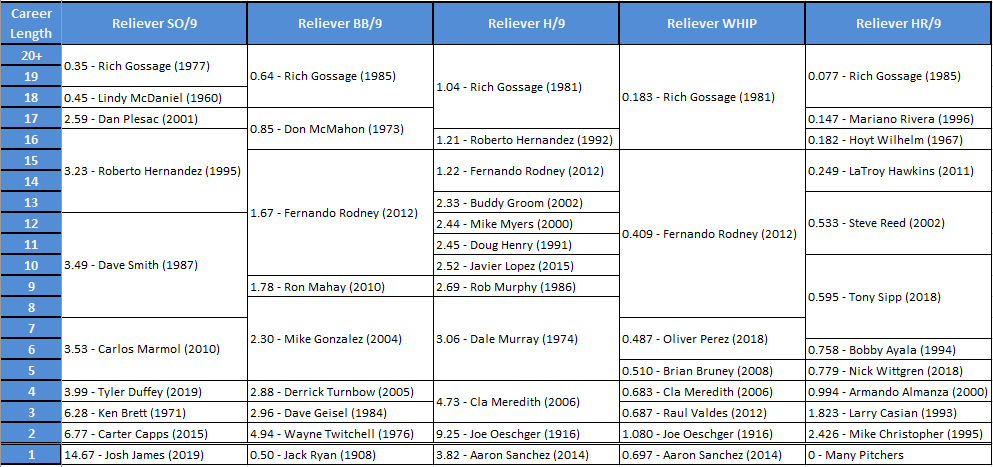
Strikeouts per 9 Innings Pitched
- Rich Gossage‘s 1977 season for the Pirates is reflected here. Acquired from the White Sox after his one season as a starter, the Pirates moved Gossage back to the bullpen, where he turned in his second 6+ WAR season as a reliever, the only pitcher with that accomplishment. Gossage signed a free agent contract with the Yankees after this season.
- Lindy McDaniel makes the list for his 1960 season when he led the majors with 27 saves and posted a career best 195 ERA+. McDaniel compiled a franchise record four 100+ IP relief seasons for the Cardinals.
- Dan Plesac‘s 13.5 SO/9 at age 39 for the 2001 Blue Jays is reflected here. Pleasac’s five best SO/9 seasons, and 7 of the top 8, were recorded aged 35 or older. Plesac’s four 30+ IP seasons aged 35 or older, with 10+ SO/9 and 125+ ERA+, are the most among left-handed relievers.
- Robert Hernandez posted his career best 12.7 SO/9 for the White Sox in 1995. Hernandez’s 326 career saves are the most by any Puerto Rican-born pitcher.
- Dave Smith pitched for eleven seasons with the Astros, including his 1987 campaign reflected here. Smith’s 199 career saves for Houston is a franchise record for right-handed pitchers.
- Carlos Marmol makes the list for his 2010 season with the Cubs. His 16.0 SO/9 that year was then the highest recorded in any 30+ IP relief season, and is still the Cub franchise record.
- Tyler Duffey makes the list for his 2019 season with the Twins. His 1.006 WHIP that season was also a career best in a qualified relief season. Duffey is one of five Minnesota relievers with 35+ games started and 35+ games finished for the Twins.
- Ken Brett posted his career best SO/9, as a reliever, for the 1971 Red Sox. It was also Brett’s only season with as many strikeouts as hits allowed. But, there was nothing much else that went right for him that season, as Brett posted negative WAR with an ERA and BB/9 both north of the 5 mark. Brett pitched in two games of the 1967 World Series and remains the youngest pitcher to appear in the Fall Classic.
- Carter Capps makes the list for his 16.8 SO/9 for the 2024 Marlins. That season is one of only six 30+ IP relief campaigns with SO/9 of 15 or more and a 300 or better ERA+.
- Josh James made 49 appearances for the Astros to record his 14.67 SO/9 in 2019. Outside of that campaign, James managed only 45⅓ IP over three seasons, with the long ball his principal nemesis; his career 13.3 SO/9 is the highest for any relief pitcher with 100+ IP and HR/9 of 1.5 or more.
Walks per 9 Innings Pitched
- Don McMahon‘s best BB/9 came in the 1973 season at age 43. His 4-0 record that year was his only perfect mark in 17 relief seasons with 30+ IP. McMahon’s 1297 career relief IP is the 9th highest total, while his 2.94 relief ERA ranks 15th among pitchers with 1000+ relief IP. McMahon logged an ND in each of his eight World Series games, all of which his team lost (though his team did win two of his three World Series). That is the longest such streak to begin a World Series career.
- Fernando Rodney‘s career best season in 2012 is reflected here. In addition to his 1.8 BB/9, Rodney posted career bests of 0.777 WHIP, 0.2 HR/9, 5.07 SO/BB, 3.7 WAR, 2.4 WAA, 48 saves and 0.60 ERA, the last four Rays franchise records in 60+ IP relief seasons. (Quiz: 24. Which Rays reliever posted a 60+ IP season with three times as many strikeouts as hits allowed?) (Brad Boxberger, 2014)
- Ron Mahay makes the list for his 2010 season with the Twins. That was Mahay’s final season at age 39, with his 3.13 SO/BB that year also a career best in 30+ IP seasons. Mahay’s 1.417 WHIP is the highest expansion era mark in a 500+ IP career with 80% of games in relief and ERA+ of 120 or better. (Quiz: 25. Which pitcher recorded the highest WHIP in such a modern era career?) (Leo Kiely, 1.436 WHIP)
- Mike Gonzalez‘s 1.2 BB/9 for the 2004 Pirates is reflected here, his only result under 3.5 in an 11 year career. Gonzalez had an equally stingy 1.25 ERA and 0.877 WHIP to go with a 9.17 SO/BB ratio, all of those marks also career bests. Gonzalez’s 134 ERA+ is the sixth best result for relievers in 400+ IP careers with BB/9 of 4 or higher.
- Dave Geisel‘s 1.9 BB/9 in 1984 was his only result under 4.5 in three relief seasons of 30+ IP. Giesel’s 1.8 WAR for the Cubs is the top career mark for 20th century relievers with no more than 60 IP for Chicago.
- Wayne Twitchell was a starter for most of his career but shows up here for his 2.6 BB/9 for the 1976 Phillies. Twitchell added 9.8 SO/9 and a 1.75 ERA in 61⅓ IP to make a very creditable showing in his first season as a reliever. His other relief season didn’t go nearly as well, as 7.6 BB/9, 5.24 ERA and -1.2 WAR over 77⅓ IP made for a painful final season three years later. Twitchell’s 1973 season featured 6.7 WAR and a 1.71 SO/BB ratio. (Quiz: 26. Which Phillie pitcher recorded the lowest SO/BB ratio in a modern era 6 WAR season?) (Ken Heintzelman, 6.3 WAR & 0.70 SO/BB ratio in 1949)
- Jack Ryan allowed only two walks over 35⅔ IP for the 1908 Cleveland Naps, posting a 0.813 WHIP that would stand for 98 years as the lowest debut season mark in a 30+ IP relief season (it is still a Guardian franchise record for such seasons). It didn’t go nearly as well for Ryan after that, posting 10.1 H/9 and 1.485 WHIP over 65⅓ IP to close out his career.
Hits per 9 Innings Pitched
- Buddy Groom makes the list for his 2002 season with the Orioles. Groom added career bests in WAR, ERA and WHIP to go with his 6.4 H/9. Groom’s 2.8 WAR that season is the best mark this century by an Oriole reliever aged 35 or older. (Quiz: 27. Which Browns/Orioles pitcher was the first to top 3 WAR in a 30+ IP relief season aged 35 or older?) (Satchel Paige, 3.5 WAR in 1952)
- Mike Myers shows up for his 2000 season with the Rockies, posting career bests in WAR, ERA, WHIP and HR/9 to go with his 4.8 H/9. That was Myers’ only 30+ IP relief season with as many walks as hits allowed. (Quiz: 28. Which pitcher recorded the lowest BB/9 in such a season?) (Jose Leclerc, 2018)
- Doug Henry makes the list for his rookie season for the 1991 Brewers, posting career bests in WAR, ERA, FIP, WHIP and HR/9 to go with his 4.0 H/9. Henry pitched 10 more seasons but never came close to any of those rookie marks. Henry’s 2.2 WAR in 1991 is the fourth best result in a season with less than 40 IP, but is neither a franchise or rookie record for such seasons. (Quiz: 29. Which pitcher beat out Henry for both of those honors?) (Ray Searage, 1984)
- Javier Lopez‘s 2015 season is reflected here, posting career bests in Games, ERA and WHIP to go with his 4.0 H/9. Lopez finished his career the next season with the ultimate loogy campaign, making 68 appearances but compiling only 26⅔ IP. No other pitcher has recorded even 20 appearances in a season with IP amounting to less than 40% of games pitched.
- Rob Murphy makes the list for his 1986 rookie season, posting career bests in WAR, ERA, FIP and WHIP to go with his 4.6 H/9 and zero HR allowed. Murphy’s 0.72 ERA is the lowest rookie result in a 50+ IP relief season, while his 0.934 WHIP is a Reds franchise record for such rookie seasons.
- Dale Murray‘s 1974 rookie season shows up here, with career bests in WAR, ERA and WHIP to go with his 5.9 H/9. Murray’s 1.03 ERA and 0.990 WHIP remain Expo/National franchise records for rookie relievers in 50+ IP seasons. Murray showed a definite affinity for playing in Canada, compiling 5.8 WAR in 463⅓ IP for the Expos and Blue Jays, compared to -2.9 WAR in 439 IP for the Yankees, Mets, Reds and Rangers.
- Cla Meredith also makes the list for his rookie season, posting career bests in WAR, ERA, FIP, WHIP, HR/9, BB/9 and SO/BB to go with his 5.3 H/9 for the 2006 Padres. Meredith’s 0.711 WHIP is the lowest for any rookie reliever in a 35+ IP season, while his 1.07 ERA, 1.1 BB/9 and 6.17 SO/BB are all franchise records for such rookie seasons.
- Aaron Sanchez was practically unhittable in his only relief season, carding 3.82 H/9, 0.697 WHIP and 1.09 ERA in his 2014 rookie season. All three marks are Blue Jay franchise records for 30+ IP relief seasons, and rank 3rd, 2nd and 10th, respectively, among such rookie seasons for any franchise. Sanchez last played in the majors four years ago but, after compiling a nifty 1.55 ERA in eight Dominican League starts this past winter, has inked a free agent deal with the Royals. Stay tuned.
Walks plus Hits per Inning Pitched
- Oliver Perez makes the list for his 0.742 WHIP for the 2018 Indians. His 1.39 ERA, 4.7 H/9, 1.9 BB/9 and 6.14 SO/BB that season were also the best marks of his career. Perez’s 2.57 ERA is the lowest by a Cleveland reliever in 50+ appearances aged 35 or older.
- Brian Bruney‘s 0.990 WHIP for the 2008 Yankees is reflected here. Bruney also posted career bests that season in WAR, ERA, FIP, H/9, BB/9 and SO/9. Bruney posted five relief seasons of 30+ IP, but none with more than 50 IP. While Bruney’s 5.7 BB/9 is the highest career mark by a Yankee reliever with 150+ appearances, his career .800 W-L% (12-3) is the best among that same group of pitchers.
- Cuban-born Raul Valdes debuted as 32 year-old rookie for the 2010 Mets, but makes our list for his Phillies season two years later, carding career bests in ERA, FIP, WHIP, H/9, BB/9 and SO/BB. But, a 7.91 ERA with 2.1 HR/9 over his last two seasons marked the end of his short career.
Home Runs per 9 Innings Pitched
- Mariano Rivera‘s best year against the long ball was his first season as a full-time reliever, allowing just one HR over 107⅔ IP in 1996. He also posted career bests that year in WAR and SO/9. Rivera is the all-time leader among relievers in Saves, GF and ERA+. Rivera’s 89.1% career save percentage ranks 2nd (by a hair) to Joe Nathan, among pitchers with 200+ saves, but there is less than 1% currently separating the top 7 on that list (incl. active pitchers), and less than 2% separating the top 10.
- Hoyt Wilhelm‘s best HR/9 season came at age 44 for the 1967 White Sox, allowing just two HR over 89 IP. After 361 relief appearances over his first six seasons, Wilhelm made his first starts in the 1958 season and was a full-time starter the year after that, leading the majors in 1959 with a 2.19 ERA (173 ERA+). He filled a swingman role in 1960, then returned to the bullpen for the remainder of his career. Wilhelm’s 1.92 ERA for the White Sox is the top figure (by more than half a run) for relievers with 200+ IP for Chicago, and the top figure (by ¾ of a run) for relievers aged 40-45 with 200+ IP.
- LaTroy Hawkins‘ 0.2 HR/9 at age 38 in 2011 is his best result. After six seasons struggling as a starter (6.16 ERA, 11.7 H/9, 1.5 HR/9), the Twins converted Hawkins to a reliever, a move that paid immediate dividends with a 3 WAR season in 2000, including 153 ERA+, 8.7 H/9 and 0.7 HR/9. That was Hawkins’ first of sixteen relief seasons totaling over 900 appearances for eleven franchises, with career marks as a reliever including a 3.28 ERA (134 ERA+) and 1.262 WHIP. Hawkins’ 1467⅓ career IP ranks 2nd among relievers who pitched for 10 or more franchises. (Quiz: 30. Which pitcher tops that list?) (Bob Miller, 1551⅓ IP)
- Steve Reed‘s best HR/9 came in his 2002 season, split between the Padres and Mets. Reed also recorded a career best 2.01 ERA that year, with his 2.6 WAR the second best total of his career. Reed’s ERA and WHIP climbed each of the following three seasons, especially in his final campaign for the Orioles at age 40. An original Rockie, Reed’s 11.8 career war for Colorado is a franchise record for relievers.
- Tony Sipp makes the list for his 0.2 HR/9 in 2018, his next-to-last season in which he also posted career bests in ERA, ERA+ and FIP. Home runs were Sipp’s nemesis for most of his career, with his 1.5 HR/9 for Cleveland and 1.2 for Houston both highest among the 35 and 24 relievers, respectively, with 200+ IP and 2+ WAR for those franchises (Sipp is the only pitcher in both of those groups).
- Bobby Ayala‘s best HR/9 came in the strike-shortened 1994 season in which he also posted career bests in WAR, ERA, ERA+, WHIP, H/9, SO/9 and SO/BB. Ayala’s 17 losses over his final two seasons are the most among relievers with negative WAR over that part of their careers. (Quiz: 31. Which pitcher shares that distinction with Ayala?) (Jose Jimenez, 2003-04)
- Nick Wittgren posted career best results in HR/9 and FIP for the 2018 Marlins. Wittgren is the only reliever with 1+ WAR and 100+ IP for both the Guardians and Marlins.
- Armando Almanza makes the list for his 0.6 HR/9 in his 2000 rookie season for the Marlins. Almanza’s 1.8 HR/9 for the remainder of his career is the fifth highest mark among relievers with 150+ IP over their final five seasons.
- Larry Casian‘s 1993 rookie season is reflected here, with career bests in WAR, IP, ERA, ERA+, FIP, H/9 and WHIP to go with his 1 HR allowed over 56⅔ IP. Casian’s HR/9 shot up to 1.5 for the remainder of his career, with his 2.4 HR/9 for Minnesota in 1994 the second highest rate by a Twins reliever in a 30+ IP season.
- Mike Christopher posted an unimpressive 1.2 HR/9 as a 31 year-old Tiger rookie in 1995. But, that was way better than his 3.6 result the next season, the all-time record high in a 30+ IP relief season.
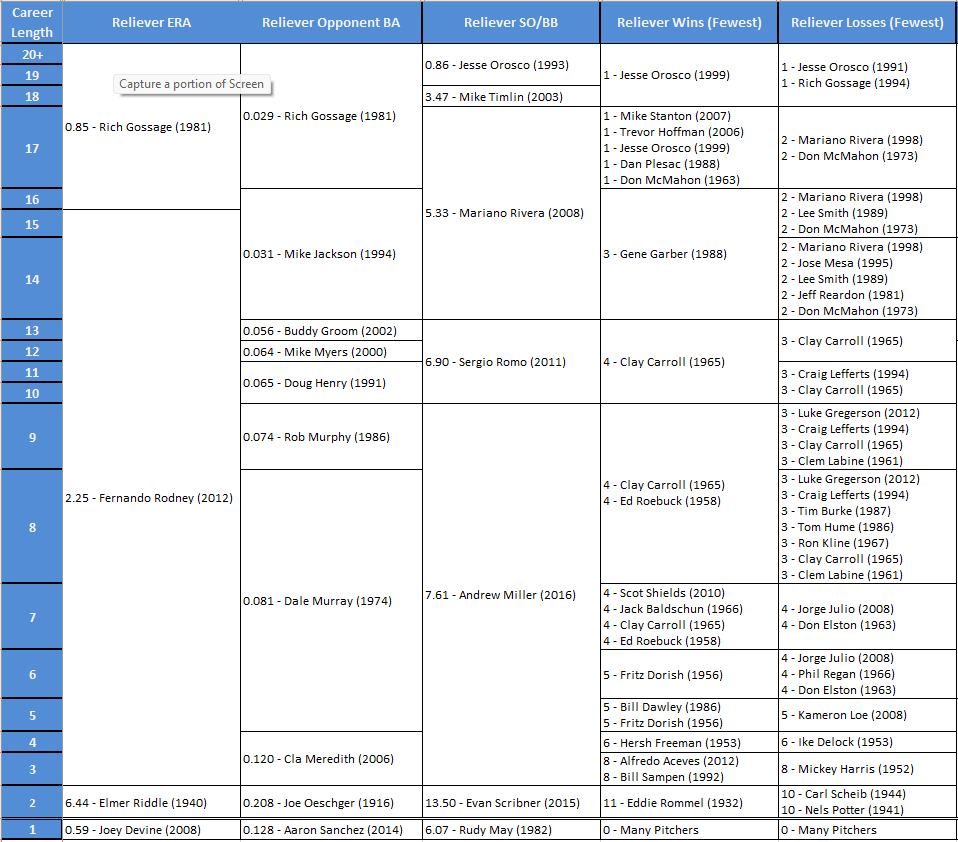
Earned Run Average
- A starter for most of his career, Elmer Riddle makes the list for his 1.87 ERA for the 1940 world champion Reds. But, it was a different story seven years later, with an 8.31 ERA and 2.407 WHIP in his other relief season. Riddle bounced back the next season, with 2.7 WAR in 191 IP as a Pirate starter. Riddle and his brother Johnny, a seldom used reserve catcher, had been teammates on the Reds and were reunited for a final time on that 1948 Pirate team. Johnny caught Elmer only once with the Reds, and for only four batters, two of whom homered. In their first game together with the Pirates, the battery lasted just two batters, both of whom homered. In a probable second game later that season (it’s “probable” because there’s no play-by-play but, unless the Pirates left the bases loaded in the 8th, the brothers had a full inning together), two runs scored but nobody homered so maybe that’s a small improvement. Regardless, the Pirates rallied for three runs in the 8th to get Elmer off the hook for the loss, then walked off the Phillies in the 9th on a home run by pitcher Kirby Higbe, who had relieved Elmer in the top of the inning.
- Joey Devine‘s pitching was truly divine in his 2008 season, with 0.59 ERA, 0.832 WHIP, 4.5 H/9 and zero HR allowed over 45⅔ IP. That ERA ranks 3rd in 30+ IP relief seasons, and Devine’s 2.0 WAR and 153 ERA+ rank 5th and 6th, respectively, in relief careers of 50+ games and fewer than 100 IP. Finally, Devine’s 87 consecutive relief outings without allowing a home run is the longest streak to end a live ball era career, and second longest (by three games) of the modern era.
Opponents’ Batting Average
- Mike Jackson held opponents to a .164 BA in 1994 as he posted career bests in ERA, FIP, WHIP, H/9, SO/9 and SO/BB. Jackson is one of fifteen pitchers with careers of 1000 or more games.
Strikeout to Walk Ratio
- Jesse Orosco makes the list for his 1993 season when he also posted a career best 2.7 BB/9. Orosco’s 1252 games played is the all-time record for pitchers. Orosco’s career best 31 saves in 1984 was then a Met franchise record, while his 12.3 WAR for the Mets ranks 2nd among relievers in franchise history. Orosco’s 3 wins for the Mets in the 1986 NLCS remains an LCS record.
- Mike Timlin‘s 7.32 SO/BB in 2003 is more than double his second best result in 1998, and is due chiefly to a career best 1.0 BB/9. Not walking batters, though, came at a price as Timlin allowed 11 home runs, second most of his career, while posting 1.2 HR/9, his fourth highest result. Timlin pitched on four world championship teams, two each with Blue Jays and Red Sox. (Quiz: 32. Which other pitcher played in the World Series on four or more championship teams, including two or more championships for each of two or more franchises?) (Catfish Hunter, 1972-74 A’s, 1977-78 Yankees)
- Sergio Romo‘s 14.0 SO/BB in 2011 was almost double his second best 7.10 in 2015, as Romo posted career bests in both SO/9 and BB/9. He also recorded his best results for WAR, ERA, ERA+ and WHIP. Romo posted four consecutive seasons (2010-13) with 60+ games and ERA under 3.00, the longest such streak of seasons by a modern era Giant pitcher. (Quiz: 33. Which pitcher recorded the most such seasons for the Giants?) (Gary Lavelle, 1975-77, 1979, 1982, 1984)
- Following a theme, Andrew Miller‘s 13.67 SO/BB in 2016 was also more than double his next best result in 2014. Miller posted other career bests that season in WAR, Wins, ERA, ERA+, WHIP, BB/9 and SO/9. Miller’s 3.66 WAR per 100 IP is the highest rate by a Cleveland reliever in 100+ career IP, while his 4.39 rate for the Yankees is the highest for that franchise in such careers (Mariano Rivera‘s 4.39 rate is fractionally behind Miller’s, though Rivera did it for almost twelve times as many innings).
- Evan Scribner posted an eye-popping 16.0 SO/BB in 2015, with 9.6 SO/9 and a miniscule 0.6 BB/9, all three career bests. He also allowed 14 home runs in only 60 IP, a 2.1 HR/9 more than four times higher than the 0.5 rate he posted in his other qualified season in 2012. That SO/BB ratio is the highest in any reliever season of 30+ IP with negative WAR.
- Rudy May was a starter for most of his 16 year career, but moved to bullpen for his final two seasons, with qualified innings in the first. Comparing to his seasons as a starter, May posted career bests that year in FIP, HR/9, BB/9 and SO/BB. Two years before, in 1980, May posted a career high 4.9 WAR while leading AL starters in ERA, ERA+, FIP, WHIP and SO/BB. (Quiz: 34. Besides May, which other live ball era southpaw pitcher recorded 30+ CG and 30+ GF in less than 1000 IP for the Yankees?) (Tommy Byrne)
Wins (Fewest)
- Mike Stanton posted his career low in wins in his final season with the Reds. His ERA, ERA+, H/9 and WHIP were also the worst of his career. Stanton recorded three World Series in which he allowed no runs and only intentional walks over four or more appearances; no other relief pitcher has done so more than once.
- Trevor Hoffman posted zero wins for his 2006 season, while leading the NL with 46 saves and finishing 2nd in CYA voting. Hoffman had also been CYA runner-up the other time he led his league in saves, in 1998.
- Gene Garber had nary a win in his final season with the Royals. Garber earned his 16th save of the 1978 season by striking out Pete Rose to end this game, and also end Rose’s 44 game hitting streak, longest of the modern era in the National League.
- Clay Carroll recorded zero wins in his 1965 rookie season with the Braves. Carroll led the majors with 37 saves for the 1972 Reds, but his blown save in game 4 of that year’s World Series gave the A’s a 3-1 series lead; the Reds battled back to force game 7, but the A’s prevailed for their first World Series title in 42 years.
- Ed Roebuck didn’t win a game in 1958, while posting a career worst 1.8 HR/9. Roebuck had also recorded 1.5 HR/9 in both 1955 and 1956, giving him three of the worst thirteen results for pre-expansion Dodger relief pitchers, a track record that led to a demotion to the minors for all of the 1959 season (where he allowed only 0.2 HR/9 in 196 IP as a starter). Back with the big club, Roebuck posted a career best 2.5 WAR in 1960, then was injured for most of 1961, but returned the next year as a bullpen mainstay, pitching 22 relief innings with a 2.45 ERA in a tense September pennant chase. When the calendar turned to October, Roebuck logged 8 more IP in the 1962 pennant playoff, pitching in all three games (for 6 games in 7 days), but ultimately ran out of gas in the 9th inning of the deciding game as the Giants rallied from two runs down to take the pennant. A slow start the next season resulted in a trade to the Senators, before Roebuck finished his career with the Phillies where, in 1964, he again figured prominently in a famous pennant race, with 18 IP and a sparkling 1.00 ERA in eleven Sep/Oct appearances.
- Scot Shields went winless in his final 2010 season while posting career worst results in WAR, ERA, ERA+, FIP, WHIP, H/9, HR/9, BB/9 and SO/BB. Shields leads Angel relievers in career Wins, Losses and IP, and ranks 3rd in WAR and WAA.
- Jack Baldschun won just one game for the 1966 Reds while posting career worst results in ERA, ERA+, WHIP and H/9. He spent most of the next two seasons in the minors, before finishing his career with the expansion Padres where he posted an 8-2 record, but with -1.4 WAR and 65 ERA+. Baldschun posted a Phillie franchise record two relief seasons (1962-63) with 2+ WAR, 10+ Wins and ERA+ of 125 or more. (Quiz: 35. Which pitcher shares that franchise record with Baldschun?) (Turk Farrell, 1957 & 1960)
- Fritz Dorish failed to win even one game in his final season in 1956. Dorish ranks 2nd in the pre-expansion era for career WAR, WAA, Wins, IP and ERA+ among White Sox relievers with 200+ IP for Chicago.
- Hersh Freeman won just a single game for the 1953 Red Sox while posting career worst results in WAR, ERA, ERA+, WHIP, H/9, BB/9, SO/9 and SO/BB. A move to the senior circuit in 1955 changed Freeman’s fortunes dramatically, as he became one of only three pre-expansion Reds relievers to post 120 ERA+ or better in 200+ IP for Cincinnati.
- Bill Dawley posted an 0-7 record for the 1986 White Sox, despite 1.6 WAR and decent results across the board, including 132 ERA+ over 97⅔ IP. Dawley was one of the NL’s leading relievers in 1984, ranking 1st in Wins, 2nd in ERA and ERA+, 3rd in WAR and 4th in WAA. Dawley is one of three Astro relievers to record 20+ Wins and a .600 W-L% in 200+ IP for Houston.
- Alfredo Aceves logged a 2-10 record for the 2012 Red Sox while posting career worsts of -1.2 WAR, 5.36 ERA and 79 ERA+. That flipped the script from the season before when he posted a 10-2 record and career best 2.7 WAR to go with 2.61 ERA and 165 ERA+. Aceves’ .833 W-L% (15-3) is a Yankee franchise high among relievers with career totals of 50+ games and 100+ IP for New York.
- Bill Sampen posted a 1-6 record in 1992 with a 3.25 ERA. His next lowest win total was the season before with a 9-5 record but a 4.00 ERA. Sampen is one of five Expo/National relievers with 20+ wins and ERA under 3.50 in 200+ IP over the first three seasons of a career.
- Eddie Rommel won just one game for the A’s in his final season in 1932, while posting career worsts in WAR, ERA, ERA+, WHIP, H/9 and HR/9. His other relief season was three years earlier with 1.7 WAR, a 12-2 record and 2.85 ERA (148 ERA+). Rommel’s franchise career ranks include 3rd in WAR and IP, 4th in Wins and 5th in ERA+, among pitchers with 1000+ IP for the Athletics.
Losses (Fewest)
- Lee Smith posted a 6-1 record with 25 saves for the 1989 Red Sox, while recording a career best 12.2 SO/9. Smith posted an ERA under 3.00 in 200+ appearances for both the Cubs and Cardinals. (Quiz: 36. Which other relief pitcher did the same?) (Bruce Sutter)
- Jose Mesa went undefeated in 62 appearances for the 1995 AL champion Indians. He also posted career bests in WAR, Saves, ERA, ERA+, FIP, WHIP and H/9. Mesa is the only relief pitcher to finish his career with fourteen consecutive seasons of 50+ appearances.
- Jeff Reardon posted a 3-0 record in his 1981 season split between the Mets and Expos, while also recording a career best 0.981 WHIP. Reardon’s 1.85 ERA is a franchise record low over the first 100 relief appearances for the Expos/Nationals.
- Craig Lefferts lost just once in his final season for the 1994 Angels, but posted career worst results for WHIP and H/9. Lefferts’ 9.4 career pWAR leads modern era German-born pitchers. (Quiz: 37. Who is the all-time career pWAR leader among German-born pitchers?) (Pretzels Getzien, 18.9 pWAR)
- Luke Gregerson had no losses for the 2012 Padres while posting a career best 1.9 WAR. Gregerson is the only relief pitcher to start his career with eight seasons of 50+ games, 110 or better ERA+ and WHIP under 1.400.
- Clem Labine lost just once pitching for the defending world champion Pirates in 1961, before finishing his career the next year with a few games for the Mets. The day after Don Larsen‘s perfect game in the 1956 World Series, Labine pitched 10 innings to shut out the Yankees 1-0 and force a seventh game, won by the Yankees 9-0 on a shutout pitched by Johnny Kucks. Those two games are the only times a pitcher has thrown a shutout in a World Series elimination game, when making the only start of his post-season career. (Quiz: 38. Which other pitcher, like Labine, threw an extra-inning shutout in a World Series elimination game?) (Jack Morris, 1991 game 7)
- Tim Burke was undefeated in his 1987 season in which he posted career bests in WAR, ERA, ERA+, FIP, WHIP, H/9, HR/9, BB/9 and SO/BB. Burke’s 356 ERA+ that season is the best in any 85+ IP relief season. Burke is the franchise career WAR leader among Expo/National relievers.
- Tom Hume lost just one game in his 1986 season with the Phillies. Hume is one of eight modern era Reds pitchers to make 25+ starts and 25+ relief appearances in 200+ IP over the first two seasons of their careers. (Quiz: 39. Which of those pitchers played those seasons for two pennant winning teams?) (Gene Thompson, 1939-40)
- Ron Kline posted a 7-1 record for the 1967 Twins. Kline’s four seasons (1963-66) of 75+ IP with 1.5+ WAR are a the most by a Senator/Ranger reliever.
- Jorge Julio was undefeated in his 2008 season split between the Indians and Braves. Julio’s 217 ERA+ in 2002 is the best by a Browns/Oriole reliever in a 60+ IP rookie season with SO/BB of 2.00 or more.
- Don Elston suffered just one loss for the 1963 Cubs, while posting career best WHIP and BB/9 and second best ERA and FIP. Elston and HoFer Lee Smith are the only Cub relievers to finish 30+ games in five or more consecutive seasons.
- Phil Regan posted a stellar 14-1 record for the 1966 Dodgers while recording career bests in WAR, ERA, ERA+, FIP, WHIP, H/9, SO/9 and SO/BB. Regan’s .933 W-L% that season is the best by a Dodger reliever in a season with 15+ decisions. It was the Dodger franchise record for any pitcher in such seasons, until Tony Gonsolin posted .944 (16-1) in 2022.
- Kameron Loe was undefeated in his 2008 season for the Rangers. Loe’s WAR, ERA, FIP, WHIP and H/9 are all worst among Senator/Ranger pitchers with 40+ starts and 40+ relief appearances over the first four seasons of their careers.
- Ike Delock lost only once for the 1953 Red Sox when he posted career best HR/9, but career worst WHIP and H/9. Delock and Derek Lowe are the only pitchers to record 100+ starts and 100+ games finished for the Red Sox.
- Mickey Harris did not record a loss in his final season in 1952, despite posting career worst ERA+ and HR/9. As a Senator in 1950, Harris led AL pitchers in Games, Games Finished and Saves. (Quiz: 40. Which Minnesota Twins pitcher did the same?) (Mike Marshall, 1979)
- Carl Scheib did not record a decision in his 1944 rookie season, in which he posted career best HR/9, SO/9 and SO/BB. Scheib’s 21 games pitched before his 18th birthday are tied with Jim Derrington for the most in the modern era.
- Nels Potter posted a 3-1 record in his 1941 season, in which he posted career worst ERA, ERA+, WHIP, BB/9, SO/9 and SO/BB. Potter’s 19.5 WAR for St. Louis is a franchise high for pitchers with fewer than 1000 IP for the Browns/Orioles.
I have the results for Swingman seasons still to follow, but I think the post is already long enough, so I’ll leave that for another day. Thanks for sticking with me through my rambling comments; I hope you’ve found them at least somewhat interesting.