Oldest Players with Pinch Home Runs by Franchise

Last season, Justin Turner hit the first walk-off home run of his career, a two-run pinch-hit blast against the Orioles on August 3rd that kept the Cubs just two games back of the division-leading Brewers. What the 40 year-old Turner may not have known was that he had become the oldest Cubs player to hit a pinch home run. After the jump, more on pinch home runs by “experienced” players.

Turner actually first became the oldest Cub with a pinch home run four weeks earlier, in a much less memorable 8-1 loss to the Twins. Before that, the record-holder was none other than Mr. Cub himself, Ernie Banks, connecting off of Tug McGraw in an 11-7 win over the Mets in 1971, one of seven players to go deep on a windy day at Wrigley.

Stathead records 128 games in which a player aged 40 or older hit a home run in a game he entered as a pinch-hitter. In most, but not all, of these games that home run came in a pinch-hit AB. The youngest of these players was Bob Thurman, whose 3-run pinch blast on his 40th birthday in 1957 vaulted his Redlegs into the lead (but one they would later relinquish to the visiting Phillies). Only two players aged 40 or older have hit a pinch home run and then added a second blast in the same game: 42 year-old Albert Pujols on May 22, 2022; and 40 year-old Raul Ibanez on Sep 22, 2012. Ibanez’s game, good for 0.867 WPA, is particularly notable as his second blast capped a 4-run 13th inning comeback by the Yankees to extend a game they walked off in the next frame. The win kept New York atop the AL East, a game ahead of the Orioles, who also won in extras that day.

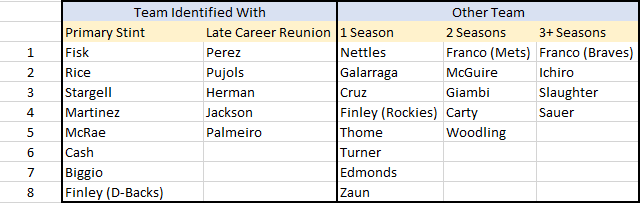
So, which players hold franchise records as the oldest player with a pinch home run? Here’s the list.
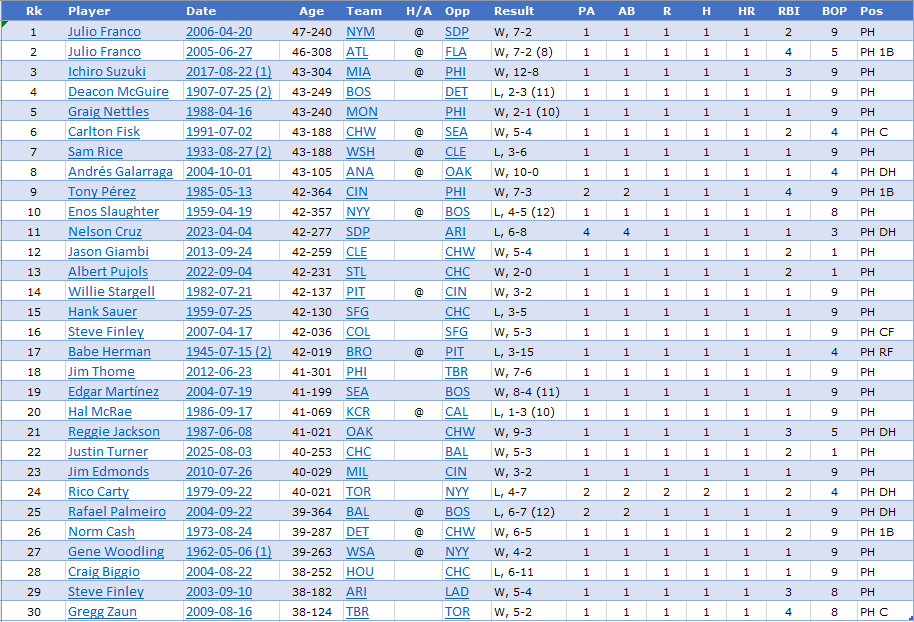
Some comments about these players and games are found below, matched by number to the table above.

  1. Unsurprisingly, Methuselah tops this list with record blasts for two franchises. Franco holds down the top 3 spots, and 22 of the top 24, in the list of oldest players with a home run. Included among his 23 blasts in those 22 games are four pinch home runs, including the two shown here. As a Met, Franco’s 8th inning blast delivered the first runs of a 6-run uprising that carried the New Yorkers to a 7-2 win.
  2. As a Brave, Franco became the oldest player to hit a grand slam homer, helping his team to another 7-2 win. That was one of four 4+ RBI games for Franco aged 44 or older; nobody else has any. The oldest Braves to hit a pinch home run before the franchise moved to Atlanta were 41 year-old Mickey Vernon for the Milwaukee Braves in 1959, and 37 year-old Ab Wright for the Boston Braves in 1944. Before that season, Wright had last played in the majors nine years earlier; he showed some pop in Beantown to become the oldest Boston Brave to homer in 3.5% of AB in a 200+ PA season.
  3. Ichiro‘s home run was the last of his career, a 3 run shot to break open a tied game in the 7th inning. Suzuki’s blast was one of 27 pinch hits for the 43 year-old that season, one shy of John Vander Wal‘s record total in 1995.
  4. Deacon McGuire‘s shot was also the last of his career, a game-tying blast in the 9th inning of what is the earliest of the games highlighted here. It is also the only “bounce” homer on this list, and of McGuire’s career (that we know about). If you’re cringing at the thought of a bounce homer making this list (or because McGuire had only 7 PA for Boston), the next oldest Red Sox player is 40 year-old Tony Perez in this 1982 game.
  5. Graig Nettles also appears on this list with the last homer of his career, a game-tying shot in the 8th inning of this 1988 game, won by the Expos in extras on a walk-off hit by Tom Foley (Foley is the most recent of 15 modern era players, including two HoFers, to begin a career with twelve consecutive 100+ PA seasons, each with OPS+ under 100). Nettles’ second-to-last homer was also as a pinch-hitter, for Atlanta the season before, when Nettles became the oldest Brave with a pinch home run (until Franco came along). The oldest Washington National with a pinch home run is 37 year-old Jayson Werth in this 2016 game.
  6. Carlton Fisk‘s 8th inning blast tied this game for the White Sox in 1991. He would add two multi-HR games later that season, then the oldest player with a two HR game, and still the oldest with a pair of such games in a season.
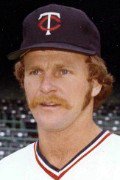
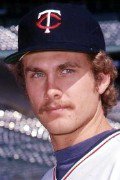
  7. Sam Rice was exactly the same age as Fisk when he made this list for his final home run as a Senator. Playing for the Indians the next season, Rice homered leading off this game to become the oldest player with that accomplishment (Rickey Henderson was three months older than Rice when Henderson homered for the final time of his career, leading off the bottom of the first inning in this 2003 game). The oldest Minnesota Twin with a pinch homer is 39 year-old Jim Thome with a 9th inning blast against the Phillies in 2010 to key a 5-run rally and an eventual 13-10 win in extras.
  8. Andres Galarraga makes this list for the last home run and last hit of his career, coming in his final PH appearance. This was the next-to-last game of Galarraga’s career, but just his sixth tilt as an Angel. The next oldest Angel with a pinch homer is 38 year-old Joe Adcock, with an 8th inning game-winning shot in this 1966 contest.
  9. Tony Perez makes the list playing for the Reds in 1985 on the day before his 43rd birthday and connecting for a 6th inning granny to break open this tied game against the Phillies. Perez’s 138 OPS+ that season is the best by 25 points among players aged 43+ in a 200+ PA season.
  10. Enos Slaughter‘s blast was a 9th inning game-tying shot for the Yankees in this 1959 game. Slaughter’s 6 homers that season was then a record total for players aged 43 or older, a record that would stand for 24 years, until Yaz reached double digit dingers in 1983. Once recognized as the origin of the Yankee franchise, the Baltimore Orioles of 1901-02 hit a total of 57 home runs, but none (that we know of) by pinch-hitters.
  11. Nelson Cruz makes the list in his third game, and first PH appearance, as a Padre. Cruz’s 464 career homers are the most among players with none before their 25th birthdays.
  12. Jason Giambi makes the list for the Indians with a come-from-behind walk-off shot in the last week of the 2013 season. That blast makes Giambi the oldest player to hit a walk-off home run, as a pinch-hitter or otherwise. The win kept Cleveland one game up on the Rangers in the race for the second (and last) AL wildcard spot (the Indians made it; Texas didn’t).
  13. Albert Pujols‘ 8th inning blast drove in all of the Cardinal runs in a 2-0 win and series sweep of the Cubs. This was the first of nine Sep/Oct homers for the 42 year-old Pujols in the final month of his career, tying him with 40 year-old Darrell Evans in 1987 for the most Sep/Oct homers among players aged 40 or older.
  14. Willie Stargell‘s 8th inning solo shot won this 1982 game for the Bucs. It would be the last home run of Stargell’s career.
  15. Hank Sauer‘s solo shot in this 1959 game was the last home run and last hit of his career, and the only hit of his final season. Sauer’s 39 homers over his three age 40+ seasons was a Giant franchise record until surpassed by Barry Bonds. The oldest New York Giant with a pinch home run is 40 year-old Gabby Hartnett in this game from his final season in 1941. Hartnett retired with 236 career home runs, the most among catchers until he was passed by Yogi Berra in 1956.
  16. Steve Finley makes the first of two appearances on this list with a blast leading off the 8th inning that keyed a 5-run Rockies uprising for a come-from-behind 5-3 win over the Giants. It would be the last home run of Finley’s career and the only long ball of his final season.
  17. Babe Herman is the most unlikely name on this list. Herman’s major league career had seemingly ended eight years before, after which he compiled seven productive minor league seasons, the last six with the Pacific Coast League’s Hollywood Stars. But Herman had retired from pro ball when the Dodgers came calling in mid-season of the 1945 campaign, desperate for bodies to fill a war-depleted roster. The 42 year-old Herman got a pinch knock in his first game and a pinch homer in this contest, the fourth of his 37 appearances, all but one as a pinch-hitter. The oldest Los Angeles Dodger with a pinch home run is 41 year-old Albert Pujols in this 2021 game.
  18. Jim Thome makes the list in his final season and second stint as a Phillie. Thome was still going deep at a good clip, with 8 homers in 163 AB (about a 30 HR rate for a full season), but was a dud as a Phillie pinch-hitter, going 1 for 17 in that role. But the one was memorable, a walk-off blast to beat the Rays in this 2012 contest.
  19. Edgar Martinez makes the list with a 9th inning game-tying shot against the Red Sox. That last place 2004 Mariners team was a true greybeard unit, with all nine of the regulars (on the team’s B-R page) aged 30+, including four age 35+ players. Joining Martinez in the over-40 club were reserve catcher Pat Borders and staff “ace” Jamie Moyers (7-13, 5.21 in 202 IP).
  20. In a battle between 41 year-olds, Hal McRae took Don Sutton deep for an 8th inning game-tying blast in 1986, but the Angels prevailed in extras, en route to taking the AL West crown (remarkably for a post-season team, those Angels boasted a record seven age 35+ players with 90+ games). McRae saved his best for this last time facing the HoF righty, against whom he managed only 2 for 19 for his career.
  21. Reggie Jackson‘s 3-run blast broke open this 1987 game as the A’s trampled the White Sox. This game was the first in which three A’s pitchers each struck out four or more batters, something that has happened only one other time since then. The oldest Athletics with a pinch homer before the franchise moved to Oakland were two 39 year-olds: Jim Rivera for the Kansas City A’s in 1961; and Wally Moses for the original Philadelphia A’s in 1950 (in their first season playing in Sacramento, the A’s connected for four pinch homers, all by players aged 28 or younger).
  22. Justin Turner’s game for the Cubs is discussed at the top of this post.
  23. Jim Edmonds‘ two-out 8th inning blast won this 2010 game for the Brewers. Edmonds’ 2 WAR season for the Brewers that year is easily the best of only four age 40+ players to play a final season in Milwaukee (actually, the best of six players, if you include these guys). The oldest Seattle Pilot with a pinch home run wasn’t all that old (though he was playing in his final season); 31 year-old Jim Pagliaroni went deep against the Yankees in this 1969 game.
  24. For the last home run of his career, 40 year-old Rico Carty went deep for the Blue Jays against 40 year-old Yankees reliever Jim Kaat in this 1979 game. Carty is one of twelve players to finish a career with four consecutive qualified seasons, each with triple digit hits and double digit homers.
  25. Two days shy of his 40th birthday, Rafael Palmeiro‘s 9th inning blast for the Orioles tied this 2004 game, but the world champion-to-be Red Sox prevailed in extras. Boston was also the opponent seventy years earlier when 38 year-old player/manager Rogers Hornsby became the the oldest St. Louis Brown with a pinch home run, keying an 8th inning rally and a come-from-behind 4-3 win. In this franchise’s inaugural season in 1901 as the Milwaukee Brewers, the team hit 26 home runs, but none (that we know of) by pinch-hitters.
  26. Norm Cash‘s 9th inning two-run blast tied the game as the Tigers topped the White Sox 6-5 in this 1973 contest. Two years earlier, at age 37, Cash edged out HoFer Hank Greenberg as the oldest Tiger with a 30+ HR season; Darrell Evans is the only older Tiger with such a season (or two) since then.
  27. Gene Woodling‘s 8th inning shot off of former teammate Ralph Terry keyed a 3-run rally as the expansion Senators edged the defending world champion Yankees in this 1962 game. Woodling moved on to the Mets a month later as he and Bob Cerv (another former teammate) became the only modern era players to post consecutive seasons playing for a franchise in its inaugural campaign. The oldest Texas Ranger with a pinch home run is 36 year-old Shin-Soo Choo in this 2019 game.
  28. Craig Biggio‘s solo shot to the Crawford box came in a losing effort for the Astros in this 2004 game. Biggio (1995-2005) and Jason Kendall (1996-2006) jointly hold the modern era record of eleven consecutive seasons with double digit HBP. Tommy Tucker is the all-time record holder with thirteen straight seasons (1887-99), the same number Biggio likely would have had if not for the 1994 strike.
  29. Steve Finley‘s 8th inning 3-run blast capped a comeback from 4-0 down as the D-Backs edged the Dodgers in this 2003 game. While Finley surely enjoyed that encounter with the Dodgers, he wanted nothing to do with L.A.’s other team: Finley posted .645 OPS in 112 games as an Angel, and .603 OPS in 38 games playing against the Halos.
  30. Gregg Zaun‘s 8th inning granny was the game-winning knock for the Rays in this 2009 game against Zaun’s former team, the Blue Jays. Zaun’s 0.56 WAR per 100 PA leads all Blue Jay catchers with a minimum 400 games caught for Toronto (you actually have to drop below 100 games caught to find anyone with a higher WAR rate).

Subscribe
Notify of
guest

59 Comments
Oldest
Newest Most Voted
Inline Feedbacks
View all comments
no statistician but
no statistician but
1 month ago

This list is remarkable for a couple of reasons not mentioned:

1) The hefty presence of HOF members, eleven, if you include shoo in Albert Pujols.

2) The near absence of players that haven’t something of resonance about their careers,
Gregg Zahn being the outlier here.

I’ll have some additional observations when time permits.

Doug
Doug
1 month ago

Zaun may lack some cachet, but once he finally got the opportunity to play regularly in Toronto, he made a quite creditable showing, ranking 11th in WAR by catchers aged 33+, just behind Yogi Berra and just ahead of Ernie Lombardi. Here’s the top 25.

No doubt part of Zaun’s late career success was not having the miles on him that most of the others on that list did, but an impressive showing nonetheless.

Scary Tuna
Scary Tuna
1 month ago

That occurred to me, as well, nsb. What also seemed remarkable was how many excellent players are the oldest with a pinch-hit home run for franchises with whom they spent very little time. I didn’t even remember Nettles played for the Expos, nor Galarraga for the Angels, nor Edmonds for the Brewers. Upon reflection, though, both facts make sense. Really good players are the ones who will still have opportunities into their late 30s and early 40s.  Many of them, though not all, were performing below replacement level at the time. They wouldn’t be playing unless they either sold tickets and merchandise or… Read more »

no statistician but
no statistician but
1 month ago
Reply to  Doug

Doug:

You’ve forestalled most of my promised observations with this chart. I have another one or two, however, that I might work into shape.

Bob Eno
Bob Eno
1 month ago

Most remarkable of all is that Justin Thomas hit his advanced-age HR despite having a career record of just one PA: a strikeout.

(Just having a little fun at your expense, Doug, while suggesting a little clean-up on Aisle A1.)

no statistician but
no statistician but
1 month ago
Reply to  Doug

This just in.

Bob Eno
Bob Eno
1 month ago

For me, the interest of posts like this one isn’t analytic; it’s the opportunity to follow the breadcrumbs of this or that instance and learn new (or relearn old) things about baseball history. In this case, Hank Sauer’s name caught my eye, and I want to say more about Sauer in a moment. But Sauer’s name also led me to Dutch Leonard, and then on to Dutch Leonard. The two Dutch Leonards are each interesting stories — worth your time looking over their records and reading their very different SABR stories (especially the later Leonard’s, which shows the critical influence… Read more »

no statistician but
no statistician but
1 month ago
Reply to  Bob Eno

Bob: I don’t think you’re giving Hank Sauer enough credit. Roberts ought to have won the 1952 MVP, no doubt there, and Robinson and Musial were the best position players per WAR, as they had been the previous three years (along with Ralph Kiner, by the way, whose meteoric career started to fade in ’52. More about Kiner in a moment.) But—Sauer. In 1952 Sauer was already 35 years old, hadn’t made the majors to stick for a number of reasons until 1948 when he was already 31, Robinson 29, Musial 27. In 1947 he had been the Minor League… Read more »

Bob Eno
Bob Eno
1 month ago

Wonderful analysis, nsb, and far fairer to Sauer than I was! Your general framework for highlighting the value of Sauer’s contributions actually provides a nice segue for me to write a bit about Dutch Leonard #2, who was Sauer’s Cubs teammate in 1952, providing excellent relief work. When I saw Leonard’s name I recalled he was the second of two Dutch Leonards and I decided to learn more about both. Leonard #2, who was less well known (and nicknamed after Leonard #1), impressed me much more. The first thing that struck me is that Leonard won 191 games, ten more… Read more »

Doug
Doug
1 month ago
Reply to  Bob Eno

Leonard’s bat was a real liability for his value. You could say the same about almost every pitcher, but Leonard was especially weak with the lumber. He is one of 24 modern era players (23 pitchers plus Bill Bergen) with OPS under .400 in a 1000+ PA career (132 pitchers have this many PA). But, he has some good company, incl. 8 HoFers.

Last edited 1 month ago by Doug
Bob Eno
Bob Eno
1 month ago
Reply to  Doug

I have several thoughts about this, Doug. They concern the salience of poor pitcher batting in assessing pitcher excellence, the problem of pitcher batting in historical terms, and questions about pitcher fielding. (1) Men who can hit MLB pitching with some success have always been a small percentage of the population. It is an exceedingly difficult skill and, of course, position players are selected primarily for this skill, with lower requirements for those who can handle the most demanding defensive positions: middle infield and catcher. Even at those demanding positions, with the singular exception of Bill Bergen there is always… Read more »

Doug
Doug
1 month ago
Reply to  Bob Eno

Well said. What makes things worse is that Stathead doesn’t list pWAR among the fields that one can run queries with. For positions players, oWAR and dWAR are both available, but only WAR for pitchers.

Another feather in Leonard’s cap: he and Roger Clemens are the only pitchers to compile 3 WAR per 100 IP over 200+ IP aged 42 or older. And, Leonard had the higher rate.

Last edited 1 month ago by Doug
Bob Eno
Bob Eno
1 month ago
Reply to  Doug

I guess that leaves Leonard as the King of Non-Cyborg Geriatric Pitchers.

Bob Eno
Bob Eno
1 month ago

Bill Mazeroski died yesterday. I was not by nature a Pirate fan but his famous HR was one of the happiest moments of my baseball-fan life. There’s a story behind that — I think I’ve told it here before, though (how many times?), and Heaven forbid I repeat myself, as I frequently say. I have something else on my mind, the result of a B-R meander in Maz’s honor. Looking at Maz’s fielding records led me to spot on some B-R page Bobby Grich’s, and following up on Grich led me to the 1973 MVP vote where he was so… Read more »

Doug
Doug
1 month ago
Reply to  Bob Eno

No wonder Maz’s RF was so good, with his twin brother out there with him all the time.

Maz, incidentally, was one of the HoFers alluded to in my passing comment about Tom Foley in the Nettles blurb.

Scary Tuna
Scary Tuna
1 month ago
Reply to  Bob Eno

Bob, the link takes us to the single season leaders for Rtot, where Mazeroski shows up twice. His 23 Rtot runs in both 1958 and 1963 are tied for fifth place among second basemen. Remarkably, though, he seems to be the only player with more than one season among the Top 24.

When switching to the career leaders among 2B, Maz only shows up once, in his rightful spot on top.

Bob Eno
Bob Eno
1 month ago
Reply to  Scary Tuna

Well, Scary, a little research reveals the simple reason for this: I pasted the wrong link. The link should have been this one, but it will be useless for you because you’ve already figured all this out!

Apologies. Maz and Fox are the Keystone Sackers who apparently shared a genetic deformity.

Scary Tuna
Scary Tuna
1 month ago
Reply to  Bob Eno

Honestly, I glossed right over that at first. Now I see that the resemblance is uncanny!

Doug
Doug
1 month ago
Reply to  Scary Tuna

And no. 1 on the list is … Jamey Caroll. Who, you say (or, at least, I said). Caroll was a 29 year-old rookie with the 2003 Expos who played until age 39, mainly on account of his defense. It was “have glove, will travel” for Jamey who played for six franchises in his twelve seasons, playing 190+ games for five of them, but only twice compiled qualifying PA, turning in 2.2 dWAR as the Rockies regular second baseman in 2006, and 1.8 dWAR at age 38 for the Twins in 2012. Caroll (2002-14), Nick Punto (2001-14) and Michael Young… Read more »

Last edited 1 month ago by Doug
no statistician but
no statistician but
1 month ago
Reply to  Doug

Doug: Caroll played only 109 games at second that year but garnered a 29 TZR score, the highest ever; he never scored in double digits before or after that season. My take? He surely was a fine fielder at second base until his last two years, but it seems to me that, in this case, his total Total Zone Runs are off the chart, meaning that circumstances beyond his skill alone played a considerable part in the result. As you point out, he was used as a utility guy most of the time: in one season he played 70 innings… Read more »

Bob Eno
Bob Eno
1 month ago

nsb, I spent a lot of time looking at Caroll’s record after spotting this a day or two ago and I think it is indeed an anomaly, but not because of any particular formula. Caroll’s exceptionally low error rate over a very high rate of chances indicates that he was basically on fire at Second in 2006. The way TZR operates there is low likelihood that this is an illusion caused by his inability to get close enough to playable chances that official scorers could not pin errors on him. I don’t think there likely were any circumstances beyond Caroll’s… Read more »

Bob Eno
Bob Eno
1 month ago

I was just looking over Dutch Leonard #1’s record to see whether I wanted to write anything about him and it struck me that he’s a good example of the type of innocent anomaly we see with Caroll, where what might appear to be a defect in statistical design is better explained as an infrequently encountered but theoretically predictable major deviation from the norm. Leonard was fairly consistent in the quality of his pitching over his career. He had six good seasons with ERA+ in the 114-121 range, and four poor seasons with his ERA+ in the range of 86-99.… Read more »

Doug
Doug
1 month ago
Reply to  Bob Eno

An interesting intersection between the two Leonards is their head-to-head matchups against Lefty Grove.

As a rookie in 1925, Grove went head-to-head with Leonard-1 in the latter’s final season. And, in his final two seasons at age 40-41, Grove went head-to-head with Leonard-2, seasons that saw Leonard top 9 total WAR, earning an All-Star selection in 1940, and leading in the AL in FIP in ’41. But, rookie or forty-something, Grove was still Grove, getting the measure of both Leonards in their head-to-head matchups, as shown below (Leonard-1 is first).

Dutch-Leonard-vs-Lefty-Grove
Last edited 1 month ago by Doug
Bob Eno
Bob Eno
1 month ago
Reply to  Doug

Thanks for catching this, Doug. Face’s season was remarkable, and made more so by the fact that both he and Hoyt Wilhelm (pitching as a starter for Paul Richards in Baltimore) got off to 9-0 starts — they stood at 9-0 at the same time. Face moved up to 10-0 on June 14 and Wilhelm’s streak was snapped the next day. Face actually got up to 17-0 in mid-September — there was much talk about Rube Marquand’s 19-0 start in 1912 — but then suffered his season’s only defeat. Apart from wins, Face’s season was not particularly remarkable. His ERA… Read more »

Doug
Doug
1 month ago
Reply to  Bob Eno

Here are the two Twins teammates.

Bill-Campbell
Doug
Doug
1 month ago
Reply to  Doug

And the other. In consecutive seasons for the Twins, each pitched (once) over 140 IP, all in relief.

Tom-Johnson
Last edited 1 month ago by Doug
Doug
Doug
1 month ago
Reply to  Bob Eno

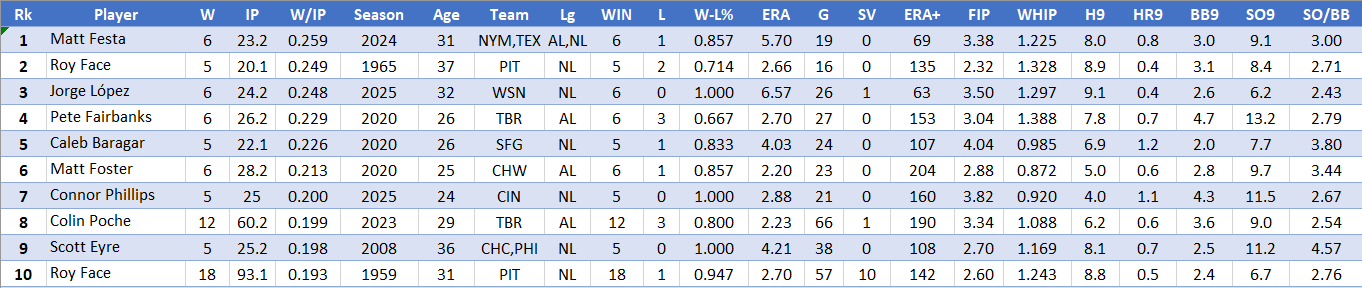
Actually, Face just makes it into the top 10 with his ’59 season, but posts a higher rank for another campaign. Note the embarrassing ERA+ scores for two recent additions to the list (ranked #1 and #3).


Highest-W-to-IP-Ratio-with-5-Wins
Last edited 1 month ago by Doug
Bob Eno
Bob Eno
1 month ago
Reply to  Doug

I should have set the threshold at 7.

How could I ever have overlooked Colin Poche?

But, let’s face it: I’m shamefaced that Face ’65 was staring me in the face as a prima facie counter-case to what I mistook for a facially obvious claim.

no statistician but
no statistician but
1 month ago

Getting back to Doug’s list of oldest HR hitters by franchise, over half of these events have occurred in the New Millennium, or in baseball terms, the three true outcomes era. Only one happened in the dead ball era, only three prior to 1959, only nine prior to 1985. Twenty-one incidents in 41 years vs 9 in 84 years. My sense is that these opposites. (post-dead ball era, anyway), are explainable by a shift in strategy, not by the elongation of playing careers. Most often in the pre-1985 years, or so I intuit, old guys with bats pinch hit for… Read more »

Doug
Doug
1 month ago

Rookie Aaron Judge hit one of the longest home runs I’ve seen. A fan made a leaping bare-handed grab from the second to last row of LF bleachers in T-Mobile Park in Seattle. No player has ever hit one completely out of that ballpark (there are three full decks of seating in RF, so it could only be done in LF) so I have to believe Judge’s blast came the closest. One home run stat that has been going in the other direction from the trend you showed: 1912 – 160 1917 – 92 1927 – 71 1937 – 27… Read more »

Last edited 1 month ago by Doug
Doug
Doug
1 month ago

Mantle makes the list of youngest players with a pinch-HR by franchise, here. Unsurprisingly, nine of the 30 homers were hit in the month of September. The most recent of the games shown was a wild one from last season, when the Rockies spotted the Pirates a pair of 9-run leads (9-0 after half an inning, and 15-6 after 4½ innings), before coming back for a 17-16 win. Overall, the second list is not nearly as interesting as the oldest player list, as only 8 of the 30 homers (including Mantle’s) were hit by the winning team, with the three… Read more »

Last edited 1 month ago by Doug
no statistician but
no statistician but
1 month ago
Reply to  Doug

This new HR list is an interesting complement to the previous one. It, too, has many names that resonate, plus four HOfers—Griffey, Jr., Andrew Jones, Killebrew, and Mantle, and some noted lesser sluggers for their times, such as Soto (a probable HOfer), Burroughs, Horton, Prince Fielder, Mayberry, Luzinski, and Barfield. Only three, however would have qualified by age for the Old Guy list, Griffey, Jr., Killer, and Johnstone, if circumstances had been right. In the other direction, taking 21 as the cutoff age, the picture is different: McGuire, Fisk, Pujols, Thome, Reggie, Palmeiro, and, strangely, Woodling, would qualify as possibles… Read more »

Doug
Doug
1 month ago

I hadn’t thought about the Rice/Suzuki similarity, but it’s certainly there. Also: -Rice and Ichiro both had 200 hits at age 34, 35 and 36, something only Pete Rose has also done. -Those three are the only players with twelve or more 175 hit seasons aged 27 or older (Rice and Rose have 13, Ichiro has 12) -Those three plus Cobb and Wagner are the only players in the modern era with eight or more 95 run seasons including 15 or fewer homers aged 27 or older (Rose and Cobb have 9, the others have 8) -Their oWAR scores are… Read more »

Bob Eno
Bob Eno
1 month ago

Wow — good catch, nsb!! (And the crowd goes wild! . . . ) I went back to see what we’d said about Rice when he was briefly up for CoG consideration in 2014. Not much. He was a quiz item for Doug, who noted as his question background, “Sam Rice and Pete Rose are the only players with 2500 hits aged 30+. Rice’s ten consecutive seasons (1921-30) with 30 doubles and 10 triples is the longest such streak of seasons.” I believe those accomplishments have not since been matched. Voomo and bstar documented Rice’s consistency in TB and OPS+. He garnered zero… Read more »

Doug
Doug
1 month ago
Reply to  Bob Eno

Nice background, Bob. Incredible story about losing his family in a tornado.

So, you don’t think Class D ball is hard labor?

Bob Eno
Bob Eno
30 days ago
Reply to  Doug

You’ve caught me, Doug. I was so mediocre as a player that any day when a coach sent me onto the field (always right field) was a day of joy. (But then, I liked factory work too.) Rice’s SABR bio, which stands out for length over cogency, puts it this way: after Rice’s family tragedy, his name did not appear on the Class D Central Assoc. Galesburg (IL) team opening day roster, and “Rice reportedly spent the rest of 1912 wandering across the Midwest, taking on a series of labor-intensive jobs.” I suppose that could indeed be a reference to… Read more »

Doug
Doug
1 month ago
Reply to  Bob Eno

Here’s a topical quiz. Rice and Ichiro are among this large group of Hall of Famers with a particular career accomplishment. But, the following everyday players, who have the same career accomplishment, are not in the Hall of Fame. 1. Barry Bonds 2. Alex Rodriguez 3. Pete Rose 4. Sammy Sosa 5. 6. 7. 8. 9. 10. 11. 12. 13. Can you complete the above list with the names of everyday players who are Hall-eligible (i.e. last active in 2020 or earlier) and were not on this year’s BBWAA HoF ballot? Hint: the remaining players on the list have not… Read more »

Last edited 1 month ago by Doug
Scary Tuna
Scary Tuna
29 days ago
Reply to  Doug

Good quiz question, Doug! I have had a few ideas that I thought were bright, but each went nowhere quickly.

This morning, I noticed two Hall of Famers who stand out on your list. If I am on the right track now, there is one other player on the Hall-eligible list who matched this rare feat.

Last edited 29 days ago by Scary Tuna
Doug
Doug
28 days ago
Reply to  Scary Tuna

There are two Hall-eligible players currently on the ballot who meet the criteria, and three more retired who meet the criteria but are not yet Hall-eligible.

But, the nine you are looking for are Hall-eligible and no longer on the ballot.

Scary Tuna
Scary Tuna
28 days ago
Reply to  Doug

The other nine Hall-eligible position players who have fallen off the ballot despite earning 50+ WAR for a single franchise are:

– Lou Whitaker
– Dwight Evans
– Ken Boyer
– Stan Hack
– Willie Davis
– Willie Randolph
– Sal Brando
– Norm Cash
– Jose Cruz

Tris Speaker (Red Sox, Indians/Guardians) and Eddie Collins (White Sox, Athletics) are the HOFers who each accomplished this for two franchises. The third player to do so? Barry Bonds, with both the Pirates and the Giants.

Doug
Doug
28 days ago
Reply to  Scary Tuna

Well done. Just barely below the 50 WAR mark for one franchise are Cesar Cedeno (49.8 for the Astros), Bert Campaneris (49 for the A’s) and Miggy (49 for the Tigers). Between 47 and 49 are a bunch of folks including Kenny Lofton, who had 10 seasons with one team, and no more than one season with 10 other teams.

I have a theory that accumulating 50 WAR for one franchise is a surer path to the HOF than accumulating 50 WAR without exceeding that level for any one franchise. But, haven’t tested it yet.

Last edited 28 days ago by Doug
Bob Eno
Bob Eno
28 days ago
Reply to  Doug

This is a much more interesting question than I expected it to be. I think this may be a case where a specific WAR threshold may be less useful than generalizing the question to cover the idea of how much strong team identification contributes to a Hall case. For example, would the Hall odds have been greater for an apparent shoo-in like Curt Schilling if he’d had the perception of single-team “loyalty” to balance the “ethics” case against him? Would Joe Mauer’s “catcher bonus” have made him a first-ballot selection if he’d played for a series of teams?

Paul E
Paul E
28 days ago
Reply to  Bob Eno

Bob,
The self-righteous moralists in the media wouldn’t have forgiven Schilling for being on the wrong side of their beliefs in his or their lifetimes. He served them well when they needed a “baseball” interview or gave them the bloody sock narrative and they let him ride that victory chariot. But that all ended when he blabbered (?) on about his political beliefs

Bob Eno
Bob Eno
27 days ago
Reply to  Paul E

Perhaps not, Paul, but Schilling might have had a much more animated fan base and a true group of sportswriter homies to amplify their outrage at the way he was treated. After all, Schilling peaked at 71% and needed just a few more votes, so we are talking about a minority of sportswriters. As I recall, what fatally ended his fairly normal rise towards a late-eligibility vote was a t-shirt that had a noose or guillotine motif next to some snark about sportswriters. His politics had already created resistance (absolutely illegitimate, in my view), but that he should “threaten” writers… Read more »

Paul E
Paul E
27 days ago
Reply to  Bob Eno

Bob, You may recall that in year nine (of 10) Schilling received 71.1% of the ballot for election to Cooperstown. Schilling then asked the BBWAA to remove him from the ballot and they responded by leaving him on the ballot so, basically, they could screw him before they acknowledged he had any right to being removed. And, they did by coming back in his final season with 58.6% voting for induction. In his ninth year on the ballot, no one was inducted by the BBWAA and Schilling led all eligibles with the 71.1%. The next year only David Ortiz got… Read more »

no statistician but
no statistician but
28 days ago
Reply to  Bob Eno

I’m not sure how this will help your theory, Doug, but a player I’ve championed here from time to time, not for COG consideration but merely as overlooked by any and all HOF committees, is Sherry Magee. He is the highest ranked left fielder (14th) in the JAWS listing without HOF status except baggage-laden Pete Rose and Manny Ramirez, coming in ahead of Stargell, Wheat, Medwick, Minoso, Kiner, Manush, and Jim Rice, all of whom have strong associations, if not 50 WAR, with a single team. Magee did accumulate 48.3 of his WAR with the Phillies franchise, but he appears… Read more »

Paul E
Paul E
28 days ago

NSB, Our man Magee is buried in Drexel Hill PA off State & Lansdowne in “Delco”. This is approximately three miles from where Morrie Rath shot himself in his office above his retail sporting goods store in Upper Darby near the corner of 69th & Market. Rath was the Game 1 leadoff hitter for Cincinnati in the 1919 WS. His “beaning” in the 2st inning supposedly let the bookies/fixers know the fix was on. Rath’s widow ran the store for another 25+ years. Magee is definitely HoF worthy when you consider where his WAR total ranked upon his retirement among… Read more »

Doug
Doug
27 days ago

Good call on Munson. Minor point, but I would think he is more parallel to Campanella than to Puckett in the sense of his career ending through a tragic accident rather than through a debilitating health issue. And, of course, both were catchers on pennant-winning teams in New York, both won MVP awards and both had three seasons batting .300 with 100 RBI (only Dickey and Piazza have more such seasons as catchers). On the other hand, Campanella’s career was close to its end anyway, whereas Munson and Puckett were still making meaningful contributions on the field, so perhaps in… Read more »

Doug
Doug
27 days ago

Was reading Magee’s bio. It paints a picture of a talented but selfish and immodest player who was not a fan favorite. The fan resentment stemmed in large measure from an incident in a July 1911 game in which Magee attacked the home plate umpire (he knocked him out cold with a left to the jaw) and was suspended for the remainder of the season. The suspension was lifted after 37 days but, during that period, the Phillies fell from a ½ game back to 6½ back and in 4th place, and weren’t able to make up the ground after… Read more »

Last edited 27 days ago by Doug
Bob Eno
Bob Eno
27 days ago
Reply to  Doug

I think I first heard about Magee’s toxic personality in “The Glory of Their Times,” but I also read his SABR bio last year when nsb (I think it was nsb) included him in a list of candidates for CoG “redemption” (nsb has made it clear that’s not what he’s suggesting now). My problem with Magee for CoG consideration was simply that his borderline WAR was achieved in an era when low-quality replacement value made it easier for high-skilled players to accumulate larger WAR totals. I looked in the bio for reasons to give Magee special consideration (in the manner… Read more »

Doug
Doug
26 days ago
Reply to  Bob Eno

Regarding Pat Moran, he managed two teams to their first NL pennants, both in his first year as their manager. A heavy drinker, Moran died at age 48 in 1924 while still the Reds manager.

In a reminder of the errors in the early season totals, Moran is credited with an RBI in his final season in which he played one game and did not bat. Play-by-play confirms that that game was only as a 9th inning defensive replacement. But the RBI still stands, officially.

Last edited 26 days ago by Doug
Bob Eno
Bob Eno
26 days ago
Reply to  Doug

Not sure how Moran came up but although I knew of him I didn’t know much about him, and certainly nothing about his orphan career-stat RBI.

It seems to me that the comment section of High Heat Stats has been moving in recent years from a focus primarily on stats to more interest in stories behind the stats — the biographical and professional circumstances that allowed or prevented the realization of talent in performance (at least for careers old enough to have a SABR bio or comparable resources). Works for me!

Paul E
Paul E
25 days ago
Reply to  Bob Eno

Bob,
Is Magee still the only non-Hall of Fame member to lead a major league in RBI four times? Just saying, no diluted WAR involved in that stat…. might be some steroids guy like Ramirez or Arod since who did it?

Bob Eno
Bob Eno
25 days ago
Reply to  Paul E

Magee was a very good player, Paul. If one of the Hall committees elected him I wouldn’t be shocked or at all opposed, and being four-time RBI champ is a strong accomplishment. But RBI isn’t a particularly persuasive traditional stat, and the CoG has a higher threshold than the Hall. It’s irrelevant for the CoG if a player is a non-Hall unicorn; the stat stands on its own. (I don’t know whether he’s the only non-CoG 4-time RBI champ.) Magee has some common features with Reggie Smith, whom I think is a viable Circle candidate, though he won’t be one… Read more »

Paul E
Paul E
28 days ago
Reply to  Scary Tuna

Kudos to the Frightening Fish!! Personally, I wouldn’t have figured this one out in a hundred sturgeon lifetimes 🙁