Most players can point to one season in their careers as their “career year”, when everything clicked, most of their luck was good, and their stat line was clearly head and shoulders above every other season of their careers. Last year I presented a post on everyday players whose best season by various statistical measures showed the largest difference from their second best season by that same statistical measure. With this post I’m presenting the same analysis applied to pitcher metrics. More after the jump on pitchers with the most “exceptional” seasons of their careers.
For this post, I’ve made use of the Lahman database, compiled annually by Sean Lahman. This database has basic statistical information for all major leagues for every season since 1871. The methodology I’ve employed for this analysis is to identify the best and second best seasons for every pitcher for a variety of statistical categories. The pitchers with the largest difference between those two seasons are identified as having the most exceptional seasons for a category, the descriptor “exceptional” denoting the largest difference or greatest exception from all other seasons. The results are illustrated in a chart like the one below, showing the most exceptional strikeout seasons of the modern era.
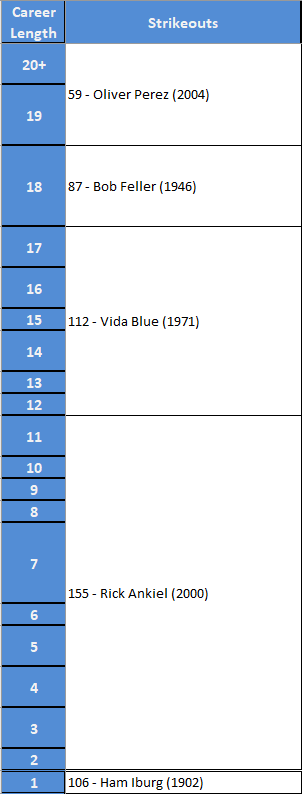
The first column shows career length measured in seasons, and the second is the most exceptional season for strikeouts among players with that career length. Thus, among players with careers of 20 or more seasons, Oliver Perez has the largest difference in strikeouts (59) compared to his next highest season total, and similarly for Bob Feller for careers of 18 seasons or more. Where table rows have been grouped, the top row in the group identifies the player’s career length, and the bottom row identifies the range of career lengths for which his exceptional season applies. Thus, Vida Blue had a 17 season career, but his exceptional season in 1971 shows the largest difference (112) over his second highest total among all pitchers with careers of 12 or more seasons. So as not to be left out, players with the highest total in a one season career are shown in the bottom row.
The seasons in the top half of the table will tend to be exceptional for standing out among many complete seasons for established players. The seasons in the bottom half of the table are more likely to be exceptional as one of a small number of complete seasons or even the only such season, and the players identified more likely to be characterized on a spectrum ranging from “one season anomaly” to “one season wonder”.
I’ve tried to find something interesting to say about all of the players identified in these tables, and have done so for most of them. As you’ll see, the same players and seasons will show up for multiple metrics, but I’ve only done a blurb once for each player.
So, without further ado, let’s begin our look at the most exceptional seasons of the modern era.
Games
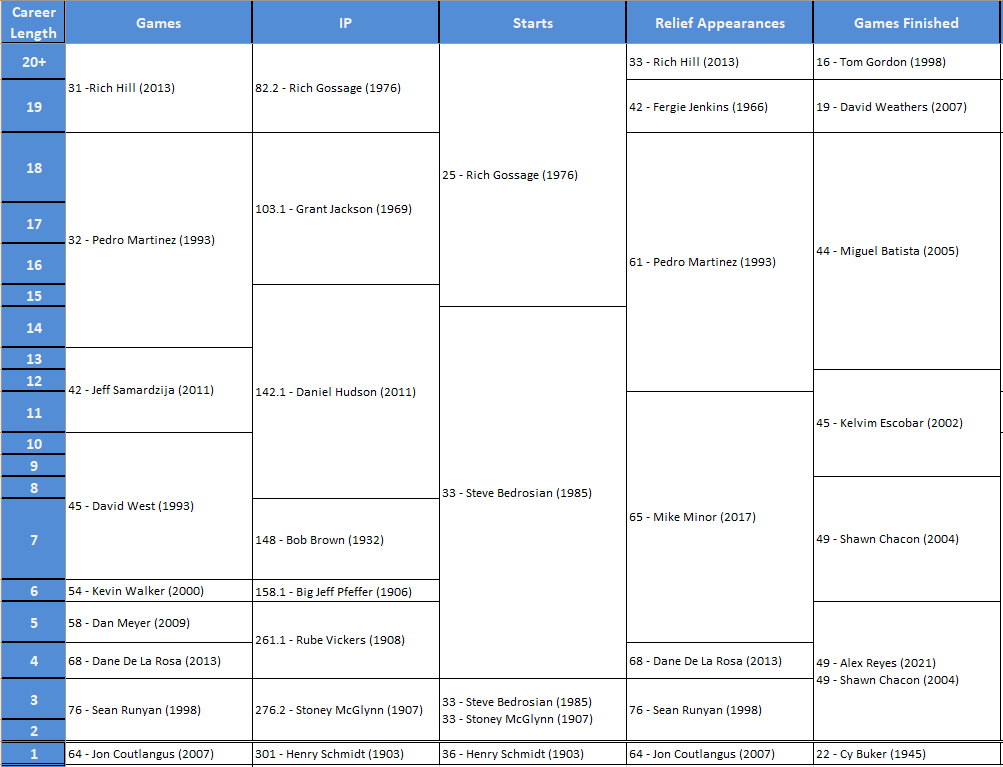
- Rich Hill apparently hasn’t formally retired, but he must surely be done (of course, I said that last year and then the Royals signed him). In any event, the 46 year-old Hill shows up here for his 2013 season with 63 appearances, all in relief. It was Hill’s only season as an Indian and his only campaign as a full-time reliever. He pitched just 38⅔ innings over those 63 games but, if Cleveland wanted an effective loogy, Hill wasn’t the answer as he allowed a .371 OBP to the first batter he faced that year (actually, not far off his .356 career OBP in that split). Those 63 games were almost half of Hill’s 138 career relief appearances, over which he allowed 6.1 BB/9, compared to 3.3 BB/9 as a starter.
- Before he became one of the premier starting pitchers of all time, Pedro Martinez was a Dodger reliever in his 1993 rookie season noted here. Martinez also excelled in that role, compiling 3 WAR with a 10-5 record and 2.61 ERA in a whopping 107 IP, all but 7⅓ in relief (Quiz:1. Which two relief pitchers won RoY honors in a 100+ IP season with 10+ wins?) Joe Black (1952), Butch Metzger (1976). That stellar performance didn’t stop the Dodgers from trading Martinez after the season to the Expos for second baseman Delino DeShields (whose 24.4 career WAR ranks 3rd among second basemen with negative career Rbat and Rfield).
- Jeff Samardzjia‘s 2011 season was his only campaign as a full time reliever and a decent season at that, with an 8-4 record and 2.97 ERA in 88 IP. But, those would be Samardzjia’s last relief innings, as he finished his career with 7 qualified seasons over his final 9 campaigns, topping 2 WAR in five of those years.
- Despite a 5.33 ERA in four seasons starting for the Twins, the Phillies evidently saw something in 6’6″ southpaw David West, trading for him after the 1992 season. In his first season in Philly noted here, West was a bullpen workhorse, making 76 appearances and posting a career best 2.92 ERA. West was a swingman the next year, doing well as a starter (3.16 ERA), but struggling in relief. He finished his career with two more seasons in limited duty as a Phillies starter.
- Kevin Walker‘s season noted here was his 2000 rookie campaign for the Padres, posting a 7-1 record in 70 relief appearances (his .875 W-L% was then a Padre record for any season with 60+ appearances). Walker underwent Tommy John surgery the next season and pitched only 35⅓ innings the rest of his career.
- Dan Meyer‘s 2009 season noted here was his first with regular duty, as he posted a 3.09 ERA (140 ERA+) in 71 appearances for the Marlins. He got off to a poor start the next year and spent most of his final major league season in the minors.
- Dane De La Rosa‘s 2013 rookie season is noted here, when he posted a 6-1 record and 2.86 ERA in 75 appearances for the Angels. De La Rosa’s 0.4 HR/9 that season ranks second (to Brendan Donnelly) among Angel rookie relievers in 60+ IP seasons since 1990.
- Sean Runyan led the majors with 88 appearances (but only 50⅓ IP) in his 1998 rookie season noted here. But 5.0 BB/9 and 1.3 HR/9 did not bode well for his future success.
- Jon Coutlangus made 64 appearances for the Reds in 2007. His 5.9 BB/9 suggests why it was his only major league season. That number follows a notable regression, from 3.4 in A ball, 4.6 in AA and 5.5 in AAA; Coutlangus evidently didn’t have a good answer for more selective hitters.
Innings Pitched
- Rich Gossage make the list with his 1976 campaign, his lone season as a full time starter. Not content with a really good thing (Gossage had turned in 8.2 WAR the year before with a 1.84 ERA over 141⅔ IP, while leading the majors with 26 saves), the White Sox tried to convert Gossage into a starter, as they had done successfully with Wilbur Wood. Fifty years on, Gossage appears to have done a decent job, with 2.8 WAR over 224 IP. He also completed 15 of his 31 starts, second in CG to Mark Fidrych among expansion era pitchers in a lone qualified season. But, at the time, Gossage’s 9-17 record with 3.94 ERA and the lowest strikeout rate of his career all looked pretty dismal. Chicago then compounded the folly of trying to make Gossage a starter by trading him with Terry Forster (a fine young pitcher the Sox ruined through overwork) to the Pirates (for Richie Zisk, who turned in one good season for the Sox before leaving as a free agent). Quiz: 2. Besides Forster, which other pitcher exceeded 200 relief appearances before his age 23 season? (Roberto Osuna)
- Grant Jackson appears for his 1969 season with the Phillies, his first as a full time starter and a successful debut in that role with 3.6 WAR and an All-Star selection. Things didn’t go so well the next year, as an ERA ballooning to over 5 earned him a ticket to Baltimore after the season. Jackson finished his career with more than 500 relief appearances over his last twelve seasons, pitching to a tidy 3.09 ERA. Jackson was a bullpen mainstay on the Pirates 1979 world championship team, continuing his good work in the post-season in which he allowed no runs in 6 appearances and collected the W in game 7 of the World Series.
- Daniel Hudson turned in a promising rookie season in 2010, with an 8-2 record and 2.45 ERA, good for 3.6 WAR from only 95⅓ IP. That led to his 2011 season noted here, with a 16-12 record and 3.49 ERA over 222 IP, but only 1.5 WAR. Hudson struggled the next year before suffering an injury that sidelined him for the rest of that season, and almost all of the next two seasons as well. When he was finally healthy again, Hudson finished his career with ten seasons as a successful reliever, including world championships with the Nationals and Dodgers.
- Bob Brown appears for his 1932 rookie season, posting a 14-7 record and earning 3.1 WAR over 213 IP for the Braves. It appears he was injured or ill the next season, pitching in only 5 games, all in relief. Brown never found his form after that, pitching to a 6.02 ERA over his final three seasons.
- Big Jeff Pfeffer (he was big, but was actually smaller than plain Jeff Pfeffer, his more illustrious younger brother) makes the list for his 1906 sophomore season with the Braves, in which he completed 33 of his 36 starts, but posted only a 13-22 record and 2.95 ERA (just 90 ERA+). Pfeffer’s workload was cut in half the next season, his last as a starter, but his ERA didn’t improve, though he turned in at least one memorable start, no-hitting the Reds in this contest. Neither Pfeffer nor his brother were actually named Jeff; that nickname was bestowed since both were thought to bear a striking resemblance to contemporary heavyweight boxing champion Jim Jeffries.
- Rube Vickers posted his exceptional season in 1908, leading both leagues with 17 GF while also completing 21 games, including 6 shutouts, in 317 IP. Vickers pitched less than half as many innings over his other four seasons, during which he gave up almost half of his 6.2 WAR from that 1908 campaign to finish with just 3.3 WAR for his career. Vickers did not give up a home run in his 1908 season, one of eight such modern era seasons of 300+ IP. Quiz: 3. Which two HoFers were the last pitchers with this accomplishment? Walter Johnson (1916), Babe Ruth (1916)
- Stoney McGlynn was a 35 year-old sophomore pitcher who led the majors in Starts, CG, IP … and losses in his 1907 season, posting a 14-25 record in 352⅓ IP for the last place, 101 loss Cardinals. McGlynn started his professional career at age 32 with the York PA team of the independent Tri-State League; after his time with the Cardinals, McGlynn compiled over 1100 IP aged 37-39 with the Milwaukee Brewers of the American Association. McGlynn is the oldest modern era pitcher to complete the first 10 or more starts of his career.
- The Brooklyn Superbas were the successful suitor for Henry Schmidt after his 35 win season in 1902 for the Oakland Oaks of the independent California League. As a 30 year-old rookie in 1903, Schmidt posted a 22-13 record in 301 IP for the Superbas, despite an 84 ERA+, 0.80 SO/BB ratio and a league-leading 21 hit batsmen. Schmidt declined Brooklyn’s contract offer for the 1904 season, stating that he preferred living in California, and returned thither to pitch over 800 innings the next two seasons with the Oaks.
Starts
- Despite (or maybe because of) three successful relief seasons (26-22, 341⅓ IP, 41 saves, 136 ERA+, 8.7 WAR), Atlanta tried to convert Steve Bedrosian into a starter in 1985, with middling results, as Bedrosian compiled over 200 IP with league average ERA+, but posted only a 7-15 record with 1.9 WAR. Much like the White Sox experiment with Rich Gossage, the Braves then traded away Bedrosian after that one marginal season as a starter, sending him to the Phillies where he would turn in a CYA season in 1987 on the strength of a majors-leading 40 saves.
Relief Apperances
- The Cubs acquired Fergie Jenkins from the Phillies early in the 1966 season and used him extensively in the bullpen for most of that year (90 IP in 48 relief outings), before a move to the starting rotation for the last six weeks of the season. A Hall of Fame career as a starter would ensue, beginning with the first of six consecutive 20-win seasons the following year.
- After beginning his career with 5 seasons as a Braves starter, an injury sidelined Mike Minor for all of the 2015 season and most of the 2016 campaign. When he made it back to the majors in 2017, Minor posted a stellar relief campaign for the Royals with 3 WAR and 176 ERA+ in 77⅔ IP over 65 appearances. Minor resumed his career as a starter the next season with Texas, where he posted a majors-leading 8.0 WAR in 2019.
Games Finished
- Tom Gordon shows up here with his 1998 season, his first as a full time reliever. Flash finished 69 of the 73 games in which he appeared, including a league-leading 46 saves, while earning his first All-Star selection. Gordon and Dennis Eckersley remain the only pitchers with 200 starts and 600 relief appearances. (Quiz: 4. Mike Williams finished all 59 of his relief appearances in 2002, a record total in a season with 100% of relief games finished. Whose record did Williams break?) Doc Crandall, 26 GF in 1911; he led the majors in GF each season 1909-12, finishing 93 of 99 relief assignments.
- David Weathers finished a career high and league-leading 60 games as a 37 year-old in 2007. That was the eighth of a record ten seasons closing Weathers’ career with 65+ games and ERA+ of 100 or better.
- Miguel Batista posted his career high in GF with the Blue Jays in 2005 at age 34, his first season as a full time reliever. He returned to the starting rotation for the next three seasons, before finishing his career with four seasons as a middle reliever and occasional starter.
- Kelvim Escobar shows up here for his 68 GF for the 2002 Blue Jays, his first season since his 1997 debut in which he didn’t start at least 10 games. It would also be the last season of his career as a full time reliever.
- After three seasons in Colorado’s starting rotation, Shawn Chacon became the Rockies closer in 2004, finishing 60 games and saving 35. But that tells only part of the story: Chacon’s -1.5 WAR, 7.11 ERA and 70 ERA+ that season are all second worst (to Brad Lidge in 2009) among pitchers with 30+ saves, while his .100 W-L% is the worst among 178 such seasons with 10+ decisions. Chacon returned to the rotation for three of his final four seasons, and redeemed himself as a reliever in the other season, with 1.5 WAR in 96 IP for the Pirates.
- Alex Reyes was the Cardinal closer in 2021, finishing 54 games and saving 29 over 72⅓ IP, almost matching the 72⅔ IP that he had compiled over his career prior to that season. Reyes’s 18 decisions (10-8) in 2021 are the third most in any season with zero starts and less than 75 IP. I don’t know if he has officially retired, but Reyes hasn’t pitched anywhere since that 2021 season.
- Cy Buker finished 22 games for the Dodgers in his only season in 1945. His SABR bio relates an eventful July road trip to Chicago and St. Louis (the teams Brooklyn was chasing in that season’s pennant race) when the Dodgers’ train collided with an oil tanker truck, killing the truck driver, engineer, fireman and brakeman, and engulfing much of the train in a short-lived inferno. Emerging unscathed from the wreckage, the Dodgers managed to get to Wrigley in time for the next day’s double-header, with Buker starting and winning the second game, beating the Cubs again two days later in a 4⅓ IP relief stint and, two days after that, saving both ends of a double-header against the Cardinals. By the end of the month, no less an authority than the New York Times was hailing Buker as (manager Leo) “Durocher’s fireman” (was this the first use of that term to describe a reliever?). Buker never made it back to the majors after that season, but bounced around (I mean he really bounced around) the minors for the rest of his professional career, playing for affiliates of the Dodgers, Braves, Yankees, White Sox, Giants and Athletics.
Complete Games
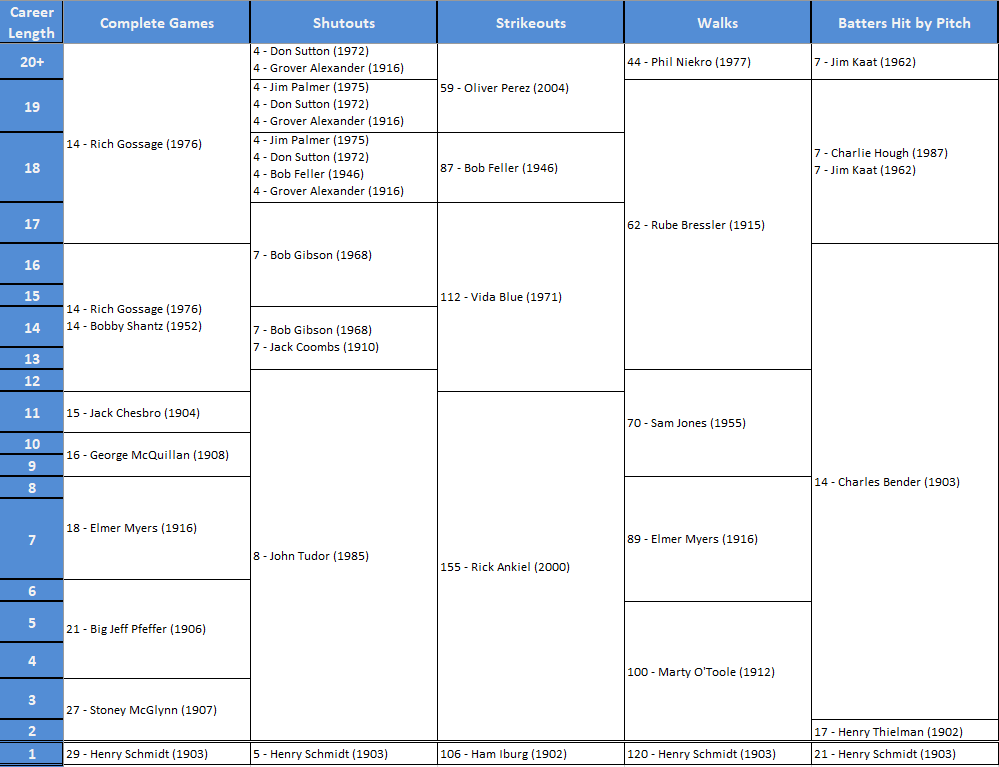
- Bobby Shantz‘s career year in 1952 is reflected here when he claimed the AL MVP award on the strength of a majors-leading 8.8 WAR and AL-leading marks of 24 wins, a .774 W-L%, 1.048 WHIP and 2.41 SO/BB ratio. Shantz (now 100 years young) completed 27 of his 33 starts that season, one of ten qualified integration-era seasons by pitchers completing 80% or more of their starts? (Quiz: 5. Which pitcher accomplished this feat most recently?) Rick Langford, 1980 (28 CG in 33 starts)
- Jack Chesbro posted career best totals for the Highlanders in 1904, including 10.6 WAR, a 1.82 ERA and majors-leading marks of 41 wins (the most in the modern era), 48 CG and 454⅔ IP. Chesbro’s 29.8 career WAR still ranks as the 6th highest total by a Yankee right-handed starter. (Quiz: 6. Which pitcher leads that list?) Red Ruffing, 46.5 WAR for Yankees
- George McQuillan posted career best totals for the Phillies in his 1908 rookie season, including 9.1 WAR, 23 wins, 1.53 ERA, 0.984 WHIP, 359⅔ IP and 32 CG. McQuillan leads all Phillie pitchers in qualified modern era rookie seasons in WAA, ERA, FIP, CG, SHO and WHIP, and ranks 2nd among the same group in WAR, Wins, IP, ERA+ and H/9.
- Elmer Myers posted only 77 ERA+ in 1916 for the 117 loss Athletics, but that didn’t stop the rookie right-hander from compiling 315 IP, including 31 CG in 35 starts. Myers is the last starting pitcher to complete 85% of his starts in a qualified rookie season.
Shutouts
- Don Sutton‘s career year in 1972 included a majors-leading 9 shutouts and NL-leading marks of 0.913 WHIP and 6.1 H/9. Those marks were his career bests, as were he 6.6 WAR, 2.08 ERA, 162 ERA+ and 18 CG.
- Jim Palmer‘s CYA season in 1975 featured majors-leading marks of 8.4 WAR, 2.09 ERA, 169 ERA+ and 10 shutouts. Palmer also posted career bests of 23 wins, 25 CG, 323 IP and 2.2 BB/9.
- Grover Alexander posted career bests in Wins, CG, SHO and IP for the 1916 Phillies, while leading the majors in those categories plus WAR, ERA and ERA+. Alexander
is the last pitcher tocompiled 40 WAR for two franchises. (Quiz: 7.Since Alexander, wWhich pitcher has matched Alexander’s feat, and which pitcher has come closest tomatching that featdoing so since then?) (Lefty Grove, Randy Johnson) - Four years of military service didn’t slow down Bob Feller, who posted career bests in 1946 in WAR, CG, SHO, IP and Strikeouts. In his pursuit of the modern era single season strikeout record, Feller pitched in three of the Indians’ final four games that season, racking up 21 K’s over 23 IP to reach 348 for the season and surpass Rube Waddell‘s record total of 344 in 1904. Alas, later review of Waddell’s box scores revealed a tabulation error and a revised total of 349 K’s for the A’s southpaw, a record that would stand for 61 years, until surpassed by another lefty, the Dodgers’ Sandy Koufax, whose 382 K’s in 1965 remains the NL record total.
- Bob Gibson‘s legendary 1968 season featured career bests in WAR, CG, SHO, ERA, ERA+, FIP, WHIP and H/9, with his 1.12 ERA and 13 shutouts that season remaining live ball era records. After Don Drysdale established a record six consecutive shutouts earlier that season, Gibson almost matched him with five straight whitewashes. His bid for a sixth came while pitching against Drysdale but ended anti-climactically with a first inning Dodger run scoring on a wild pitch, one of just four wild ones uncorked by Gibson that season. That would be the Dodgers’ only tally of the game as Gibson recorded his eighth of 13 straight CG, the last twelve as the winning pitcher. (Quiz: 8. Which two pitchers have also recorded 12 straight CG wins within a single integration era season?) Ewell Blackwell (1947), Ellis Kinder (1949)
- Jack Coombs posted his career year for the 1910 world champion A’s, leading the majors with 31 wins, 13 shutouts and zero home runs allowed, while also posting careers bests with 353 IP and 1.30 ERA. Coombs’s ERA more than doubled the next year to 3.53, but his 28 wins still led the majors as the A’s repeated as World Series champions. Coombs posted CG wins in his first four World Series starts to match Christy Mathewson‘s record. (Quiz: 9. Which other pitcher has recorded CG wins in his first four World Series starts?) Lew Burdette, 1957-58
- John Tudor posted his career year for the 1985 NL champion Cardinals, with majors-leading totals of 9 SHO and 0.938 WHIP and other career bests in WAR, Wins, ERA, ERA+, FIP, CG, H/9, BB/9. Tudor added another shutout in the post-season to become the most recent pitcher with a shutout in game 4 of the World Series. (Quiz:10. Which pitcher’s game 4 shutout clinched the World Series for his team?) Dave McNally, 1966
Strikeouts
- Oliver Perez‘s career year for the 2004 Pirates saw him lead the majors with 11.0 SO/9 while also posting career highs in WAR, IP and Strikeouts. Perez posted 5.7 WAR in that 2004 season, more than the 4.4 WAR he would compile over his other 19 seasons combined.
- Vida Blue‘s 301 strikeouts in 1971 was his only season with 200+ K’s, as he led the AL in SHO, ERA, FIP, WHIP, H/9 and SO/9. Blue’s 17 wins before the All-Star break broke Bob Feller‘s 1941 record of 16 wins (matched by Hal Newhouser in 1946 and Whitey Ford in 1961) and led to a Time magazine cover for the A’s southpaw (Blue’s record was short-lived, with Mickey Lolich tying it the next season, and Wilbur Wood adding one more W the year after that).
- Rick Ankiel‘s 2000 season highlighted here saw him post a career best 3.3 WAR in his only campaign as a full-time starter. Ankiel was injured early the next season and, aside from a brief reprieve in 2004, was not healthy again until he returned to the majors as an outfielder in 2007. Ankiel is the only modern era Cardinal player with 50+ games as a pitcher and as an outfielder.
- Like Henry Schmidt, Ham Iburg was another Californian who, after one major league season, opted to return to the Golden State where he played most of the rest of his professional career. Despite his 106 K’s for the 1902 Phillies (the 11th highest NL total that year), Iburg had no fastball to speak of, but instead succeeded by varying speeds (slow, slower and slower still) on his wide assortment of junkball pitches. He surrendered only one home run (an inside-the-park shot) in 236 IP, one of six Phillie pitchers to allow one home run or none in a 200+ IP season.
The exceptional seasons in the next two categories are for seasons with the highest totals, where higher means bad. Categories where good seasons are indicated by low totals will be covered in Part 2 that looks at rate stats.
Walks
- Phil Niekro‘s 164 walks in 1977 came in a season in which he also led the NL in IP, BF and CG. His 4.5 BB/9 that year was then his highest rate, but one he would twice exceed later in his career. Niekro’s 16 seasons with double-digit wins and losses in a modern era record.
- Rube Bressler posted 3.4 WAR as a 19 year-old rookie for the 1914 AL champion A’s, but came quickly undone the next season, with a 4-17 record and 5.20 ERA, including 6.0 BB/9, for a team that lost 109 games after Connie Mack sold off most of his best players. Bressler never regained his rookie form as a pitcher, but did develop into a useful outfielder, posting a .311 career BA for Cincinnati that is the second highest mark (after teammate and HoFer Edd Roush) by a modern era Reds outfielder in 2500+ PA for Cincy.
- Sam Jones‘s career high 185 walks allowed came as a 29 year-old rookie with the 1955 Cubs. That was also the first of four straight seasons for Jones leading the NL in SO/9, with Jones reducing his BB/9 from 6.3 for the first two of those seasons, to 3.7 for the next two. With his late start, Jones’s career was short at just twelve seasons, and only eight with regular play. However, in those eight seasons, Jones’s player page shows 16 desirable black ink marks in performance categories, and a 25 black ink “score” that is apparently the 92nd highest total by a pitcher (comparing very favorably to his JAWS ranking of 566th among starting pitchers).
- Marty O’Toole‘s career high in walks was a majors-leading total of 159 for the 1912 Pirates. But, that was also O’Toole’s career year in a good sense, garnering 4.1 WAR on the strength of a 2.71 ERA (122 ERA+) over 275⅓ IP. O’Toole pitched two more seasons, each worse than the last, to end his major league career aged only 25.
Batters Hit by Pitch
- Jim Kaat‘s 1962 season is highlighted here, his second straight campaign leading the AL in both HBP and WP. But, that doesn’t mean it was a bad season for Kaat, as he posted the 3rd best WAR and 2nd best qualified ERA+ of his very long career. He also garnered his first All-Star selection and the first of (count ’em) 16 gold gloves, matching the total for Brooks Robinson.
- Charlie Hough‘s career high in HBP led the AL in 1987 as did his career highs of 40 starts, 285⅓ IP and 1231 batters faced. (Quiz:11. Which other pitcher led his league in all four of those categories aged 39 or older?) Phil Niekro, 1978-79
- Charles Bender‘s career high in HBP was a majors leading total of 25 in his age 19 rookie season in 1903. Bender’s 29 CG (in 33 starts) that season remains the modern era record for teenage pitchers.
- Henry Thielman‘s career high HBP also came in his rookie season. He pitched briefly in the majors the next season, then played the rest of his professional career with the Eastern League’s Jersey City Skeeters. Thielman’s major league debut was also the professional debut for the 21 year-old, starting for the Giants in their season-opening series with the Phillies. And, an adventurous affair it was, as Thielman allowed 5 hits and 5 walks but also whiffed 5 to escape with no earned runs allowed (but with 6 unearned tallies on his docket). That remains the only known start in a major league debut with 5 or more runs, hits, walks and strikeouts, but without an earned run surrendered.
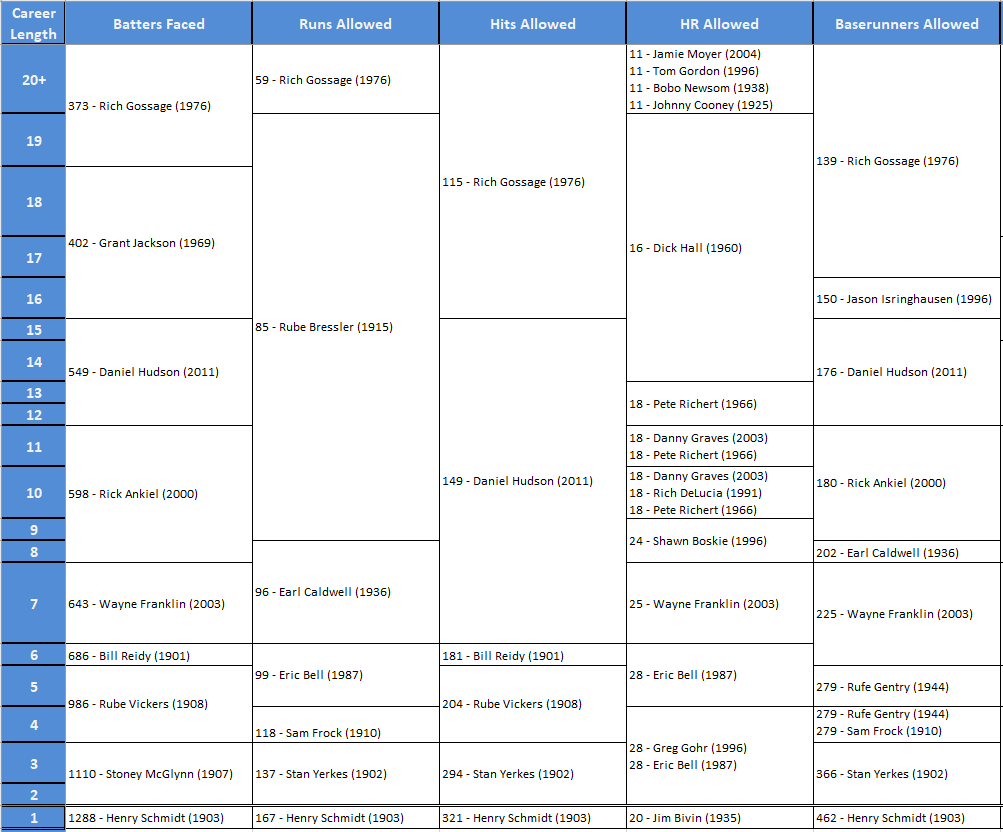
Except for Batters Faced, for the metrics in the chart above, more usually indicates worse. So, for those metrics, exceptional seasons will be those that are (probably) worse than all others by the greatest amount.
Batters Faced
- Aside from a rough first game, Wayne Franklin enjoyed some success as a starter in a September call-up to the Brewers in 2002. But, it was a different story the next season, his only campaign as a full-time starter, as Franklin posted a 5.50 ERA in 194⅔ IP and led the league in Runs and Home Runs allowed. But, there was one game when everything came together for Franklin, shutting out the Padres on two hits and two walks while facing just three batters over the minimum.
- Bill Reidy‘s exceptional season was his rookie campaign for the Brewers in 1901, compiling 3.5 WAR over 301⅓ IP, but with an 85 ERA+ and a majors-leading 14 home runs allowed. Reidy kept the ball in the yard the next three seasons (only one HR allowed over 280⅓ IP) but his 80 ERA+ for that period marked the end of the line for his major-league career. In the second game of a 1902 double-header, Reidy dueled with the Cleveland Blues’ Bill Bernhard for 15 innings before the game was called, probably on account of darkness. It was the second of sixteen modern era tied games (the last and longest being the most famous) in which both starters went the distance for 15+ IP. (Quiz: 12. Who is the only pitcher to play in more than one such game?) Joe Oeschger, 1919-04-30 (20 IP) and 1920-05-01 (26 IP). Here are the sixteen games.
Runs Allowed
- Earl Caldwell posted one qualified season in his eight year career, with his 146 runs allowed for the 1936 Browns easily his highest total. Caldwell pitched in only 9 games the next season, then not at all until a late career renaissance with the White Sox that started as a 40 year-old wartime replacement in 1945, but continued for the three following seasons as well. Caldwell’s 3.5 WAR for the White Sox is the franchise’s second highest total (behind HoFer Hoyt Wilhelm) for relief pitchers aged 40 or older.
- Eric Bell‘s exceptional season was his rookie campaign in 1987 when an apparently juiced ball inflated home run totals in both leagues. Bell fared worse than most, with his 1.7 HR/9 that season the highest mark ever in a qualified rookie season.
- Sam Frock makes the list for his 1910 season as a Braves swingman, making 29 starts and 16 relief appearances for Boston and pitching to a 102 ERA+. Frock went the distance, but allowed 10 runs in the first start of his career. Three modern era pitchers have recorded complete games allowing 10+ runs in the first two starts of their careers, two of whom never made another start. (Quiz: 12A. Who was the third man, who lived to pitch another day?)
- Stan Yerkes‘s 1902 rookie season began as the Cardinals’ opening day starter. Alas, there weren’t many other high points in Yerkes’s season, as he led the NL in losses and ER allowed in what would be his only campaign as a full-time starter. Yerkes is one of nine modern era pitchers with a CG in each of his first 7 major league games (the record holder is Jack Bracken with 12 straight CG to start his career, but with a 6.21 ERA that also ended his career right there). Yerkes’s 21 losses remain a modern era record for Cardinal rookies. (Quiz: 13. Which other Cardinal rookie led the NL in losses?) Ken Hill (1989)
Hits Allowed
I’ve already talked about all the players on this list, so on to to the next category.
Home Runs Allowed
- Jamie Moyer‘s 2004 season was his worst for the long ball and is especially notable in that he was playing for the Mariners, and not in the Kingdome. Since Seattle moved to the great outdoors, only Ryan Franklin (the season before) has also led the AL in HR allowed. Moyer’s 20 HR allowed at home that season ranks 3rd, behind Franklin (22 in 2003) and Yusei Kikuchi (21 in 2019), among Mariner pitchers since 2000.
- Bobo Newsom‘s career high in HR allowed in 1938 coincided with career highs in starts, CG, IP and BF, with Newsom leading the majors that season in all of those categories. That caveat aside, Newsom’s 1938 season was also his worst for HR/9, though not by a lot. Newsom’s 31 CG in 1938 remain the most in the live ball era without a shutout.
- Johnny Cooney makes the list for his 1925 season, his only campaign as a full-time starter. That was Cooney’s third straight 2+ WAR season on the mound, but elbow problems surfacing near the end of that season foretold an early end to his pitching career. After a decade (1926-35) spent mostly in the minors (where manager Casey Stengel tutored him on the finer points of outfield play) Cooney returned to the majors at age 35 and turned in in six straight 400+ PA seasons. Cooney’s results improved with his age, as he joined Henry Aaron and Chipper Jones as the only Braves to top 5 WAR aged 39-40. Cooney’s only two home runs in over 1100 major league games came at age 38, on consecutive days at the Polo Grounds in the last week of the 1939 season; his 695 games played through his age 37 season are the most among non-pitchers (i.e. those who played a majority of games at other positions) with no home runs to that point of their careers.
- Dick Hall makes the list for his 1960 season with the A’s. After struggling to find playing time with the Pirates, Hall’s trade to Kansas City gave the 29 year-old his first shot at a regular rotation spot. The results were only okay, as Hall delivered 28 starts and 182⅓ IP with league average ERA+. Can’t know whether Hall would have continued as an A’s starter, as he was traded again just before the following season, landing in Baltimore where he was used for one season as a swingman before moving to the bullpen and becoming one of the game’s best relievers of the 1960s. For the 1961-70 decade, Hall ranks 4th in WAR among AL relievers, and 6th among all relievers; four of the top five on the AL list compiled at least 5 WAR with the Orioles during that period.
- Pete Richert makes the list for his second season with the expansion Senators. After being used as an occasional starter in three seasons with the Dodgers, Richert came to Washington in the Frank Howard trade and assumed a regular rotation spot, garnering 4.9 WAR in his first AL season. Increasing his workload by 50 innings the next season, Richert’s WAR dropped by more than half and his HR allowed doubled. Richert pitched one more season as a starter before a trade to Baltimore and a move the Oriole bullpen.
- After five good seasons (9.1 WAR, 140 ERA+) as a reliever, the Reds moved Danny Graves to the rotation for the 2003 season, with disastrous results. As in a 4-15 record, 5.33 ERA and negative WAR. Graves moved back to the bullpen the next season but never regained his earlier form, closing his career with 8-23, 5.18 and -2.7 WAR over his final four seasons.
- After an impressive September debut in 1990, Rich DeLucia found himself in the Mariners’ rotation the next season, posting a 5.09 ERA (81 ERA+) over 182 IP with a league-leading 31 HR allowed. DeLucia was used as a swingman the next season, before a move to the bullpen for the remainder of his career. (Quiz: 14. Which live ball era team featured two rookie pitchers sharing the league lead in HR allowed?) 1928 Browns, Jack Ogden & George Blaeholder
- Shawn Boskie makes the list for his 1996 campaign, the only qualified season of his career. While his majors-leading 40 HR allowed that season was truly exceptional, gopher balls were nothing new for Boskie; his 1.9 HR/9 over his final three seasons was then the highest rate in 250+ IP over that part of a career, and still ranks as the third highest rate today.
- Greg Gohr allowed 31 homers in his final major league season in 1996, and did so in only 115⅔ IP. That 2.4 HR/9 is the second highest rate (to Ken Dixon in 1987) in a final season of 100+ IP, and fourth highest in any 100+ IP season.
- Jim Bivin toiled for seventeen professional seasons (sandwiching three years of military service), but just this one season in the majors with the Phillies. While Bivin’s 20 homers allowed gets him recognized here, what he’s really famous for is retiring the Babe in the final PA of Ruth‘s career. Bivin’s 12.2 H/9 is the highest in a qualified modern era season by an NL rookie, just a hair better than AL record holder Charlie Shield‘s 12.4 for the Orioles and Browns in 1902. Bivin’s .182 W-L% was also pretty bad, but not quite as bad as the .167 posted by another Phillie rookie that season, one Hugh Mulcahy, who would retire with a .336 career W-L%, second lowest in the modern era in 125+ decisions.
Baserunners Allowed
- Jason Isringhausen‘s exceptional season was his only qualified campaign, playing for the 1996 Mets. An impressive rookie campaign the season before, with a 9-2 record, 2.81 ERA and 3.0 WAR, fueled high expectations for the big righty. Too high, perhaps, as the sophomore jinx hit Isringhausen hard, cratering to a 6-14 record, 4.77 ERA and negative WAR. He spent most of the next season in the minors, then missed all of 1998 with an injury. Ineffective starting the 1999 season, Isringhausen was dealt to the A’s at the deadline, where his career immediately turned around, as a bullpen ace. For the 1999-2008 decade, Isringhausen’s 293 saves led all relievers not in the Hall of Fame. His career came full circle when he carded the final 7 saves of his career (for an even 300 total) playing for … the Mets.
- Rufe Gentry makes the list for his 1944 season with the Tigers, notable for leading the AL with 108 walks allowed. Absent wartime exigencies, Gentry’s wildness likely would have kept him out of most rotations, as his 5.4 BB/9 in AA, and 6.9 in AAA hardly suggested major league control. But, it was wartime, and so Gentry got 30 starts, pitched 203⅔ innings and, to his credit, even kept his BB/9 under 5. Thus, Gentry’s 1.566 WHIP ranks as only the 8th highest mark in a 200+ IP rookie season (and better than HoFer and recent CoG inductee Ted Lyons‘s 1.622).
Wins
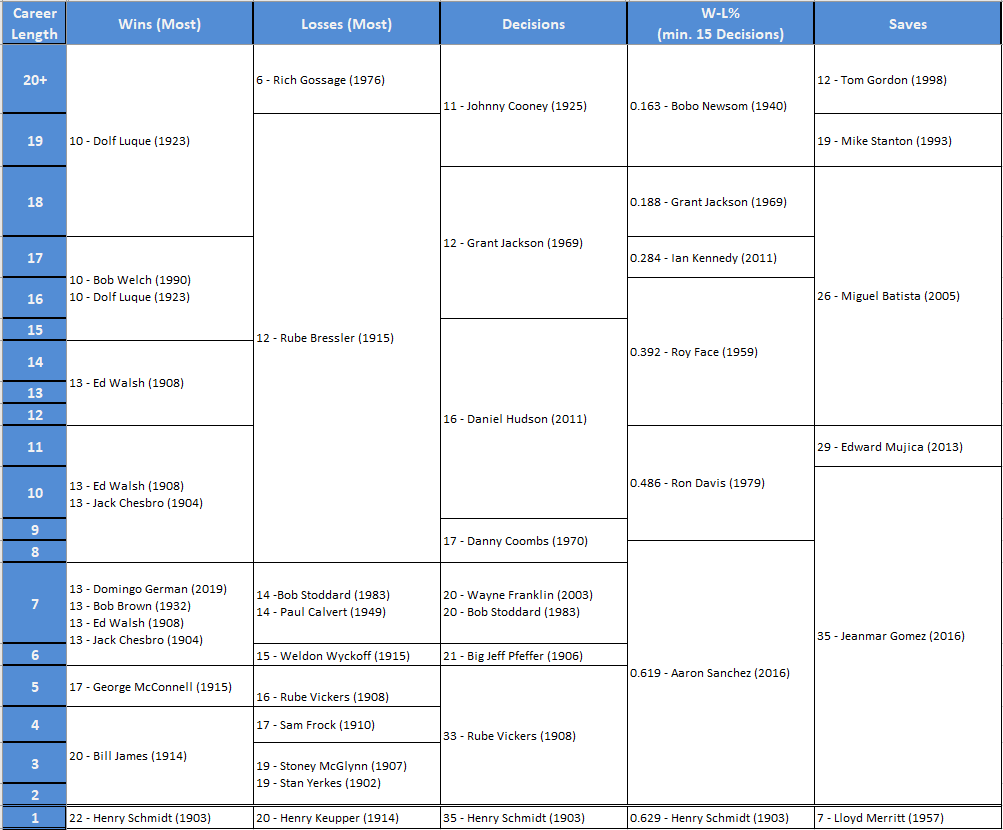
- Dolf Luque makes our list with his career year in 1923, leading the majors with career bests in WAR, Wins, ERA and ERA+. Luque’s 27-8 record that season was good for a league-leading .771 W-L%, compared to .469 (127-144) for the rest of his twelve seasons with the Reds. Luque finished his career pitching for the Giants where, at age 43, he became the oldest pitcher, by 5 years, to win the clinching game of a World Series, pitching 4⅓ scoreless innings in relief to beat the Senators in 1933.
- Like Luque, Bob Welch also posted a career best 27 win season, for the 1990 AL champion Athletics. Welch was the CYA winner that season, and an All-Star selection for the first time in a decade, making up, perhaps, for not being recognized for his league-leading 7.1 WAR season in 1987. Those 27 wins are the second most in the modern era (to Jack Coombs‘s 28 wins in 1911, mentioned above under Shutouts) in a season with less than 3 WAR. With Welch and Dave Stewart, the A’s boasted two pitchers with 60+ wins for the 1988-90 seasons. (Quiz: 15. Who were the pitchers the
onlyother three times the A’s got 60+ wins from multiple pitchers in a 3-year span?)(Eddie Plank/Rube Waddell 1902-07, Eddie Plank/Jack Coombs 1910-12, Lefty Grove/George Earnshaw 1929-32) - Ed Walsh‘s 40 wins in 1908, the last such season of the modern era, highlighted a campaign in which Walsh also led the majors in IP, starts, CG, shutouts, strikeouts and even saves. Walsh’s single walk allowed in game 3 of the 1906 World Series stood for 119 years as the WS record (tied by three others) for the fewest walks allowed in a 12+ strikeout game, until Trey Yesavage walked none in game 5 of the 2025 series.
- Domingo German‘s 18 win season in 2019 is highlighted here. Those 18 wins are the most by a starting pitcher in a season with less than 150 IP. German was suspended for the 2020 season and managed only 300 IP over his next four seasons. But, he will always be remembered for one magical evening in Oakland, the site of his 2023 perfect game. I don’t know whether German has officially retired; he pitched very briefly in the Mexican League last season, after spending most of 2024 in the minors.
- George McConnell makes the list for his 25 win season in 1915 that led the Federal League. His 303 IP that season are the most by a modern era pitcher aged 37 or older who is not in the Hall of Fame (McConnell, Rip Sewell and Charlie Hough are the only pitchers not in the Hall of Fame to crack the top 20 on that list). Excluding his Federal League season, McConnell’s .281 career W-L% (16-41) is second worst in the modern era among starting pitchers with 500+ combined IP in the AL and NL.
- Bill James makes the list for his famous 1914 season for the world champion Braves. Over the last three months of that season, James went 19-2 with a 1.64 ERA over 225⅓ IP, including 18 consecutive CG, four of them in a 9 day span from Sep 2nd to 10th. So, it may not surprise you to learn that James suffered from a sore arm for most of the rest of his career.
Losses
The exceptional seasons for this category are for the worst seasons in losses. Exceptional seasons for fewest losses will be covered in Part 2.
- After a 2.47 ERA (168 ERA+) in late-season call-ups over the two prior seasons, the Mariners gave Bob Stoddard a regular rotation spot in 1983, but with unfortunate results. Stoddard added two full runs to his ERA and saw his HR/9 jump by over 60%, leading to the 17 loss season shown here. Stoddard was ineffective as a reliever and occasional starter the next season, then bounced around with a few clubs to end his career.
- Paul Calvert was ineffective in relief in his 1944 rookie season with the Indians and returned to the minors the next year. Calvert had drifted all the way down to playing independent ball in his native Quebec when the Senators gave him a shot in their rotation in 1949, where he turned in the league-leading 17 loss season reflected here. The Tigers tried him in their bullpen the next season, but Calvert continued to struggle, with a 6.31 ERA and 1.870 WHIP pitching exclusively in relief, one of only ten such modern era 50+ IP seasons with those two metrics at such elevated levels. Calvert is the last of ten modern era pitchers with a 100+ game career including ERA+ under 80 and SO/BB under 0.8.
- Weldon Wyckoff had a rocky season (-1.5 WAR, 6.7 BB/9) as a rookie for the 1913 world champion Athletics. He improved a bit (0.3 WAR, 5.0 BB/9) in qualified innings the next season as the A’s repeated as AL champions. With Connie Mack selling off most of the star players from that club, Wyckoff became a rotation fixture in 1915, pitching 276 innings for the 109 loss A’s team, but finishing the year with majors leading marks of 22 losses, 165 walks and 14 wild pitches. That would be Wyckoff’s final major league season with meaningful playing time, with his career ending in controversy three years later when he was blackballed by the Red Sox for refusing a demotion to the minors (he was ultimately reinstated by commissioner Landis, but not until 1922, four years after the event).
- Henry Keupper‘s 20 losses led the Federal League in 1914, in what would be his final professional season. Released by the last place St. Louis Terriers after the season, Keupper tried to catch on in the minors the next year, only to find he had been barred from organized baseball for “jumping” to the Terriers from the Three-I (Illinois-Indiana-Iowa) League’s Bloomington Bloomers.
Decisions
- Danny Coombs, a lanky lefty from Maine, makes the list for his 1970 season with the 99 loss Padres. In his only season used primarily as a starter, Coombs logged 188⅓ IP and led Padre pitchers with 3.1 WAR and 121 ERA+, both marks the best of his career. The promise shown in his 1970 season quickly faded in a disastrous and career-ending 1971 campaign, as Coombs cratered to -2.1 WAR and a 6.24 ERA (53 ERA+), with 10 HR surrendered in only 57⅔ IP.
Win-Loss %
Exceptional seasons in this category are limited to seasons with 15 or more decisions.
- Ian Kennedy makes the list for his career year in 2011, with career bests in WAR, Wins, W-L%, IP and ERA. Kennedy’s 21 wins and .840 W-L% were both tops in the NL. Included were two starts with identical 91 game scores to join Randy Johnson and Curt Schilling as the only D-Backs to post a season including multiple games with 90+ games scores. Kennedy’s 46 wins over his first 100 games with the D-Backs ranks fourth in franchise history, behind Schilling, Johnson and Zack Greinke.
- Roy Face famously posted an 18-1 record in 1959, garnering 3.2 WAR over 93⅓ IP, all in relief. His .947 W-L% remains the highest qualifying mark in a full length modern era season. Face’s 11 seasons with 50+ relief appearances and 65+ IP for the Pirates are second only to Mariano Rivera‘s 12 such seasons for one franchise, while Face’s nine such consecutive seasons (1956-64) are the record high for one franchise.
- Ron Davis makes the list for his 1979 rookie season with the Yankees, posting a 14-2 record in 44 relief appearances, with his .875 W-L% the highest qualifying W-L% for any modern era rookie. Davis is one of nine relievers to compile 2 WAR per 100 IP in 250+ career IP for the Yankees.
- Aaron Sanchez‘s career season in 2016 is reflected here. Sanchez led the majors with his .882 W-L% from a 15-2 record, 3.00 ERA and 0.703 HR/9, the latter two marks the fifth and fourth highest, respectively, to lead the AL. Sanchez struggled to stay healthy throughout his career, with this season being his only qualified campaign.
Saves
- Mike Stanton makes the list for his 27 save season for the Braves in 1993. WAR, though, was not impressed, dinging him with a -1.7 score for a 4.67 ERA (86 ERA+) and negative WPA and cWPA for the two-time defending NL champions.
- Edward Mujica‘s 2013 season for the Cardinals is reflected here, with career bests of 37 saves, 2.78 ERA and 135 ERA+, and his only All-Star selection. Mujica’s 2.27 career ERA as a Cardinal reliever ranks 3rd in franchise history among pitchers with 50+ GF.
- Jeanmar Gomez‘s career best 37 saves for the 2016 Phillies was diminished by negative WAR resulting from a 4.85 ERA (86 ERA+). Quiz: 16. Since saves became an official statistic in 1969, which pitcher was the first to post a league-leading saves season with negative WAR? (Fred Gladding, 1969)
- Lloyd Merritt makes the list for his 7 saves in his only major league season with the 1957 Cardinals. St. Louis acquired Merritt in the Rule 5 draft when the right-hander failed to reach the majors after 5 years in the Yankee system. That Cardinal team was the first since 1949 with a real shot at the pennant, closing to within 2½ games of the leading Braves with twelve games remaining. Merritt played a useful role in that pennant run, relieving in eleven September games and posting 9.6 SO/9, the second highest rate among pitchers with 9+ IP that month. Merritt played in the Cuban winter league in 1957-58, where he earned more than his major league salary (according to his SABR bio); whether by design or good fortune, he switched to the Puerto Rican winter league the next year and thereby missed the Cuban revolution.
For those who would like to give their eyes or printer a workout, I’ve summarized the appearances of these players in the various categories in this chart.
Watch for Part 2, where I’ll be looking at exceptional seasons for rate statistics.