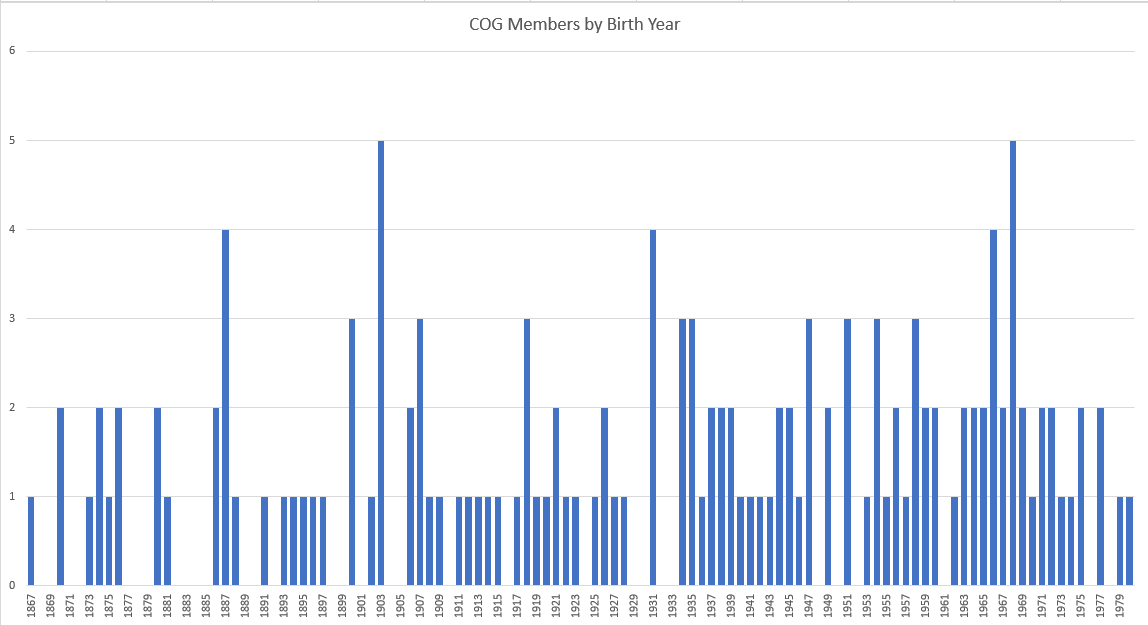
Circle of Greats 1981 Balloting Part 1

This post is for voting and discussion in the 144th round of balloting for the Circle of Greats (COG).  This is the first of two rounds of balloting adding to the list of candidates eligible to receive your votes those players born in 1981. Rules and lists are after the jump.

The new group of 1981-born players, in order to join the eligible list, must, as usual, have played at least 10 seasons in the major leagues or generated at least 20 Wins Above Replacement (“WAR”, as calculated by baseball-reference.com, and for this purpose meaning 20 total WAR for everyday players and 20 pitching WAR for pitchers). This group of 1981-born candidates, comprising those with A-M surnames, joins the eligible holdovers from previous rounds to comprise the full list of players eligible to appear on your ballots.

In addition to voting for COG election among players on the main ballot, there will be also be voting for elevation to the main ballot among players on the secondary ballot. For the main ballot election, voters must select three and only three eligible players, and list them in ranked order. The first player listed on each ballot receives three points, the second player listed receives two points, and the third listed receives one point. The one player accumulating the most points from all ballots cast in the round is inducted into the Circle of Greats. For the secondary ballot election, voters may select up to three eligible players, with the one player appearing on the most ballots cast elevated to the main ballot for the next COG election round. In the case of ties, a runoff election round will be held for COG election, while a tie-breaking process will be followed to determine the secondary ballot winner.

Players who fail to win either ballot but appear on half or more of the ballots that are cast win four added future rounds of ballot eligibility. Players who appear on 25% or more of the ballots cast, but less than 50%, earn two added future rounds of ballot eligibility. One additional round of eligibility is earned by any player who appears on at least 10% of the ballots cast or, for the main ballot only, any player finishing in the top 9 (including ties) in ballot appearances. Holdover candidates on the main ballot who exhaust their eligibility will drop to the secondary ballot with eligibility for two COG election rounds. First time main ballot candidates who attract one or more votes but do not earn additional main ballot eligibility will drop to the secondary ballot with eligibility for one COG election round. Secondary ballot candidates who exhaust their eligibility will drop from that ballot, but will become eligible for possible reinstatement in a future Redemption round election.

All voting for this round closes at 11:59 PM EST Sunday, February 1st, while changes to previously cast ballots are allowed until 11:59 PM EST Friday, January 30th.

If you’d like to follow the vote tally, and/or check to make sure I’ve recorded your vote correctly, you can see my ballot-counting spreadsheet for this round here: COG 1981 Part 1 Vote Tally. I’ll be updating the spreadsheet periodically with the latest votes. Initially, there is a row in the spreadsheet for every voter who has cast a ballot in any of the past rounds, but new voters are entirely welcome — new voters will be added to the spreadsheet as their ballots are submitted. Also in the spreadsheet is a column for each of the holdover candidates; additional player columns from the new born-in-1981 group will be added to the spreadsheet as votes are cast for them.

Choose your three players, for both the main and secondary ballots, from the lists below of eligible players. The current holdovers are listed in order of the number of future rounds (including this one) through which they are assured eligibility, and alphabetically when the future eligibility number is the same. The 1981 birth-year players are listed below in order of the number of seasons each played in the majors, and alphabetically among players with the same number of seasons played.

Holdovers:

MAIN BALLOT ELIGIBILITY SECONDARY BALLOT ELIGIBILITY
Dick Allen 10 rounds Billy Williams 6 rounds
Ted Lyons 7 rounds Ken Boyer 5 rounds
Vladimir Guerrero 6 rounds Chase Utley 5 rounds
Stan Coveleski 4 rounds Bobby Abreu 4 rounds
David Ortiz 4 rounds Don Drysdale 4 rounds
Willie Randolph 4 rounds Monte Irvin 4 rounds
Richie Ashburn 2 rounds Don Sutton 4 rounds
Todd Helton 2 rounds Andre Dawson 3 rounds
Luis Tiant 2 rounds David Cone 2 rounds
Andruw Jones this round ONLY Larry Doby 2 rounds
Jonathan Papelbon this round ONLY Jim Edmonds 2 rounds
CC Sabathia this round ONLY Ralph Kiner 2 rounds
Johan Santana this round ONLY Joe Medwick 2 rounds
Gary Sheffield this round ONLY Ted Simmons 2 rounds
Reggie Smith this round ONLY Bill Terry 2 rounds

Everyday Players (born in 1981, ten or more seasons played in the major leagues or at least 20 WAR):
Curtis Granderson
Carl Crawford
Omar Infante
Justin Morneau
Jeff Baker
Wilson Betemit
A.J. Ellis
Mike Aviles
Ryan Doumit
Nate McLouth
David Murphy

Pitchers (born in 1981, ten or more seasons played in the major leagues or at least 20 WAR):
Jorge De La Rosa
Blaine Boyer
Jeff Francis
Scott Baker
Jesse Crain

As is our custom, here are quiz questions for each of the new players on the ballot.

  1. Curtis Granderson played 500+ games for the Yankees, Mets and Tigers. Which other player recorded 500+ games for two of those franchises? (Rusty Staub, Mets and Tigers)
  2. Carl Crawford posted three consecutive seasons (2004-06) with 40+ stolen bases and 15+ triples. Which other player did the same? (Ty Cobb, 1911-13)
  3. Omar Infante played for four franchises in his career, and posted exactly one qualified season for each of them. Infante was an All-Star in 2010, while playing 15+ games at 2B, 3B, SS and the outfield. Which other All-Star player did the same? (Willi Castro, 2024)
  4. Justin Morneau’s four seasons (2006-09) with 30+ doubles, 20+ HR, 100+ RBI and fewer than 100 K’s are the most by a Senator/Twin. Which Twins’ player posted such a season more recently than Morneau? (Delmon Young, 2010)
  5. A.J. Ellis’s career best 3.4 WAR in 2012 is the most by a Dodger catcher in the lone qualified season (modern definition) of his career. Which catcher recorded the most career WAR for the Dodgers, while posting just one qualified season in blue? (John Roseboro, 21.9 WAR)
  6. Jeff Baker, “Mr. Consistency”, posted a record four consecutive seasons (2009-12) with 200 to 250 PA and 20 to 25 RBI. He also recorded 12 to 15 doubles, 1 or 2 triples and 3 or 4 home runs in each of those campaigns. Baker is one of five players with 200+ games for the Cubs and Rockies. Which two of those players were teammates on both teams? (Joe Girardi, Eric Young Sr.)
  7. Wilson Betemit compiled less than 3 WAR in a 2000+ PA modern era career that began as a teenage shortstop with the Braves. Which other player did the same? (Sibby Sisti, 1939-54)
  8. Mike Aviles is one of 25 modern era players to record 1+ WAR per 100 PA in a 400+ PA rookie season. Who was the only pre-expansion player to do so in the AL or NL? (Charlie Keller, 1939)
  9. David Murphy is the only player with 10+ WAR and 2500+ AB for Texas, and no more than one qualified season as a Ranger. Among players, like Murphy, with less than 15 WAR in 2500+ AB as a Ranger through age 32, who compiled the most WAR over his entire career? (Nelson Cruz, 42 WAR)
  10. Ryan Doumit is one of six Pirate catchers with a 3+ WAR season batting .300. Who was the first of those catchers to post such seasons consecutively? (Smoky Burgess, 1961-62)
  11. Nate McLouth’s 64 career stolen bases as a Pirate are the most by any retired player with a 90%+ stolen base success rate with any one franchise. Who is the oldest player with 50+ career stolen bases and a 90%+ success rate for one franchise? (Paul Molitor, age 36-38 with 1993-95 Blue Jays)
  12. Jorge De La Rosa’s 241 career starts rank 2nd among Mexican-born left-handers. Who was the first Mexican-born pitcher with 100 career starts? (Jesse Flores 1942-50, 113 starts)
  13. Blaine Boyer’s 2018 season is one of ten modern era campaigns with ERA of 12 or higher in 20+ IP. Which pitcher recorded the highest ERA in such a season? (Orel Hershiser, 13.14 ERA in 2000)
  14. Jeff Francis’s 17-9 record for the 2007 NL champion Rockies established a Colorado franchise record for W-L% (.654) by southpaws in seasons with 25+ decisions. Francis’s 4.96 career ERA for Colorado is second highest among eight pitchers with Rockies career marks of 10+ WAR and a winning record. Which of those pitchers recorded the highest career ERA for Colorado? (Pedro Astacio, 5.43 ERA)
  15. Scott Baker posted five consecutive seasons (2007-11) for the Twins with 20+ starts, 1.5+ WAR and a .500+ W-L%. Which two Minnesota pitchers posted the only longer runs of such expansion era seasons? (Bert Blyleven 1970-75, Dave Goltz 1974-79)
  16. Jesse Crain’s 4.0 WAR per 100 IP over the last three seasons (2011-13) of his career ranks second only to Mariano Rivera among retired expansion era relievers (min. 80% of games in relief) with 100+ IP over that part of their careers. Crain’s 11.4 career WAR ranks second among Toronto-born pitchers. Who posted the highest career WAR total among Toronto-born pitchers? (John Hiller, 30.5 WAR)

Subscribe
Notify of
guest

90 Comments
Oldest
Newest Most Voted
Inline Feedbacks
View all comments
Bob Eno
Bob Eno
23 days ago

As this round of voting for the Circle of Greats begins I want to summarize discussion from last year to explain why I’ll be advocating for Richie Ashburn as my first-place selection. (Here’s a link to last year’s string, where this discussion was fully developed. I don’t think that any newly eligible players on this year’s 1981 birthyear list alter these arguments.) My argument for Ashburn arose out of an examination of whether Andruw Jones was the greatest fielding center fielder ever, which is a strong plank in Jones’s case and has just elevated him to the Hall. I wound… Read more »

Bob Eno
Bob Eno
22 days ago
Reply to  Doug

Good points, Doug. This issue was part of the back-and-forth with KDS last year that I linked to in my post last night. I think it’s important to remember that Ashburn does not just exceed Andruw and other recent and current players in traditional stats; he exceeds everybody, including everybody who played in Shibe Park and other parks with large CF grounds in low strike-out eras. Instead of comparing Ashburn to Andruw, let’s compare him to the second-ranked center fielder in Total Zone Runs: Willie Mays (Andruw’s first, Ashburn 45th). Mays played in the same era as Ashburn and in… Read more »

Paul E
Paul E
22 days ago

#1, Rusty Staub w/Detroit & NY Mets

Paul E
Paul E
22 days ago

#2, Ty Cobb 1911-1913

Richard Chester
Richard Chester
22 days ago

For #15 I came up with Dave Goltz (1974-1979) and Bert Blyleven (1970-1975), each with 6 such seasons.

Richard Chester
Richard Chester
22 days ago

#4 is Delmon Young

Paul E
Paul E
21 days ago

Richard,
I hope all is well. While trying to ‘solve’ #7, I happened to notice that the 1921 Boston Braves had 5 starters throw over 230 innings. These hurlers drove the team to a better than .500 record despite a majority of unknown position players. Has the quintet of 230+ IP hurlers on a single team ever happened before or since?

Richard Chester
Richard Chester
21 days ago
Reply to  Paul E

I found 2 such teams. The 1922 Yankees with 5 pitchers (Bullet Joe Bush, Waite Hoyt, Sad Sam Jones, Carl Mays and Bob Shawkey). Also the 1923 Yankees with 5 such players (Bush, Hoyt, Jones, Shawkey and Herb Pennock).

Paul E
Paul E
21 days ago

Richard,
Thanks for the quick response. Obviously, this worked out a lot better for NY than it did for the Braves.

Tom
Tom
22 days ago

#12 Fernando Valenzuela.
#5, Johnny Roseboro?

Tom
Tom
21 days ago
Reply to  Doug

Anytime I see Mexican pitcher, I automatically think EL TORO.

#12 is Jesse Flores, from 1942-1950. His bio says that he was the scout who signed Bert Blyleven.

Paul E
Paul E
22 days ago

#7, Sonny Jackson

Doug
Doug
22 days ago
Reply to  Paul E

Not Sonny. He began his career as an Astro shortstop.

Paul E
Paul E
21 days ago
Reply to  Doug

Got it backwards there 🙁

Richard Chester
Richard Chester
21 days ago

#14 I am not sure if I understand the question but I came up with Pedro Astacio

Doug
Doug
21 days ago

Astacio is correct. He posted 10 WAR and a winning record in his time as a Rockie, and his 5.43 ERA is the highest of the eight pitchers who have done so (one of the eight, Jon Gray, is still active though no longer with Colorado). My first reaction was that 7 such retired pitchers seemed an absurdly low number, but that reaction appears unfounded. The Marlins and D-Backs have only 6 such pitchers and the Rays only 3. Going further back, the Mariners have 8 such pitchers and the Blue Jays 12. So, 7 such pitchers may be about… Read more »

Tom
Tom
20 days ago
Reply to  Doug

Astacio’s ERA+ for his Rockie years was 102.

Doug
Doug
20 days ago
Reply to  Tom

Good catch, Tom. John Thomson and Kevin Ritz matched Astacio in posting 5+ ERA and 100 ERA+ for their Rockie careers. Other pitchers to do so for a career for a particular team (min. 100 IP) are: -Bert Abbey for CHC 1893-95 -Willie McGill for CHC 1893-94 -Cal Eldred for CHW 2000-01 -George Blaeholder for CLE 1936 -Huyler Westervelt for NYG 1894 Only Westervelt, with a one season career, did so for his entire career. There have been 27 such single seasons (min. 100 IP), three of them by Astacio. Surprise name on the list is Dwight Gooden, late in… Read more »

Last edited 20 days ago by Doug
Bob Eno
Bob Eno
21 days ago

Look back over earlier CoG rounds I found a very good discussion of the case for and not for (rather than against) Santana in last year’s Round 1. Voomo and nsb were the principal discussants. (I’m going to try to find more of these past discussions of individual candidates and critical issues to help inform our conversations this round.)

Paul E
Paul E
21 days ago

………off the beaten path here, but while trying to figure out the Wilson Betemi quiz (#7 above), i came across Hod Ford (aka Horace; B-R has the name backwards). Ford played 2b & SS for the Braves and, in a strange statistical oddity, batted between .271 and .279 for seven consecutive seasons (1921 – 1927) while accumulating between 223 and 614 plate appearances in those seasons. I’ll bet that kind of consistency has never been duplicated.

Richard Chester
Richard Chester
21 days ago
Reply to  Paul E

Nellie Fox had between 11 and 18 strikeouts each season for 15 consecutive seasons.

Paul E
Paul E
20 days ago

Richard,

AND, all qualified seasons no less for Fox – more impressive for the sake of consistency, I believe, than Joe Sewell’s 9 consecutive seasons of 3-9 strikeouts.

As far as consistent hitting, IIRC, I believe you mentioned years ago that Dick Allen and Ted Williams were the only two guys to have an OPS+ greater than 145 every season between the ages of 22 and 32 ?

Richard Chester
Richard Chester
20 days ago
Reply to  Paul E

I don’t recall mentioning those stats about Williams and Allen. However I just did a search a few minutes ago and found that that feat was accomplished by Mickey Mantle, Dick Allen and Ty Cobb. Ted Williams missed 3 years during the 22 to 32 age bracket due to military service but had an OPS+ >+ the other 8 yeqrs.

Paul E
Paul E
20 days ago
Reply to  Doug

Great! ….take your time, whenever you get a chance

Paul E
Paul E
21 days ago

#16, John Hiller

Paul E
Paul E
20 days ago
Reply to  Doug

Thanks for the breakdown

no statistician but
no statistician but
21 days ago

Overlooking Richie Ashburn, per Bob Eno (with whom I concur), is one of the COG’s longtime lapses in judgment. Overlooking Reggie Smith is a second. Not much black ink, playing in the shadow of Yastrzemski in Boston and under a bigger shadow of racial intolerance, then to St Louis for a couple of years, leading a second-place team in WAR, then on to being one of the big guns for the Dodgers in their back-to-back pennant years, 1977-78. In 1979 and 1980 combined, what with injuries, he played basically a full season of 160 games with 6.2 WAR. The next… Read more »

Bob Eno
Bob Eno
21 days ago

nsb, I need more convincing on Smith. I voted for his elevation to the primary ballot last round and have felt for a while that we’ve undervalued him, but while I think he’d be fine in the CoG I haven’t seen him as an obvious pick over competitors on what is now a very compressed ballot (reflected in the rather narrow range of WAR and WAR/162G figures I just posted below). The case for Smith seems to me to rest on his consistency — that total of ten 4.0< seasons that Doug notes is a good measure. Another way to… Read more »

Last edited 21 days ago by Bob Eno
no statistician but
no statistician but
20 days ago
Reply to  Bob Eno

Bob: Additional statistics aren’t really there, or the kind you’d prefer. Bill James points out that of the games Reggie played in, the teams he played for won at a .544 percentage, one of the highest among position players with long careers. When he appeared on the scene in Boston, St. Louis, L.A., and San Francisco, each team improved its record substantially. Other factors were involved, perhaps, but coincidence is when two things occur. Four times out of four probably means something, especially with the Dodgers in 1977. The COG balloting years ago concerning Larry Walker often focused on how… Read more »

Bob Eno
Bob Eno
20 days ago

nsb, I take your point on WAR in the last paragraph. This is why I always like to list WAR/162G for position players. But the cases for Vlad and Ortiz are actually not based on WAR, as the table of candidate WAR totals and rates shows. Ortiz’s case is mostly based on traditional stats and black ink as well as high visibility pennant and postseason presence. I think Vlad’s case is also based mostly on traditional stats, along with his memorably dynamic presence on the field. (In any case, I think Allen and Randolph are the chief challenges to Smith… Read more »

Bob Eno
Bob Eno
21 days ago

In the interest of focusing CoG discussion I’m listing below our primary and secondary ballot candidates (ignoring 1981-birth lists) by WAR per 162G, as calculated by B-R, with total WAR in parens and separated into position player and pitcher lists. (Papelbon is in brackets because WAR norms are skewed differently for relief pitchers.) Candidates by WAR/162G (per B-R) Primary list, position players Allen 5.4 (58.8) Smith 5.3 (64.6) Randolph 4.9 (65.9) Ashburn 4.7 (64.3) Andruw 4.6 (62.7) Vlad 4.5 (59.5) Helton 4.5 (61.8) Sheff 3.8 (60.5) Ortiz 3.7 (55.0) Primary list, pitchers Coveleski 5.5 (61.9) Johan 5.4 (51.7) Tiant 4.2… Read more »

Bob Eno
Bob Eno
20 days ago

I’ve been looking back in old CoG discussions to find good advocacy posts for players on our ballots now. I haven’t yet found a good post of Drysdale, but Drysdale has been hanging around for many years and there may be too many strings to explore to locate one. I don’t believe there has been a detailed advocacy post for Papelbon or Sabathia. I’ve arranged these by ballot and chronological order. There may be other good advocacy posts for these pitchers that I’ve missed — please add ones you recall (or wrote!). Primary Ballot epm on Lyons, 2019 https://www.highheatstats.com/2018/01/circle-of-greats-2018-redemption-round/#comment-124650 Doug… Read more »

no statistician but
no statistician but
20 days ago

Center fielder for the Atlanta Braves, led the position players on his team in WAR 6 times, led the NL in HRs and RBIs, won gold gloves year after year, seven times an All-Star, dominating player for roughly a decade, then the bottom dropped out. Sound familiar?  Let me go on: two-time MVP, played for a string of abysmal teams, was a super-straight arrow, no booze, drugs, or smokes, happily married and faithful to his wife since their marriage in 1979. How soon we forget.  162 game averages: D Murphy: oWAR 48.9 R 89  H 157  HR 30  RBI 94  BB… Read more »

Doug
Doug
19 days ago

Murphy’s superiority to A Jones as a hitter is reflected in their oWAR scores: 48.9 for Murphy and 39.8 for Jones. There’s only 400 PA difference between them, so the results per 162 or per PA will show similar differences. But, Jones more than makes up that difference in fielding, 24.4 to -6.8 in dWAR, and 235 to -33 in Rfield, for two guys who mostly played the same positions. Here are their seasons as regulars (2/3 of team games) at each position. -Murphy: CF 8 seasons, RF 4 seasons, 1B 1 season -Jones: CF 10 seasons, RF 1 season… Read more »

Last edited 19 days ago by Doug
Bob Eno
Bob Eno
19 days ago
Reply to  Doug

Doug’s point seems on target to me. Although there are still sports writers who cast votes on the basis of vibes or team loyalty, the vast majority seem to be using the same statistical tools that we usually use here. (HHS voters have been more reluctant to exclude clearly Hall-quality players because of late-career PED use.) The writers still make egregious mistakes that CoG votes don’t (Curt Schilling), but the traditional types of errors are now mostly confined to the committee selections (which also corrects earlier BBWAA errors). As Doug suggests, the comparison between Murphy and Andruw shows that WAR… Read more »

Doug
Doug
19 days ago
Reply to  Bob Eno

Point taken that omission can constitute an “egregiously bad” choice. But, errors of commission are the ones that provide the opportunity to look for someone better for the CoG. Looking back on the BBWAA choices, there are a few dubious ones, but none have me crying “what were they thinking?”. It appears that reaction is reserved for the committee choices, then and now. Here are my personal worst choices by the BBWAA: Pie Traynor (1948), Rabbit Maranville (1954), Ralph Kiner (1975), Lou Brock (1985), Catfish Hunter (1987), Bruce Sutter (2006), Jim Rice (2009). As I said, none of these are… Read more »

Last edited 19 days ago by Doug
Bob Eno
Bob Eno
19 days ago
Reply to  Doug

I’d add Herb Pennock (1948) and Ducky Medwick (1968) to your list, Doug. As for Pennock, I know just what they were thinking: his sudden death was sad.

no statistician but
no statistician but
19 days ago
Reply to  Doug

I’ve not expressed this opinion in the past, or only indirectly, but I wish the COG weren’t obligated to elect someone, anyone, every time the BBWA does so. I’m a big fan of Richie Ashburn and see Reggie Smith as not just overlooked but underrated. But when I compare them to the players in the COG, with few exceptions, I don’t think they quite make the grade. As for the remainder on either ballot, only Monte Irvin strikes me as being on a par with the COG norm, but he is handicapped by history. The others all seem languishing on… Read more »

Bob Eno
Bob Eno
18 days ago

Dear MOO, Welcome to HHS! It seems to me that you are basically (as am I) a Small Hall Guy. There have been years where I felt the Hall would do better not to elect any of the players on their ballot, but they have, because SHGs like you and me are in the minority now — a minority small enough to constitute fewer than 25%. Your approach would surely lead to a gradual shrinkage size of the CoG vs. the HoF, due to our predilections and the increasingly compressed range of talent in MLB, which is a reflection of… Read more »

Bob Eno
Bob Eno
19 days ago

It’s been a long time since we talked about Billy Williams, who has been on the secondary ballot for many rounds. Sometimes I’ve voted for him; more often, I think, not. He was known for his consistency over many seasons and the brief string on consistency that Paul E initiated above (Hod Ford, Nellie Fox, etc.) made me think about Williams. Williams’ consistency is one of the elements that could be the foundation of an advocacy case for him. His 1117-game consecutive game streak was an NL record (by far) and stretched from 1963 to 1970. During his full-time playing… Read more »

Doug
Doug
19 days ago
Reply to  Bob Eno

Williams’ consistency at a high level is what sets him apart. If you look at similar players, the top names (all within a 2½ points of each other) are Andre Dawson, Carlos Beltran, Dave Parker and Luis Gonzalez. But the thing is, their similarity scores range from 883 to 886, which actually isn’t that similar, with 950 and above being very similar, and 900-950 somewhat similar. The other thing is that the similarity scores don’t take into account run scoring environment, with Williams the lowest, Dawson and Parker a bit higher, and Beltran and Gonzalez quite a bit higher. So,… Read more »

Last edited 19 days ago by Doug
Richard Chester
Richard Chester
19 days ago
Reply to  Bob Eno

As far as I know Williams holds the record for most games played in 5 year span with 814 games from 1965 to 1969.

Bob Eno
Bob Eno
19 days ago

That appears to be correct. The magic of Wrigley Field without lights.

Bob Eno
Bob Eno
18 days ago

Taking a break from shoveling snow, I decided to use the time to lay out some comparative stats on five pitchers, four on the primary ballot and two on the secondary ballot. They break into two eras: 1960-1970s (Drysdale, Tiant) and 1990s-2010s (Cone, Sabathia, Santana). Two primary ballot pitchers whom I have advocated for in the past, Coveleski and Lyons, are from eras so different that I didn’t want to do straight up comparisons. I have not included Papelbon and Sutton because I think neither is at the level of these five, much less at the levels of Coveleski and… Read more »

no statistician but
no statistician but
18 days ago
Reply to  Bob Eno

Re Drysdale: He was actually younger than Koufax, joined the Dodgers a year after Sandy, who was semi-trapped on the big-league bench as a bonus baby (K appeared in 28 games with 15 starts in his two BB years, so he did see some work), but arrived with his skills pretty well developed at age 19. At age 20 he was the Dodger Ace, while Sandy, a year older, was mopping up. From 1957 to 1962, six years, he produced 32.7 pWAR while Sandy managed 16.4, 10.2 of those in the final two seasons. A theory that might be floated… Read more »

Bob Eno
Bob Eno
18 days ago

All on the mark, nsb. As a related tangent, I remember listening to a radio broadcast in 1957 when Drysdale threw a temper tantrum on the mound (rather than a fastball) and Vin Scully referred to him, amiably, as a young man who was “something of hothead.” He was just a kid and shouldering a big role for the reigning NL champions.

Doug
Doug
17 days ago

That 1968 season for Drysdale breaks down like this: game 1-7: 1-3, 2.52, one shutout, one 10 inning start games 8-13: six shutouts games 14-31: 7-9, 2.87, one shutout, one 10 inning start, 4 other CG (2-2 record, incl 8 ER allowed in one of the CG losses; only 3 expansion era pitchers have allowed more ER in a CG loss) So, outside of those six shutouts, Drysdale was 8-12, 2.77, a good ERA most years, but only a bit better than NL average (2.99) in 1968 and higher than the Dodgers team ERA (2.69). Then it all unraveled in… Read more »

Last edited 17 days ago by Doug
Bob Eno
Bob Eno
17 days ago
Reply to  Doug

Walter Alston was a famously winning manager, but he clearly had no idea that great pitchers could wear out through overuse. This is well documented in Koufax’s case but your comment is the first I’ve seen to illustrate how it applies to Drysdale, Doug.

Bob Eno
Bob Eno
18 days ago

It has stopped snowing and I’ve done my final shoveling, so I feel like indulging in one more comment today about a player on our primary ballot: Dick Allen. I believe I’ve voted for Allen occasionally but more often not included his name, and I’ve never felt good about doing either. He’s one of the most vexed cases we’ve encountered. I’m going to focus on one negative element that I think has not been stressed as a sort of invitation for an Allen partisan to offer a full-blown advocacy argument. When I look at Allen’s basic stats it’s hard to… Read more »

Jeff H
Jeff H
17 days ago

Lyons
Ortiz
R. Smith

Secondary:
B. Williams
Sutton
Dawson

Voomo
Voomo
17 days ago

Vote:

Ashburn
Lyons
Randolph

Secondary:

Abreu
Drysdale
Simmons

Bob Eno
Bob Eno
16 days ago

Last year I listed all the players on the primary ballot according to the rankings on Adam Darowski’s “Hall of Stats.” I thought I’d update it for our present ballots (excluding Papelbon, who ranks very poorly, because WAR-based calculations don’t really work for relievers). Here are the lists with a few side comments. I’ll add notes below them. Primary ballot Tiant 128 Coveleski 127 Jones 127 Smith 126 Randolph 125 Lyons 124 (Rank: #141 all time, close to the current CoG size, which I think is 142) Helton 121 Ashburn 120 (Note: Hall of Stats adopts B-R dWAR figures) Allen… Read more »

Tom
Tom
16 days ago

Ashburn
Allen
Smith

Secondary:
Utley
Irvin
Drysdale

Bob Eno
Bob Eno
16 days ago

Primary Ballot: Ashburn Coveleski Lyons Secondary Ballot: Utley Irvin Doby After putting my vote together I realized that all but Utley involve some major mitigating factor(s) beyond ordinary, stat-based considerations. Ashburn: As discussed at the top of this comment string, concerning dWAR. Coveleski: Lost three prime years because MLB could not get him released from his contract in the Northwest League (as discussed during last year’s vote, linked in an earlier comment above). Lyons: Lost three years of an utterly unique late-career prime because of WWII (as discussed during last year’s vote, linked in an earlier comment above). Irvin: Double/triple… Read more »

Andy
Andy
15 days ago

Main Ballot:
Ted Lyons
Stan Coveleski
Richie Ashburn

Secondary Ballot:
Ken Boyer
Chase Utley
Don Drysdale

Bob Eno
Bob Eno
14 days ago

Vote update: We’re heading into the last day when a previously cast ballot can be changed, so I thought I’d provide this unofficial count as of 11:00 on Thursday the 29th:

Primary Ballot

10….Ashburn
9……Lyons
4……Coveleski
2……Allen, Ortiz, Smith
1……Randolph

Secondary Ballot

3….Drysdale, Utley
2….Irvin
1….Abreu, Boyer, Dawson, Doby, Simmons, Sutton, Williams

(5 voters so far: Jeff H, Voomo, Tom, Bob Eno, Andy)

no statistician but
no statistician but
14 days ago

OK. I’ve suddenly realized that my misgivings about the current list of candidates has suffered from an oversight. For almost six months I worked at a project aimed at identifying the best pitchers per era and across eras. You may recall the enormous rafts of statistics I uploaded to this site last July, much to the consternation, bewilderment, and ultimately, indifference of the world at large. Among my closing remarks I cited twenty-four pitchers in the period from 1915 or so to the present who excelled most in ten statistical categories, including 19 already in the COG, three who were… Read more »

Doug
Doug
13 days ago

Years ago, in one of his Abstracts, Bill James did a piece on Shocker as one of the best unknown pitchers of his time, unknown mainly for spending most of his career with the Browns. Late in his career, Shocker went to the Yankees (where he had begun his career in the mid-teens) and won 19 and 18 games for the ’26 and ’27 pennant winners. Shocker might have gained some notoriety in the Big Apple limelight, except that his name sounded a lot like one of his teammate’s, long-time Yankee starter Bob Shawkey, and thus Shocker was often mistaken… Read more »

Last edited 13 days ago by Doug
Bob Eno
Bob Eno
13 days ago

nsb, judging from the number and length of the comments last July, I think your posts met with anything but indifference. I seems to me that you’ve contributed many comments over the past year or two that really should be packaged as multi-part posts so that the format invites more sustained discussion and the volume of information comes in manageable portions. A lot of the initial discussion of your lists (which I’ve obviously gone back to review) concerned methodology, and I think the intertwining of conversation about methods and individuals is the single most interesting element of HHS. But it… Read more »

no statistician but
no statistician but
13 days ago
Reply to  Bob Eno

Bob:

The ballot required three names. After considering the others on the secondary ballot I glanced at Terry’s record and then his bio and realized that he had a slightly better case to my way of thinking than the ho-hum others. I’ll explain why when I have time.

Doug
Doug
13 days ago

My ballot.
Primary: Tiant, Ashburn, Jones
Secondary: Williams, Drysdale, Doby

Doug
Doug
13 days ago

Fun fact on Ted Lyons is he recorded at least one walk as a batter in every season of his career. Here are pitchers with the most consecutive seasons with a walk as a batter, with asterisks denoting every season of a career. 22 – Tom Glavine* 21 – Ted Lyons*, Early Wynn 19 – Robin Roberts*, Red Faber 18 – Warren Spahn, Tom Zachary, Sad Sam Jones Faber, Roberts, Spahn and Glavine walked in over 10% of their PAs, despite career BAs under .200, with Faber’s .134 the lowest among all players with such careers of 1500+ PA. Only… Read more »

Bob Eno
Bob Eno
13 days ago
Reply to  Doug

Doug, I may be missing something in looking at your last two paragraphs. Among the four pitchers list I only see Faber over the 10% mark, and among the five non-pitchers only Gallo. Are we talking about walking in 10% of PAs in a career (which is how I read your comment) or only in one or more seasons?

Doug
Doug
12 days ago
Reply to  Bob Eno

You’re right Bob. I started with BB of 10% of PA, but somewhere along the line, the PA got dropped. Thanks for spotting this. So, you’re quite right – Faber is the only pitcher with a batting career including 1500+ PA and a 10% walk rate. His 38% K rate suggests he may simply have kept his bat on his shoulder until two strikes (and maybe even left it there on 3-2 counts). And, indeed, Gallo is the only such retired non-pitcher with a career BA under .200 (and also the only player, including pitchers, with a 45% K rate… Read more »

Last edited 12 days ago by Doug
Bob Eno
Bob Eno
11 days ago
Reply to  Doug

Taylor Walls. This is why I probably shouldn’t even be commenting on this site, Doug. I had no idea who he was when I read your answer. When I was a kid and there were 16 teams the thought of not knowing a regular player or even a second-stringer on any roster was inconceivable, and if I missed a September bit player I’d catch up with “Who’s Who in Baseball” in the spring. It didn’t matter if the player was on a big-market contender or on the Senators or KC Godforsaken Athletics. Now, with most of my retention gone and… Read more »

no statistician but
no statistician but
13 days ago
Reply to  Doug

The most recent good hitting pitcher I’ve noted was Carlos Zambrano. His chief flaw at the plate—for a number 9 batsman—was his inability to work his opposing number for a walk, drawing just ten in 744 PAs. His career BA, thus was .238, while his OBP was just .248.

Unfortunately, this is a moot point for future discussion, or for discussion of the future, what with the DL entrenched in both leagues now.

Tom
Tom
9 days ago

Zach Greinke hit .225 with a .262 obp.
In 2013, he hit .328 with 7 walks and a hbp for a .409 obp,

Scary Tuna
Scary Tuna
13 days ago

Hmm, the website doesn’t seem to like me editing my post, as it has now disappeared. So, here it is again. [Doug, if it the original shows up, can you please delete this second version?] Once again, I am late to the party, without enough time for a proper defense of Johan Santana’s Circle of Greats candidacy. Perhaps with a few short points, though, I can coax another vote or two besides mine and keep him on the primary ballot for another round. In my mind, analytics were already mainstream 20 years ago, and award voters were already looking at value… Read more »

Bob Eno
Bob Eno
12 days ago
Reply to  Scary Tuna

I think this is a very well marshalled defense of Santana’s candidacy, Scary. I believe your vote will actually ensure Santana’s place on next round’s primary ballot. A slot is guaranteed to any player who is among the top nine (including ties) in ballot mentions (regardless of ballot rank), and by my count Santana is currently in a six-way tie for fifth place. With eight votes in and the deadline now less than forty hours away, this is how the primary ballot vote shapes up in terms of ballot mentions:

7…Ashburn
4…Coveleski, Lyons
3…Smith
1…Allen, Jones, Ortiz, Randolph, Santana, Tiant

Scary Tuna
Scary Tuna
13 days ago

Primary: Santana, Ashburn, Coveleski
Secondary: Irvin, Doby, Drysdale

Paul E
Paul E
12 days ago

Allen, Coveleski, Guerrero

Williams, Sutton, Simmons

Ryan
Ryan
12 days ago

For the 1981 – Part 1 election, I’m voting for:

CC Sabathia
Todd Helton
Andruw Jones

Other top candidates I considered highly (and/or will consider in future rounds):
-Randolph
-Guerrero
-Ortiz
-Tiant
-Allen
-Lyons
-Coveleski
-Ashburn
-Smith
-Sheffield

Thanks!

Ryan
Ryan
12 days ago
Reply to  Ryan

(This is opal611)

opal611
opal611
11 days ago
Reply to  Ryan

Quick Note: Should Josh Hamilton have been listed as one of the new candidates for this selection? I would not be voting for him, but it looks like he had a 28.1 WAR.

Bob Eno
Bob Eno
11 days ago
Reply to  opal611

I haven’t thought of Hamilton for years. What an excruciatingly sad story.

Doug
Doug
9 days ago
Reply to  opal611

You’re right, Opal. Don’t know how I missed him.

I’ll include Hamilton in round 2.

opal611
opal611
11 days ago

For the Secondary Ballot, I’m voting for:

-Don Sutton
-Andre Dawson
-Chase Utley

Bob Eno
Bob Eno
10 days ago

It looks to me as though the only addition to Doug’s present vote tally is opal611’s vote. So I have the outcome of this round (pending Doug’s official count) as: Primary Ballot 16…Ashburn 10…Coveleski 9…..Lyons 5….Allen 3….Sabathia, Santana, Smith, Tiant 2….Helton, Jones, Ortiz 1….Guerrero, Randolph 0….Papelbon, Sheffield (move to secondary ballot) In terms of primary ballot added qualifying rounds, based on percentage of ballots a candidate is mentioned on: [7..Ashburn] 5…Coveleski (4 future rounds added) 4…Lyons (2 future rounds added) 3…Smith (2 future rounds added) 2…Allen, Jones (1 future round added) 1…Guerrero, Helton, Ortiz, Randolph, Sabathia, Santana, Tiant (1 future… Read more »

Paul E
Paul E
8 days ago
Reply to  Doug

Doug

Regarding Keller at #8, it looks like Williams missed by 7 PAs that same season?

Doug
Doug
8 days ago
Reply to  Paul E

Yeah, that one was a bit hard to understand. Thought I must have made a mistake with the query. But, no mistake – Keller was the only one. But, if we drop the criteria just 5%, from 1 WAR per 100 PA down to 0.95 WAR per 100 PA, then several players show up (incl. Williams, as you’ve noted).

Paul E
Paul E
5 days ago
Reply to  Doug

Thanks for the list!