
Jered Weaver’s no-hitter last week was actually part of an occurrence even rarer (at least, recently) than the no-hitter itself. What was this occurrence? The answer is a shutout streak – a team recording consecutive complete games with no runs allowed.
After the jump, I’ll take a closer look at this vanishing phenomenon.
This past week, the LA Angels became the first team in almost 36 years to have a 4-game stretch of recording back-to-back shutouts and being shutout back-to-back. Including Weaver’s no-hitter, the Angels blanked the Twins for two, and then got a taste of their own medicine in a pair against Toronto. These are the games.
| Rk | Strk Start | End | Games | W | L | CG | SHO | IP | H | BB | SO | HBP | WP | BK | Opp | |
|---|---|---|---|---|---|---|---|---|---|---|---|---|---|---|---|---|
| 18 | TOR | 2012-05-03 | 2012-05-04 | 2 | 2 | 0 | 2 | 2 | 18.0 | 9 | 1 | 11 | 0 | 0 | 0 | LAA |
| 19 | LAA | 2012-05-01 | 2012-05-02 | 2 | 2 | 0 | 2 | 2 | 18.0 | 3 | 2 | 15 | 0 | 0 | 0 | MIN |
The last team to have such a 4-game stretch was the 1976 St. Louis Cardinals who were shut out by the Mets and then blanked the Expos, in these games.
| Rk | Strk Start | End | Games | W | L | CG | SHO | IP | H | BB | SO | HBP | WP | BK | Opp | |
|---|---|---|---|---|---|---|---|---|---|---|---|---|---|---|---|---|
| 52 | STL | 1976-07-02 | 1976-07-03 | 2 | 2 | 0 | 2 | 2 | 18.0 | 12 | 6 | 15 | 0 | 0 | 0 | MON |
| 53 | NYM | 1976-06-29 | 1976-07-01 | 2 | 2 | 0 | 2 | 2 | 18.0 | 8 | 5 | 14 | 0 | 2 | 0 | STL |
Here are the other times since 1969 that a team has been involved in two different shutout streaks in the same week.
| Team | Start | End | Games | Opponent | |
| Mets | NYM | 1969-09-17 | 1969-09-18 | 2 | MON |
| PIT | 1969-09-19 | 1969-09-20 | 2 | NYM | |
| Cubs | PIT | 1971-05-30 | 1971-06-01 | 3 | CHC,STL |
| CHC | 1971-06-03 | 1971-06-04 | 2 | CIN,ATL | |
| Royals | CHW | 1971-07-03 | 1971-07-04 | 2 | KCR |
| KCR | 1971-07-05 | 1971-07-06 | 2 | CHW,MIL | |
| Brewers | MIL | 1978-09-04 | 1978-09-06 | 2 | SEA,TOR |
| MIL | 1978-09-08 | 1978-09-09 | 2 | MIN | |
| Angels | MIL | 1992-09-23 | 1992-09-24 | 2 | CAL |
| KCR | 1992-09-29 | 1992-09-30 | 2 | CAL | |
| Red Sox | BOS | 1993-04-18 | 1993-04-19 | 2 | CHW |
| SEA | 1993-04-21 | 1993-04-22 | 2 | BOS |
Of course, with complete games disappearing from most pitchers’ stat lines, complete game shutouts have become pretty rare, never mind shutout streaks. Here’s a chart, showing number of shutout streaks by year. Note that streaks of more than 2 games are counted as a single streak. Also, “team shutouts” are excluded – a shutout is defined as a complete game with no runs allowed.
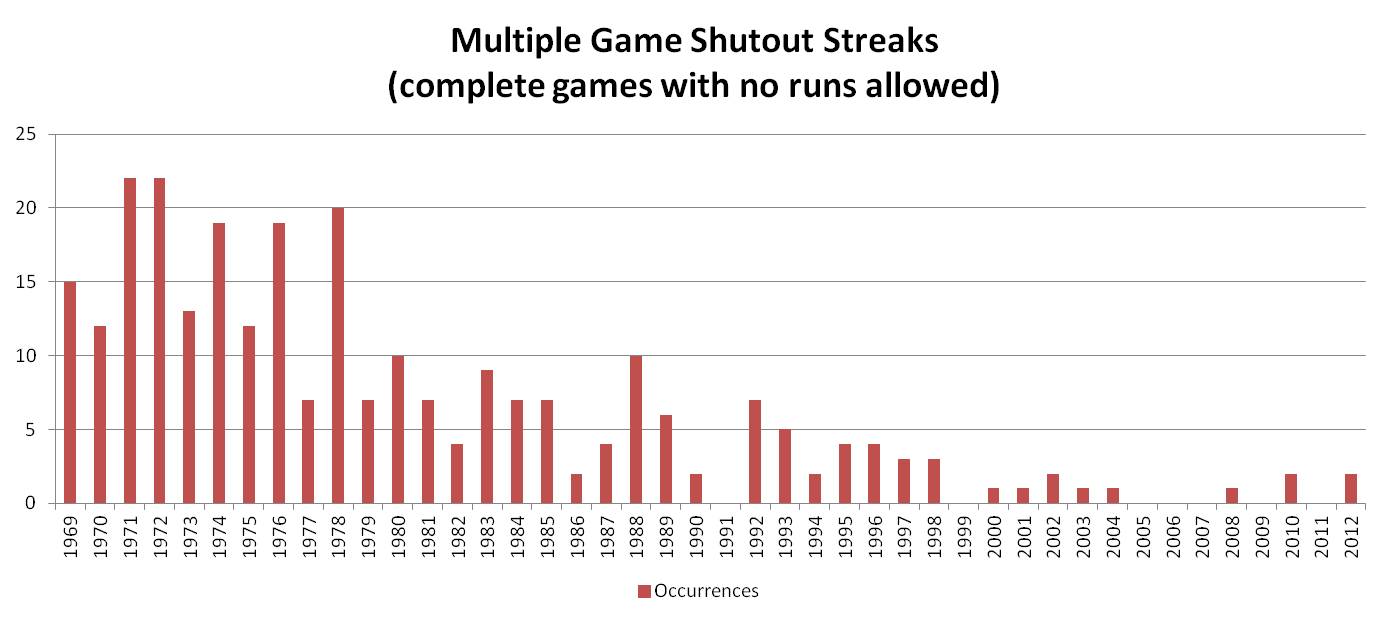
With the two streaks last week, the total number of multi-game shutout streaks since 2000 stands at eleven. In comparison, from 1969 (the year of the major rule changes) to 1976, there were at least 12 multi-game shutout streaks every year. For the twenty-one seasons from 1969 to 1989, there were at least 6 such streaks in all but three years, something that has happened only once (1992) since then. The first year since 1969 with no streaks was 1991, whereas that has happened in 5 of the past 8 seasons. There has not been a season with more than 2 streaks since 1998, a trend which could change this year.
Of the 275 shutout streaks since 1969, only these ones are longer than 2 games.
| Rk | Strk Start | End | Games | W | L | CG | SHO | IP | H | BB | SO | HBP | WP | BK | Opp | |
|---|---|---|---|---|---|---|---|---|---|---|---|---|---|---|---|---|
| 1 | BAL | 1974-09-02 | 1974-09-06 | 5 | 5 | 0 | 5 | 5 | 45.0 | 16 | 6 | 24 | 0 | 0 | 0 | BOS,CLE |
| 2 | PHI | 1969-08-13 | 1969-08-16 | 4 | 4 | 0 | 4 | 4 | 36.0 | 20 | 10 | 18 | 2 | 1 | 0 | ATL,HOU |
| 3 | MIN | 2004-07-05 | 2004-07-07 | 3 | 3 | 0 | 3 | 3 | 27.0 | 13 | 2 | 24 | 3 | 0 | 0 | KCR |
| 4 | BAL | 1995-09-26 | 1995-09-29 | 3 | 3 | 0 | 3 | 3 | 27.0 | 13 | 2 | 17 | 0 | 0 | 0 | TOR,DET |
| 5 | NYM | 1988-04-12 | 1988-04-15 | 3 | 3 | 0 | 3 | 3 | 24.0 | 9 | 4 | 16 | 0 | 0 | 0 | MON,STL |
| 6 | LAD | 1983-05-22 | 1983-05-24 | 3 | 3 | 0 | 3 | 3 | 27.0 | 10 | 10 | 24 | 0 | 0 | 0 | NYM,PHI |
| 7 | MON | 1979-05-29 | 1979-05-31 | 3 | 3 | 0 | 3 | 3 | 27.0 | 18 | 4 | 17 | 0 | 0 | 0 | PHI |
| 8 | CAL | 1976-10-03 | 1977-04-07 | 3 | 3 | 0 | 3 | 3 | 27.0 | 14 | 13 | 29 | 0 | 0 | 0 | OAK,SEA |
| 9 | PIT | 1976-10-02 | 1976-10-03 | 3 | 3 | 0 | 3 | 3 | 27.0 | 17 | 4 | 13 | 0 | 0 | 0 | STL |
| 10 | CAL | 1974-09-28 | 1974-10-01 | 3 | 3 | 0 | 3 | 3 | 27.0 | 11 | 12 | 31 | 1 | 0 | 0 | MIN,OAK |
| 11 | OAK | 1972-07-31 | 1972-08-02 | 3 | 3 | 0 | 3 | 3 | 27.0 | 10 | 1 | 14 | 0 | 0 | 0 | TEX,KCR |
| 12 | CHC | 1971-08-03 | 1971-08-05 | 3 | 3 | 0 | 3 | 3 | 27.0 | 14 | 6 | 16 | 1 | 0 | 0 | HOU,SDP |
| 13 | PIT | 1971-05-30 | 1971-06-01 | 3 | 3 | 0 | 3 | 3 | 27.0 | 11 | 7 | 15 | 0 | 0 | 0 | CHC,STL |
| 14 | NYM | 1970-05-13 | 1970-05-16 | 3 | 3 | 0 | 3 | 3 | 27.0 | 6 | 8 | 32 | 1 | 0 | 0 | CHC,PHI |
| 15 | NYM | 1969-09-24 | 1969-09-27 | 3 | 3 | 0 | 3 | 3 | 27.0 | 11 | 6 | 16 | 0 | 0 | 0 | STL,PHI |
| 16 | CHC | 1969-05-11 | 1969-05-13 | 3 | 3 | 0 | 3 | 3 | 27.0 | 17 | 9 | 30 | 0 | 0 | 0 | SFG,SDP |
| 17 | BAL | 1969-04-12 | 1969-04-13 | 3 | 3 | 0 | 3 | 3 | 27.0 | 11 | 4 | 19 | 0 | 0 | 0 | WSA |
Here is a table showing multi-game shutout streak data by team, since 1969.
| Shut Out Opponent Streak | Shut Out By Same Opponent Streak | |||||
| Team | Most Recent | Streaks | Longest | Most Recent | Streaks | Longest |
| Angels | 2012-05-02 | 11 | 2 | 2012-05-04 | 11 | 2 |
| Astros | 1997-07-11 | 17 | 3 | 1992-04-29 | 5 | 2 |
| Athletics | 2000-09-10 | 12 | 3 | 1993-06-16 | 4 | 2 |
| Blue Jays | 2012-05-04 | 5 | 2 | 1983-08-06 | 4 | 2 |
| Braves | 1998-08-07 | 6 | 3 | 1989-09-16 | 15 | 2 |
| Cardinals | 1996-06-03 | 13 | 2 | 1992-07-01 | 6 | 3 |
| Cubs | 2001-05-25 | 8 | 3 | 1997-06-07 | 5 | 2 |
| Diamondbacks | Never | 0 | 1 | Never | 0 | 1 |
| Dodgers | 1995-05-25 | 25 | 3 | 2002-05-15 | 5 | 2 |
| Expos/Nationals | 1997-06-07 | 9 | 3 | 2008-08-09 | 9 | 2 |
| Giants | 2002-08-20 | 9 | 2 | 1992-06-24 | 5 | 2 |
| Indians | 1981-04-18 | 6 | 2 | 1985-07-19 | 5 | 2 |
| Mariners | 1993-04-22 | 2 | 2 | 2003-09-04 | 4 | 2 |
| Marlins | 1997-04-11 | 2 | 2 | Never | 0 | 1 |
| Mets | 2010-08-13 | 18 | 3 | 1995-05-25 | 9 | 2 |
| Orioles | 1995-09-29 | 17 | 5 | 1983-05-22 | 4 | 2 |
| Padres | 1998-08-16 | 10 | 2 | 1988-08-30 | 7 | 2 |
| Phillies | 1986-09-15 | 5 | 4 | 1989-08-09 | 7 | 3 |
| Pilots/Brewers | 2008-08-09 | 15 | 2 | 1998-08-16 | 10 | 2 |
| Pirates | 1992-07-01 | 13 | 3 | 2010-05-12 | 8 | 2 |
| Rays | 2003-09-04 | 1 | 2 | 2000-09-10 | 1 | 2 |
| Red Sox | 1993-04-19 | 17 | 2 | 1993-04-22 | 4 | 3 |
| Reds | 2010-05-12 | 4 | 2 | 1986-04-27 | 7 | 2 |
| Rockies | Never | 0 | 1 | Never | 0 | 1 |
| Royals | 1992-09-30 | 6 | 2 | 2004-07-07 | 8 | 3 |
| Senators/Rangers | 1996-08-12 | 10 | 2 | 1992-07-18 | 5 | 3 |
| Tigers | 1996-06-22 | 6 | 2 | 1976-05-25 | 3 | 2 |
| Twins | 2004-07-07 | 7 | 3 | 2012-05-02 | 8 | 2 |
| White Sox | 1994-07-02 | 13 | 2 | 1993-04-19 | 7 | 2 |
| Yankees | 1978-07-20 | 8 | 2 | 1984-05-20 | 6 | 2 |
So, the Yankees have gone the longest without having a shutout streak, and the Tigers the longest without being shutout by the same opponent in consecutive games. The Yankees and Indians have both done neither since the mid-1980s, and the Angels have now done both in the past week.
Finally, for you Red Sox fans, here are the teams since 1969 to shut out their opponent in both ends of a double-header.
| Team | Start | End | Games | Opponent |
| LAD | 1971-09-19 | 1971-09-19 | 2 | ATL |
| NYY | 1972-07-21 | 1972-07-21 | 2 | CAL |
| OAK | 1974-09-09 | 1974-09-09 | 2 | KCR |
| STL | 1975-06-23 | 1975-06-23 | 2 | NYM |
| BOS | 1975-07-27 | 1975-07-27 | 2 | NYY |
| BOS | 1975-09-26 | 1975-09-26 | 2 | CLE |
| BOS | 1977-09-05 | 1977-09-05 | 2 | TOR |
Provided by Baseball-Reference.com: View Play Index Tool Used
Generated 5/6/2012.


