
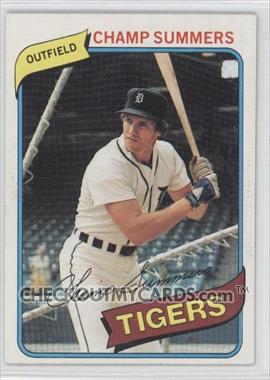
Champ Summers 1946-2012
As the Tigers celebrate their ALDS victory, news comes (thanks to HHS reader Steven for this alert) of the passing of a former fan favorite in the motor city, albeit in a brief stint with the Tigers.
Champ Summers (so nicknamed, according to Wikipedia, by his prize-fighter father who remarked at Champ’s birth that he looked like he had just gone 10 rounds with Joe Louis) came up with Oakland in 1974 and, through 1978, bounced between the majors and minors with the Cubs and Reds, being used with the big club mostly as a pinch-hitter. His fortunes changed early in the 1979 season with a trade to Detroit where, under new Tigers manager Sparky Anderson, Summers finally got to play on at least a semi-regular basis.
For his time in Detroit (1979-81), in the equivalent of about a season-and-a-half (887 PA), Champ had a .293/.388/.508 slash, good for 143 OPS+ with 40 HR, 132 RBI, 111 BB and 124 runs scored. Most of that damage came in Summers’ very impressive 1979 and 1980 campaigns when he compiled 4.2 WAR and 2.2 WAA with the totals below.
| Year | Age | Tm | Lg | G | PA | AB | R | H | 2B | 3B | HR | RBI | BB | SO | Pos | |||||
|---|---|---|---|---|---|---|---|---|---|---|---|---|---|---|---|---|---|---|---|---|
| 1979 | 33 | DET | AL | 90 | 290 | 246 | 47 | 77 | 12 | 1 | 20 | 51 | 40 | 33 | .313 | .414 | .614 | 1.028 | 171 | 9D/37 |
| 1980 | 34 | DET | AL | 120 | 408 | 347 | 61 | 103 | 19 | 1 | 17 | 60 | 52 | 52 | .297 | .393 | .504 | .897 | 143 | D97/3 |
Champ’s 1979 season featured an impressive .522 slugging percentage as a pinch-hitter, and ranks as one of the top 15 OPS+ seasons for similarly used players. Here are those seasons for players with 100+ games and under 400 PAs (Note that totals shown below for Summers are for his full 1979 season, with the Tigers and Reds).
| Rk | Player | PA | G | Year | Age | Tm | AB | R | H | 2B | 3B | HR | RBI | BB | SO | Pos | |||||
|---|---|---|---|---|---|---|---|---|---|---|---|---|---|---|---|---|---|---|---|---|---|
| 1 | Ted Williams | 190 | 390 | .645 | 113 | 1960 | 41 | BOS | 310 | 56 | 98 | 15 | 0 | 29 | 72 | 75 | 41 | .316 | .451 | 1.096 | *7 |
| 2 | Oscar Gamble | 188 | 327 | .609 | 100 | 1979 | 29 | TOT | 274 | 48 | 98 | 10 | 1 | 19 | 64 | 50 | 28 | .358 | .456 | 1.065 | D79 |
| 3 | Jim Thome | 182 | 340 | .627 | 108 | 2010 | 39 | MIN | 276 | 48 | 78 | 16 | 2 | 25 | 59 | 60 | 82 | .283 | .412 | 1.039 | *D |
| 4 | John Lowenstein | 176 | 384 | .602 | 122 | 1982 | 35 | BAL | 322 | 69 | 103 | 15 | 2 | 24 | 66 | 54 | 59 | .320 | .415 | 1.017 | *7/9 |
| 5 | Cliff Johnson | 171 | 339 | .584 | 107 | 1977 | 29 | TOT | 286 | 46 | 85 | 16 | 0 | 22 | 54 | 43 | 53 | .297 | .407 | .991 | 7D32/9 |
| 6 | Mickey Mantle | 170 | 393 | .538 | 108 | 1966 | 34 | NYY | 333 | 40 | 96 | 12 | 1 | 23 | 56 | 57 | 76 | .288 | .389 | .927 | *8/7 |
| 7 | Rico Carty | 163 | 339 | .549 | 104 | 1969 | 29 | ATL | 304 | 47 | 104 | 15 | 0 | 16 | 58 | 32 | 28 | .342 | .401 | .951 | *7 |
| 8 | Ken Phelps | 162 | 371 | .549 | 117 | 1988 | 33 | TOT | 297 | 54 | 78 | 13 | 0 | 24 | 54 | 70 | 61 | .263 | .402 | .950 | *D/3 |
| 9 | Ryan Klesko | 158 | 381 | .608 | 107 | 1995 | 24 | ATL | 329 | 48 | 102 | 25 | 2 | 23 | 70 | 47 | 72 | .310 | .396 | 1.004 | *7/3 |
| 10 | Jim Spencer | 157 | 336 | .593 | 106 | 1979 | 32 | NYY | 295 | 60 | 85 | 15 | 3 | 23 | 53 | 38 | 25 | .288 | .367 | .960 | *D3 |
| 11 | Chick Hafey | 157 | 394 | .590 | 103 | 1927 | 24 | STL | 346 | 62 | 114 | 26 | 5 | 18 | 63 | 36 | 41 | .329 | .401 | .990 | *79/8 |
| 12 | Merv Rettenmund | 156 | 385 | .544 | 106 | 1970 | 27 | BAL | 338 | 60 | 109 | 17 | 2 | 18 | 58 | 38 | 59 | .322 | .394 | .938 | 897 |
| 13 | Cy Williams | 155 | 384 | .568 | 107 | 1926 | 38 | PHI | 336 | 63 | 116 | 13 | 4 | 18 | 53 | 38 | 35 | .345 | .418 | .986 | *9 |
| 14 | Tony Clark | 154 | 393 | .636 | 130 | 2005 | 33 | ARI | 349 | 47 | 106 | 22 | 2 | 30 | 87 | 37 | 88 | .304 | .366 | 1.003 | *3/D |
| 15 | Champ Summers | 154 | 364 | .556 | 117 | 1979 | 33 | TOT | 306 | 57 | 89 | 14 | 2 | 21 | 62 | 53 | 48 | .291 | .401 | .957 | *9D3/7 |
| 16 | Al Bumbry | 154 | 395 | .500 | 110 | 1973 | 26 | BAL | 356 | 73 | 120 | 15 | 11 | 7 | 34 | 34 | 49 | .337 | .398 | .898 | *79/D8 |
Summers closed out his career with the Giants and Padres, finally making the post-season in San Diego’s pennant year in 1984. Champ’s final major league appearance came in that season’s World Series, striking out against former Tigers teammate Jack Morris.
Subscribe to: RSS feed

According to his BR page, he didn’t start playing minor league ball till he was 25. Anyone know the story there?
Actually I guess I can solve this mystery myself. He served in the US Army during Vietnam. Hence the late start to his career.
I just read that myself. Discovered playing in a men’s softball league. Wish I had known all this back then- those are the kinds of guys I really like to pull for. He actually had a couple of really fine seasons with the bat although his defense doesn’t appear to have been much in the field.
Yep, it’s a bit like another former Tiger – Ron LeFlore – who was discovered playing in a prison league. Wonder how many other stories like that are out there.
Wow, Williams had a 190 OPS+ in his final season, still raking at age 41. Is this the highest OPS+ for anyone in their final season, say minimu 300 PA?
Yes, by quite a bit. Second is Shoeless Joe Jackson at 172, who of course was banned after the 1920 season. Third, or second among players who ended their career in “normal” fashion, was Barry Bonds at 169; after that, it’s a big drop-off to the rest of the pack.
I don’t know if you can call being blackballed by all 30 teams a “normal” fashion.
(Never mind; this isn’t the place for me to argue.)
I forgot that some important events happened after the 2007 season; everything Bonds-related that happened after 2004 is kinda jumbled together for me. I forgot that he had intended to play after 2007.
You called it, Jeff. Here’s that list, for final season, 300 PA, age 35 or more.
Generated 10/12/2012.
Anyone know the backstory on why Will Clark retired when he did? After being traded to the Cardinals in mid-season, he absolutely raked (1.081 OPS) and then had a big postseason including a 1.206 OPS in the NLCS. He was only 36 at the time. Seems like he could have continued to play for a few more seasons.
Here is Clark announcing his retirement: “In every player’s career, sooner or later, you’re going to have to make a decision to move on,” Clark said. “The first part of my life was based on being a baseball player. The second part of my life is going to be based on being a daddy and a husband.”
BTW I don’t think I’m being too controversial when I say that The Thrill should have got way more HOF consideration.
Also: “The rigors of traveling and playing the game every day, combined with having 36 bone chips removed from his left elbow from 1996 to 1999, led to Clark’s choice to leave the game.”
http://www.cbsnews.com/2100-400_162-246327.html
Thanks RJ, appreciate the info. He may also have wanted to go out on top, ala Mike Mussina.
As for the HOF, I personally wouldn’t have voted for him but he certainly had a better career than say Don Mattingly. But unfortunately Clark didn’t have the good fortune to play for the Yankees.
Okay, I’m going WAY off topic here but…was just comparing Will and Jack Clark’s BR pages and was stunned to see how similar their careers were. Their career lengths were almost exactly the same (Will played in 18 more games and had 53 more PAs) and they have the exact same career OPS+ (137). Of course they also both started off with the Giants with Jack playing his first 10 years there and Will his first 8. They just missed being teammates. Of course Jack was primarily an outfielder whereas Will was almost exclusively a first baseman. Still a surprising amount of similarity for two guys who were contemporaries and shared a last name.
I don’t really like Clark for the HOF either; I just don’t think he played long enough. I think that has to come into play at some point.
As for why he retired, I just noticed that, after 1990, he would never again reach the 150-game mark for a season. Perhaps the grind of dealing with nagging injuries contributed to his early exit from the game.
Point taken, and I’m not saying he should definitely be in the hall, I just think one-and-done was a bit harsh.
I understood what you were saying RJ. It is interesting to speculate what might have happened if he had played for 2-4 more seasons. He could clearly still play though obviously health was an issue.
Bonds and Greenberg on the above list are two of only four players with a final season of 80+ walks, and walking in over 20% of PAs. Mantle was just a hair under that threshold. The other two players were Ferris Fain and Roy Cullenbine. All four had more than a 150 point spread between their BA and OBP.
Mantle was before my time as a baseball fan, but I always remember hearing stories about how he was shot at the end of his career. I guess it’s not incorrect when comparing him to his former greatness when he was younger and a CFer, but he certainly was contributing with the bat at the end thanks to his ability to draw walks, and still the ability to hit the long ball. He retired after 1968, the year of the pitcher. If had stuck around one more year, he might have found another 30-HR season in that bat.
Great memories. Thanks for the post. Growing up in Toledo (60 miles from Detroit), the Tigers on WJR were my link to MLB. The Tigers were loaded with the young talent that would eventually get them to the top in ’84, but it’s absolutely true that Champ Summers and John Wockenfuss were the fan favorites during those years, and they seemed to be player favorites too…probably good mentors for the rising stars.
R.I.P., Champ. Your name and swing were a match in Tiger Stadium — .294/.400/.569.
BTW, Summers nearly won the American Association triple crown in 1978, hitting .368/34/124, also leading in OBP and SLG. Dane Iorg beat him by .003 in BA.
He seems to have hit really well in almost all of his minor league career. Makes you wonder what he might have done if he had started at 18 like most players do
How times have changed:
In his final season, Summers was with the Padres all year as a pinch-hitter, starting just once. But teams don’t carry pure PHs any more. In 1984, there were 12 nonpitchers with at least 40 games but fewer than 1.5 PAs per game. This year there were just 2.
That is what comes of carrying 12 or 13 pitchers, you cannot afford to have one of your 4 or 5 bench guys be a specialist, like they did back in the 1970s and 1980s. Now they all need to be Miguel Cairo, someone who can play multiple positions.
I was a bit taken aback when I saw Summers had died. His great nickname evokes eternal youth and endless summer days of baseball, pun intended.
He somehow seems like he should be younger. Granted, 66 doesn’t seem old enough for anyone to be checking out permanently, but if someone a week ago asked me if I remembered Champ Summers and how old I thought he was, I would have said yes, and probably guessed he was in his mid-to-late 50s. His arrival in MLB conincided with when I started following the game, and I probably never realized, or I forgot, that he was in his late 20s by the time he ever made it to the Majors, and in his early 30s by the time he really got regular playing time. Hence, I always thought he was eight to ten years younger.
I also have stored away a useless factoid on Summers and wonder if it’s correct. Perhaps our resident Tiger expert JA may know. Summers supposedly was also an excellent amateur tennis player, and as a kid beat Jimmy Connors in a tennis match. It maybe true, but I just checked, and Connors was six years younger than Summers. As adults, six years isn’t all that much. As kids it’s an entirely different generation. Champ probably did play and beat him, but I’m guessing that Connors was such a child prodigy that he was forced play kids four, five and six years his senior just to challenge him. Beating Jimmy Connors is a great story. That is unless you’re sixteen and Connors was ten, which I think is probably the likely story!
RIP, Champ.
MikeD — All I know about Champ & Connors is what’s on his B-R Bullpen page:
“Gloria Connors, the mother and coach of a young Jimmy Connors, asked him to play tennis against their son so he could play against an older and tougher opponent; it was Summers who had trouble keeping up against Connors, who was six years younger.”
JA, thanks. That does confirm that I did remember the story correctly, but after seeing the six-year age difference I considered the possibility it was some other Tiger player that got jumbled in my mind. For someone like a Jimmy Connors, it must have been almost impossible to find anyone on his talent level as a 11, 12, 13-year-old, so playing older players was probably the only way to keep challenging and developing his skills.
MikeD,
I have played three players here in Basel who beat Roger Federer when he was young. All three were 17/18 and Roger was 12. Once a player of Roger’s / Connors’ / Agasse’s ability passes 12/13 it gets very difficult for even an excellent amateur to defeat them. They are playing in major international tournaments and are often attending tennis academies. They are getting strong enough to get ambitious with their serves. They start wiping the court with you.
Tag, thanks. Yup, makes a lot of sense. Anyone who beat Federer has a great story. They just need to leave out they were playing a 12-year-old when they were fully grown! : -)
I remember seeing Champ play basketball for SIU-Edwardsville when I was in junior high. He wasn’t bad on that court, either. Averaged about 18 points per game.
I’ve been doing some research in The Sporting News archives via SABR. Mid 70s to mid 80s. I recall reading that Champ never, I repeat: never played “organized” baseball while growing up. No Little League, Babe Ruth, Legion. Don’t think he started until after Vietnam, when he went to college. Remarkable.